grammar chart · Spanish
Spanish possessives and demonstratives
Possessives and demonstratives agree with the noun they go with, not with the owner or the speaker: mi casa, mis casas; nuestro coche, nuestra casa. Mi, tu and su change only for number; nuestro and vuestro, and every demonstrative, change for gender too. Este points to what is near the speaker, ese near the listener, aquel far from both.
Possessives before the noun: mi, tu, su
| Masc. sing. | Fem. sing. | Masc. pl. | Fem. pl. | |
|---|---|---|---|---|
| yo | mi | mi | mis | mis |
| tú | tu | tu | tus | tus |
| él, ella, usted | su | su | sus | sus |
| nosotros, nosotras | nuestro | nuestra | nuestros | nuestras |
| vosotros, vosotras | vuestro | vuestra | vuestros | vuestras |
| ellos, ellas, ustedes | su | su | sus | sus |
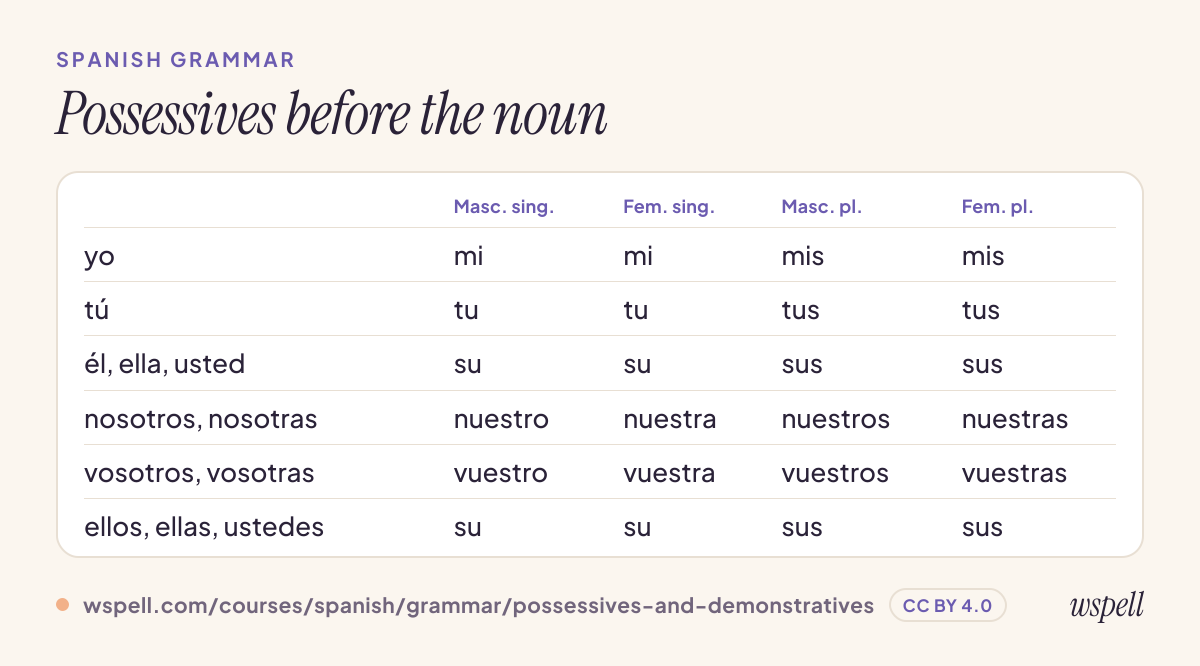
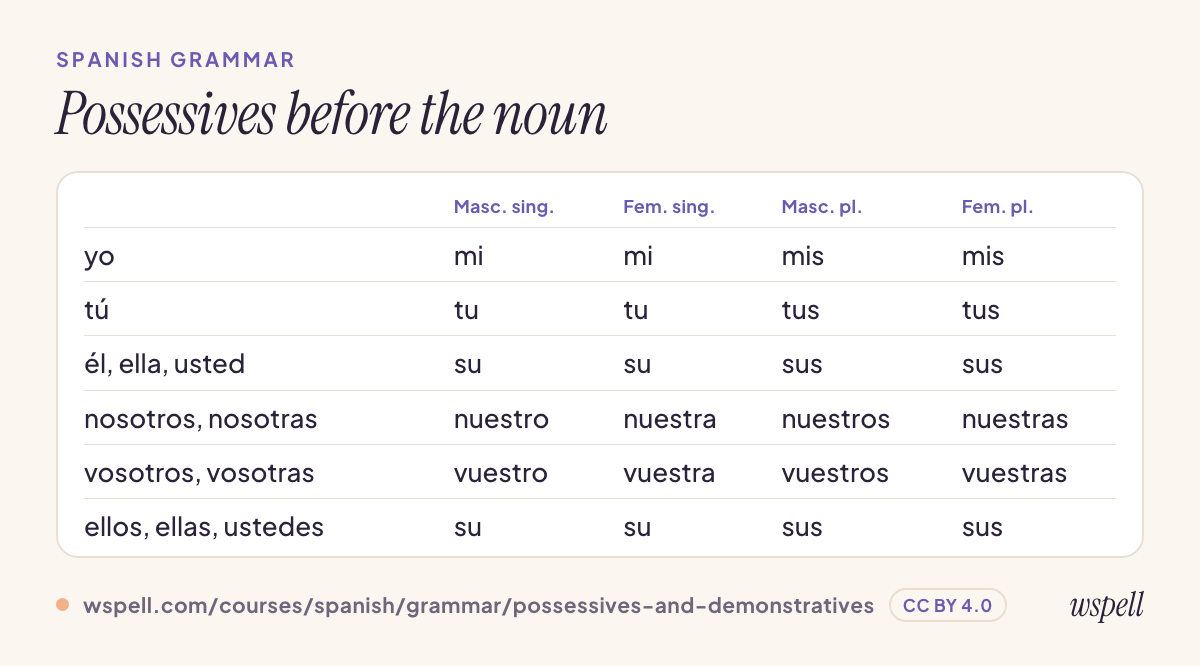
Possessives before the noun take no article
The short possessive goes before the noun and agrees only in NUMBER for mi/tu/su (mi casa, mis casas) but in gender AND number for nuestro/vuestro (nuestra casa, nuestros libros); it is never combined with an article (say mi casa, not *la mi casa). su/sus is ambiguous — 'his/her/its/their/your(formal)' — so add de él, de ella, de usted… when the owner is unclear.
- Mi hermana vive en Madrid. — My sister lives in Madrid.
- Nuestras maletas están en el coche. — Our suitcases are in the car.
- Su casa es la de ella, no la de él. — Her house is hers, not his.
Long possessives: mío, tuyo, suyo
| Masc. sing. | Fem. sing. | Masc. pl. | Fem. pl. | |
|---|---|---|---|---|
| yo | mío | mía | míos | mías |
| tú | tuyo | tuya | tuyos | tuyas |
| él, ella, usted | suyo | suya | suyos | suyas |
| nosotros, nosotras | nuestro | nuestra | nuestros | nuestras |
| vosotros, vosotras | vuestro | vuestra | vuestros | vuestras |
| ellos, ellas, ustedes | suyo | suya | suyos | suyas |
mío, tuyo, suyo: after the noun or on their own
The long forms (mío, tuyo, suyo, nuestro, vuestro) go AFTER the noun or stand alone, and always agree in gender and number: un amigo mío, la culpa es tuya, el mío. Used for emphasis, after ser, and as pronouns.
- Es un problema tuyo, no mío. — It's your problem, not mine.
- Estas maletas son suyas. — These suitcases are theirs.
el mío, la tuya: possessive pronouns
A possessive pronoun replaces a noun and usually takes an article: el mío, la tuya, los nuestros, las suyas. It agrees in gender and number with the thing possessed, NOT with the owner (la tuya = the fem. thing that is yours).
- Tu coche es rojo; el mío es azul. — Your car is red; mine is blue.
- Estas maletas son las nuestras. — These suitcases are ours.
Demonstratives: este, ese, aquel
| Masc. sing. | Fem. sing. | Masc. pl. | Fem. pl. | |
|---|---|---|---|---|
| This (near me) | este | esta | estos | estas |
| That (near you) | ese | esa | esos | esas |
| That (over there) | aquel | aquella | aquellos | aquellas |
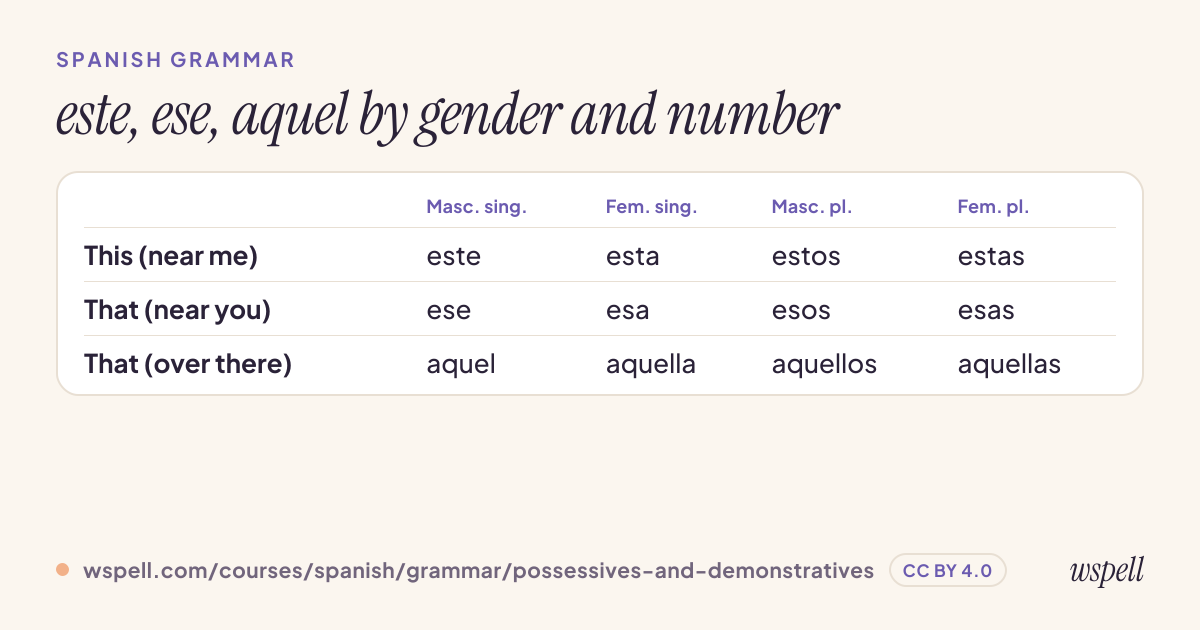
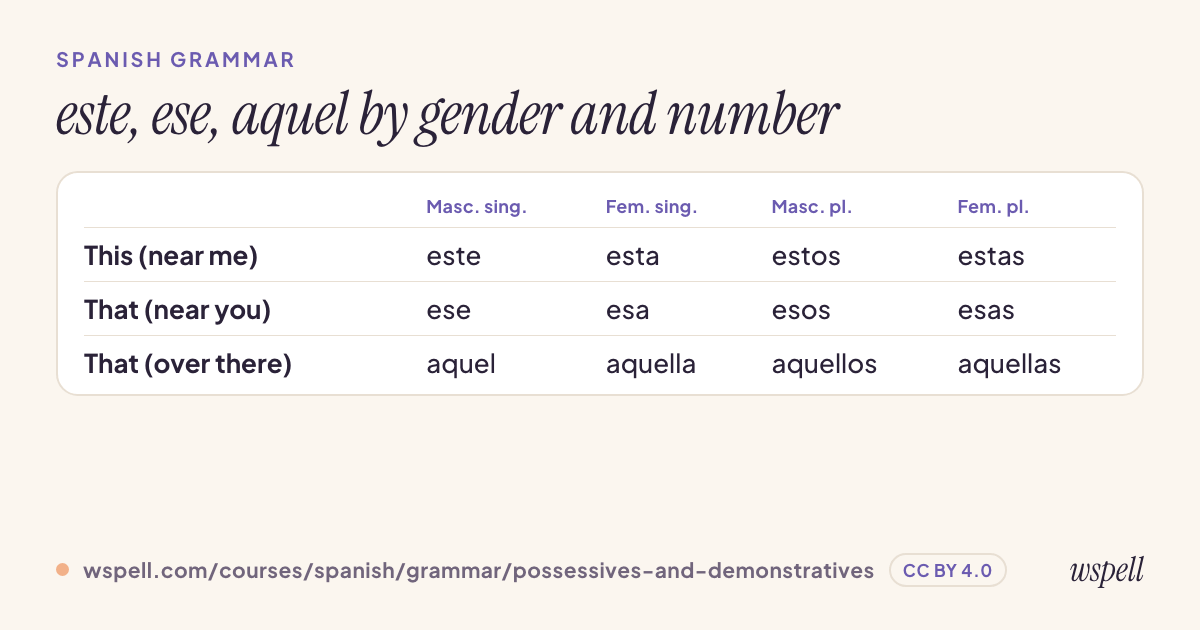
este, ese, aquel: three distances
Spanish grades distance three ways: este (this, near me), ese (that, near you), aquel (that over there / remote). Each agrees in gender and number: este/esta/estos/estas, ese/esa/esos/esas, aquel/aquella/aquellos/aquellas.
- Este libro es mío, ese es tuyo. — This book is mine, that one is yours.
- Aquella montaña es muy alta. — That mountain (over there) is very high.
este, ese, aquel on their own
The demonstratives stand alone as pronouns ('this one / that one'), agreeing in gender and number: este/esta/estos/estas (near me), ese/esa… (near you), aquel/aquella… (far from both). The old written accent (éste) is now optional and usually dropped.
- Este es mi favorito. — This one is my favourite.
- Prefiero aquella de allí. — I prefer that one over there.
esto, eso, aquello: the neuter forms
The neuter forms esto, eso, aquello are never followed by a noun and never carry an accent — they point at an idea, a whole situation or an unidentified thing: ¿qué es esto?, eso no me gusta. Do not use them before a noun.
- ¿Qué es esto? — What is this?
- Eso no tiene sentido. — That makes no sense.
learn it step by step
The DELE Spanish exam, A2 to B2: structure, scoring and practice
save or print this chart
Under the main tables on this page sits a picture of each — keep one on your phone, share it or print it.
Free to share and adapt under CC BY 4.0 — credit wspell and link to this page. the licence
credit line to copy: Spanish possessives and demonstratives — wspell, CC BY 4.0, https://wspell.com/courses/spanish/grammar/possessives-and-demonstratives
questions
How do Spanish possessive adjectives agree?
With the thing owned, not with the owner: mis padres, nuestra casa. Mi, tu and su only add -s in the plural; nuestro and vuestro have four forms.
What does su mean?
His, her, its, their or your (formal, for usted and ustedes). When the owner is unclear, say de él, de ella or de usted instead.
What is the difference between este, ese and aquel?
Distance: este is near the speaker, ese near the listener, aquel far from both. Each has four forms — este, esta, estos, estas — and a neuter form (esto, eso, aquello) for an idea or an unnamed thing.