grammar chart · Russian
Russian verbs of motion
Russian has a pair of verbs for each kind of movement: one for a single trip in one direction, in progress now or at a given moment (идти, ехать), and one for round trips, habits and movement in general (ходить, ездить). It also tells going on foot (идти, ходить) from going by transport (ехать, ездить). Prefixes turn them into verbs such as прийти and уйти.
The eight pairs
| One way, in progress | Round trips, habits | Meaning |
|---|---|---|
| идти́ иду, идёшь | ходи́ть хожу, ходишь | go on foot, walk |
| е́хать еду, едешь | е́здить езжу, ездишь | go by transport, ride, drive |
| лете́ть лечу, летишь | лета́ть летаю, летаешь | fly |
| плыть плыву, плывёшь | пла́вать плаваю, плаваешь | swim, sail |
| бежа́ть бегу, бежишь | бе́гать бегаю, бегаешь | run |
| нести́ несу, несёшь | носи́ть ношу, носишь | carry (on foot) |
| вести́ веду, ведёшь | води́ть вожу, водишь | lead, take someone (on foot) |
| везти́ везу, везёшь | вози́ть вожу, возишь | carry, take (by transport) |
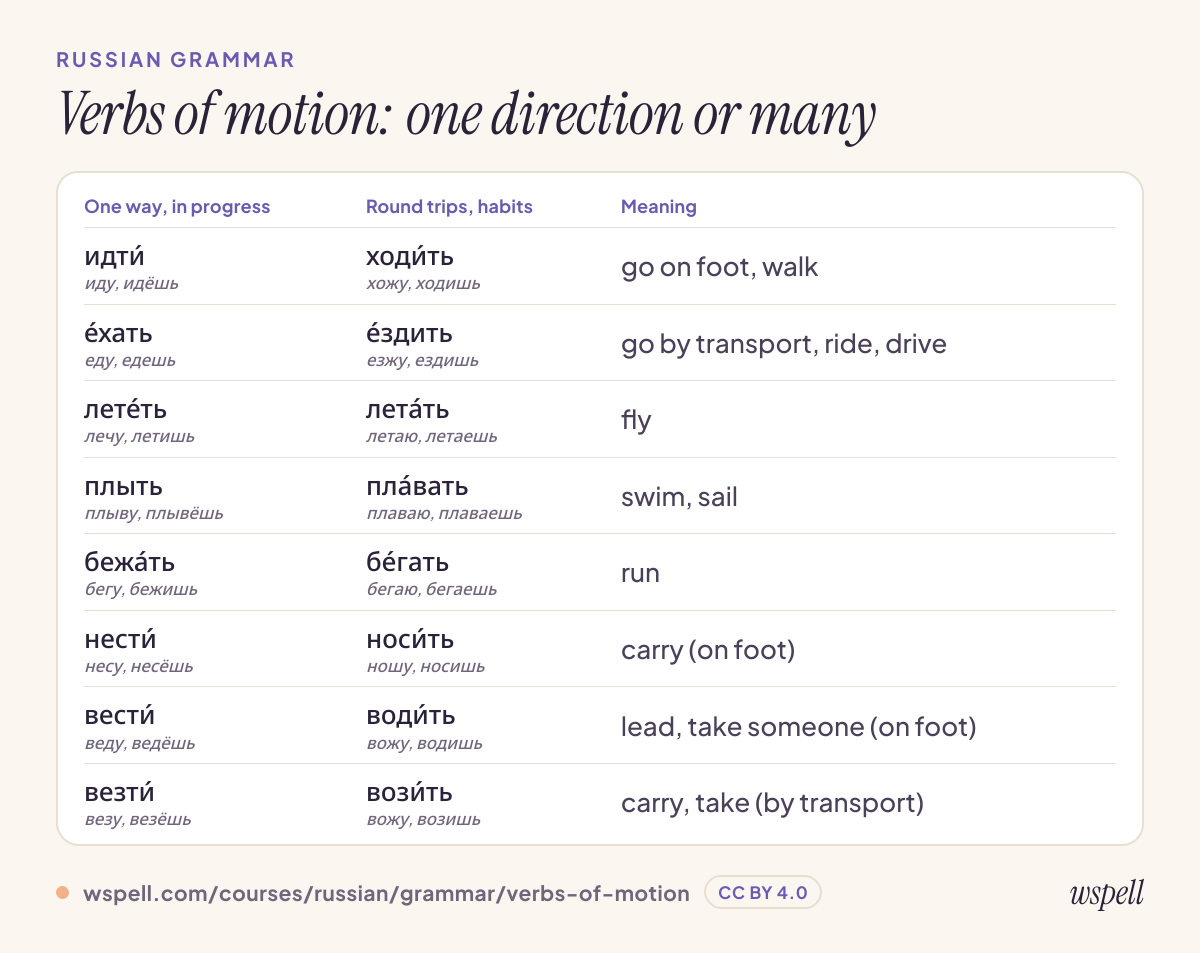
One direction or many: идти and ходить
Unprefixed motion verbs come in imperfective PAIRS: unidirectional (one trip, in progress, one direction — идти, ехать, лететь, нести) vs multidirectional (habitual, round trips, general ability, multiple directions — ходить, ездить, летать, носить). Я иду в школу (right now) vs Я хожу в школу (I attend school).
- Сейчас я иду на работу. — Right now I am walking to work.
- Каждый день я хожу на работу. — Every day I go to work.
On foot or by transport
On foot or by transport: идти and ехать
Russian distinguishes the mode: идти/ходить = on foot, ехать/ездить = by vehicle. Choose by how the journey is made, not just distance: в другой город едут (you go to another town by transport), even if 'go' in English is neutral.
- Я еду к бабушке на поезде. — I am going to my grandmother's by train.
- Дети идут в парк пешком. — The children are walking to the park.
Present tense: иду, хожу, еду, езжу
| Person | идти́ | ходи́ть | е́хать | е́здить |
|---|---|---|---|---|
| я | иду | хожу | еду | езжу |
| ты | идёшь | ходишь | едешь | ездишь |
| он, она, оно | идёт | ходит | едет | ездит |
| мы | идём | ходим | едем | ездим |
| вы | идёте | ходите | едете | ездите |
| они | идут | ходят | едут | ездят |
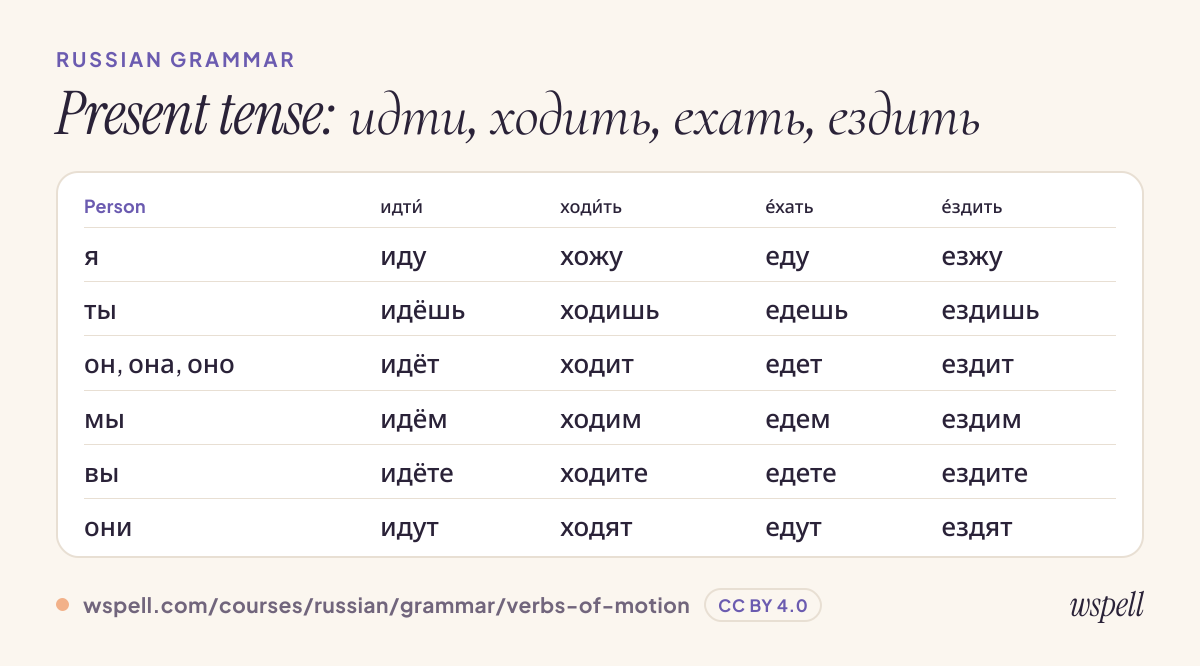
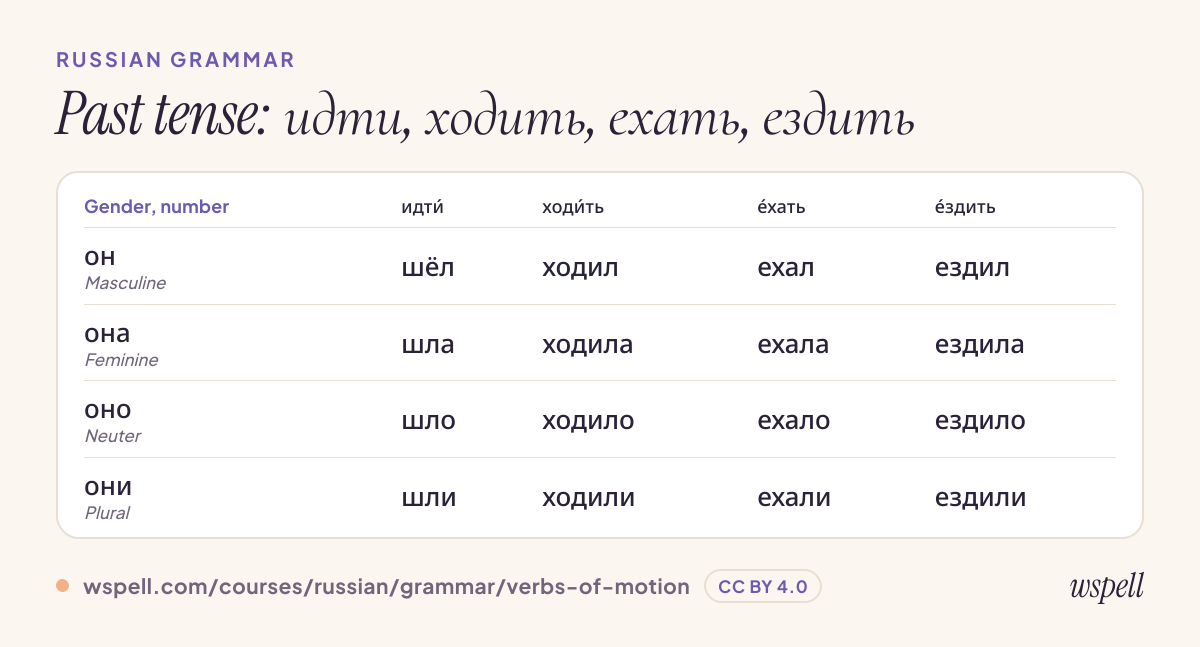
Past tense: шёл, ходил, ехал, ездил
| Gender, number | идти́ | ходи́ть | е́хать | е́здить |
|---|---|---|---|---|
| он Masculine | шёл | ходил | ехал | ездил |
| она Feminine | шла | ходила | ехала | ездила |
| оно Neuter | шло | ходило | ехало | ездило |
| они Plural | шли | ходили | ехали | ездили |
With prefixes: прийти, уйти, выйти
Prefixed verbs of motion: прийти, приходить
A directional prefix on a motion verb makes an aspect pair: prefix + unidirectional = PERFECTIVE (прийти, приехать), prefix + multidirectional = its IMPERFECTIVE partner (приходить, приезжать). The prefix adds direction (при- arrive, у- leave, в-/во- enter, вы- exit, до- reach, от- move off, пере- cross).
- Он пришёл вовремя. — He arrived on time.
- Она приходит сюда каждый день. — She comes here every day.
где, куда, откуда
где, куда, откуда
Russian splits 'where' three ways by the verb: где asks static location (answer in prepositional), куда asks direction toward (answer в/на + accusative), откуда asks origin (answer из/с + genitive).
- Куда ты идёшь? — В школу. — Where are you going? — To school.
- Откуда ты идёшь? — Из магазина. — Where are you coming from? — From the shop.
learn it step by step
save or print this chart
Under the main tables on this page sits a picture of each — keep one on your phone, share it or print it.
Free to share and adapt under CC BY 4.0 — credit wspell and link to this page. the licence
credit line to copy: Russian verbs of motion — wspell, CC BY 4.0, https://wspell.com/courses/russian/grammar/verbs-of-motion
questions
What is the difference between идти and ходить?
идти is one trip in one direction, happening now or at a given moment: Сейчас я иду на работу. ходить is for regular trips, round trips and walking in general: Каждый день я хожу на работу.
What is the difference between идти and ехать?
идти means going on foot, ехать going by transport: Я иду в парк, but Я еду на работу на автобусе.
Are Russian verbs of motion perfective or imperfective?
Both verbs of each pair are imperfective. A prefix makes the one-direction verb perfective (прийти) and the round-trip verb its imperfective partner (приходить).