grammar chart · Russian
Russian verb aspect: perfective and imperfective
Most Russian verbs come in pairs: an imperfective verb for a process, a habit or the action in general (читать), and a perfective verb for one completed action with a result (прочитать). The tables list twenty everyday pairs and how the two verbs of each pair differ — a prefix, a change of suffix or stem, or a different verb altogether.
Imperfective and perfective
Every Russian verb is imperfective (process, repetition, ongoing — читать) or perfective (a single completed whole with a result — прочитать). Aspect is chosen before tense: it is the deepest grammatical decision in the verb system and most verbs come as a lexical pair.
- Я читал книгу весь вечер. — I was reading the book all evening.
- Я прочитал книгу за вечер. — I read the (whole) book in an evening.
20 common aspect pairs
| Imperfective | Perfective | Meaning | How they differ |
|---|---|---|---|
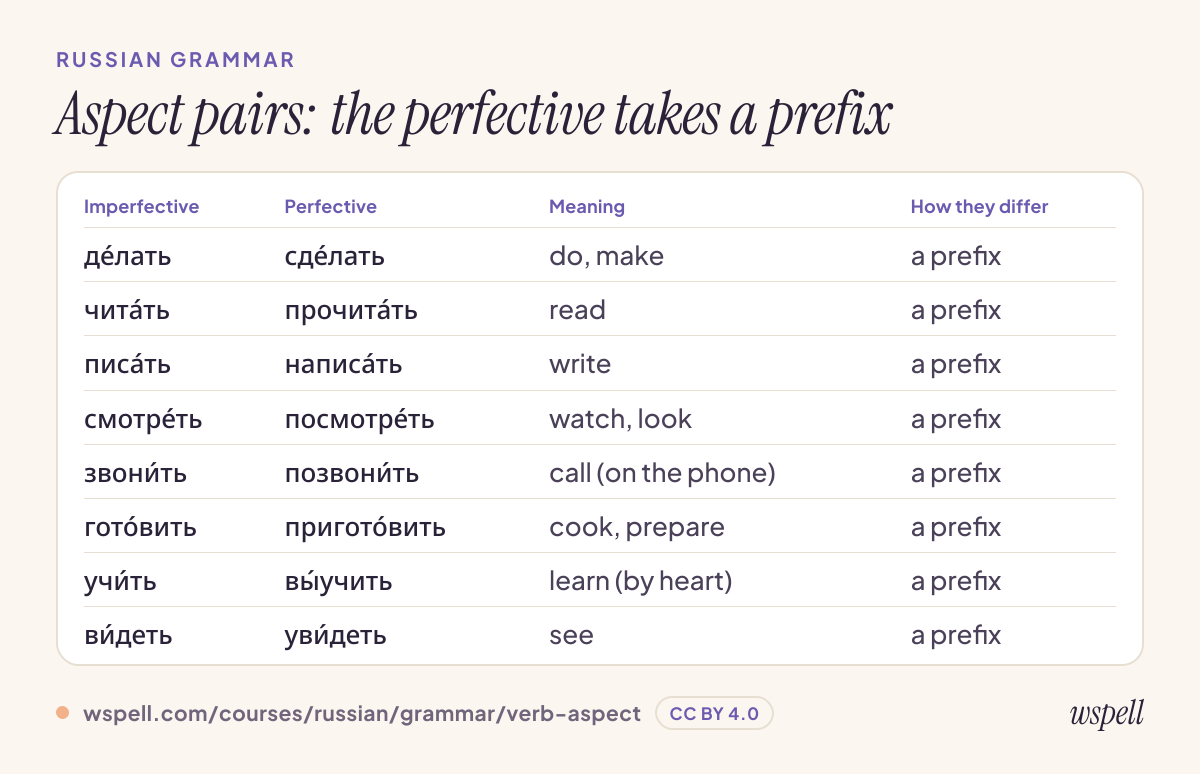
| де́лать | сде́лать | do, make | a prefix |
| чита́ть | прочита́ть | read | a prefix |
| писа́ть | написа́ть | write | a prefix |
| смотре́ть | посмотре́ть | watch, look | a prefix |
| звони́ть | позвони́ть | call (on the phone) | a prefix |
| гото́вить | пригото́вить | cook, prepare | a prefix |
| учи́ть | вы́учить | learn (by heart) | a prefix |
| ви́деть | уви́деть | see | a prefix |
| Imperfective | Perfective | Meaning | How they differ |
|---|---|---|---|
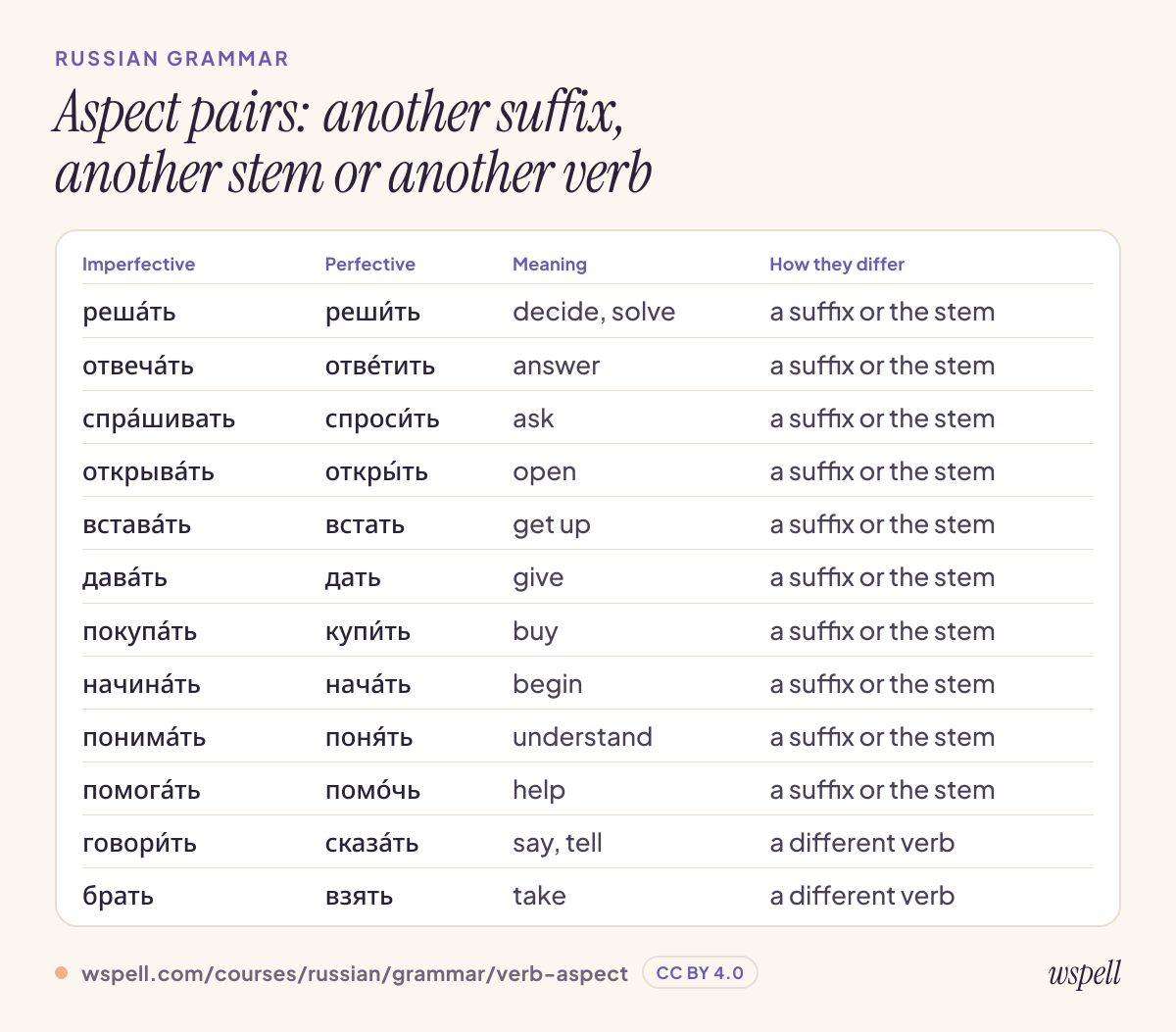
| реша́ть | реши́ть | decide, solve | a suffix or the stem |
| отвеча́ть | отве́тить | answer | a suffix or the stem |
| спра́шивать | спроси́ть | ask | a suffix or the stem |
| открыва́ть | откры́ть | open | a suffix or the stem |
| встава́ть | встать | get up | a suffix or the stem |
| дава́ть | дать | give | a suffix or the stem |
| покупа́ть | купи́ть | buy | a suffix or the stem |
| начина́ть | нача́ть | begin | a suffix or the stem |
| понима́ть | поня́ть | understand | a suffix or the stem |
| помога́ть | помо́чь | help | a suffix or the stem |
| говори́ть | сказа́ть | say, tell | a different verb |
| брать | взять | take | a different verb |
How aspect pairs are formed
The two verbs of a pair differ in one of three ways: the perfective adds a prefix (писать → написать, делать → сделать); the two differ in suffix or stem (решать — решить, давать — дать); or they are different verbs (говорить — сказать, брать — взять). Learn the pair, not one member.
- Она долго решала задачу и наконец решила её. — She worked on the problem a long time and finally solved it.
Aspect in the past
Process or result in the past
Imperfective past = an action seen as process, repetition, or background (я делал уроки — I was doing homework). Perfective past = a completed act with a result or a single whole (я сделал уроки — I finished the homework). Same time frame, opposite viewpoint.
- Вчера я весь день готовил ужин. — Yesterday I was cooking dinner all day.
- Я приготовил ужин к семи. — I had dinner ready by seven.
Aspect in the future
буду решать or решу?
Imperfective future (буду + inf) for process/repetition/general intention; perfective simple future for a single completed result. Contrast: я буду решать задачу (I'll work on it) vs я решу задачу (I'll solve it).
- Я буду звонить каждый день. — I will call every day.
- Я позвоню тебе вечером. — I will call you (once) in the evening.
After начать, забыть and other verbs
начать читать, забыть закрыть: aspect after another verb
Phase verbs начать/стать/продолжать/кончить/перестать take ONLY the imperfective infinitive (начал читать, not *начал прочитать). Verbs like забыть, успеть, удаться usually take the perfective (забыл выключить свет).
- Он начал учить китайский. — He started learning Chinese.
- Я забыл закрыть дверь. — I forgot to close the door.
Aspect in commands
открой or открывай?
Perfective imperative asks for a single completed act (открой окно — open the window). Imperfective imperative invites a process, a repeated or general action, or softens an invitation (садитесь). In the negative, the imperfective is a prohibition (не открывай — don't open), while the perfective warns against something done by accident (не упади — mind you don't fall).
- Открой окно, пожалуйста. — Open the window, please.
- Не открывай окно, холодно. — Don't open the window, it's cold.
learn it step by step
save or print this chart
Under the main tables on this page sits a picture of each — keep one on your phone, share it or print it.
Free to share and adapt under CC BY 4.0 — credit wspell and link to this page. the licence
credit line to copy: Russian verb aspect: perfective and imperfective — wspell, CC BY 4.0, https://wspell.com/courses/russian/grammar/verb-aspect
questions
What is the difference between perfective and imperfective verbs in Russian?
An imperfective verb presents the action as a process, a repetition or a fact in general: я читал книгу весь вечер. A perfective verb presents one completed action with its result: я прочитал книгу за вечер.
How are perfective verbs formed?
Often with a prefix (писать → написать, делать → сделать). In many other pairs the two verbs differ in a suffix or the stem, and it is usually the imperfective that is built from the perfective (дать → давать, открыть → открывать, решить → решать). A few pairs are different verbs (говорить – сказать, брать – взять).
Does a perfective verb have a present tense?
No. Its conjugated forms mean the future (я сделаю — I will do it), so a perfective verb has only a past and a future.