grammar chart · Russian
Russian verb conjugation: the present tense
Almost every Russian verb conjugates on one of two patterns. In the 1st conjugation the endings are -у/-ю, -ешь, -ет, -ем, -ете, -ут/-ют (читаю, читаешь); in the 2nd they are -у/-ю, -ишь, -ит, -им, -ите, -ат/-ят (говорю, говоришь). The tables show both, the -ся verbs, the special verbs хотеть, мочь and есть, and the imperative.
1st conjugation: читать, жить, писать
A stressed ending is written with ё: живёшь, живёт, живём, живёте.
| Person | Ending | чита́ть | жить | писа́ть |
|---|---|---|---|---|
| я | -у/-ю | читаю | живу | пишу |
| ты | -ешь/-ёшь | читаешь | живёшь | пишешь |
| он, она, оно | -ет/-ёт | читает | живёт | пишет |
| мы | -ем/-ём | читаем | живём | пишем |
| вы | -ете/-ёте | читаете | живёте | пишете |
| они | -ут/-ют | читают | живут | пишут |
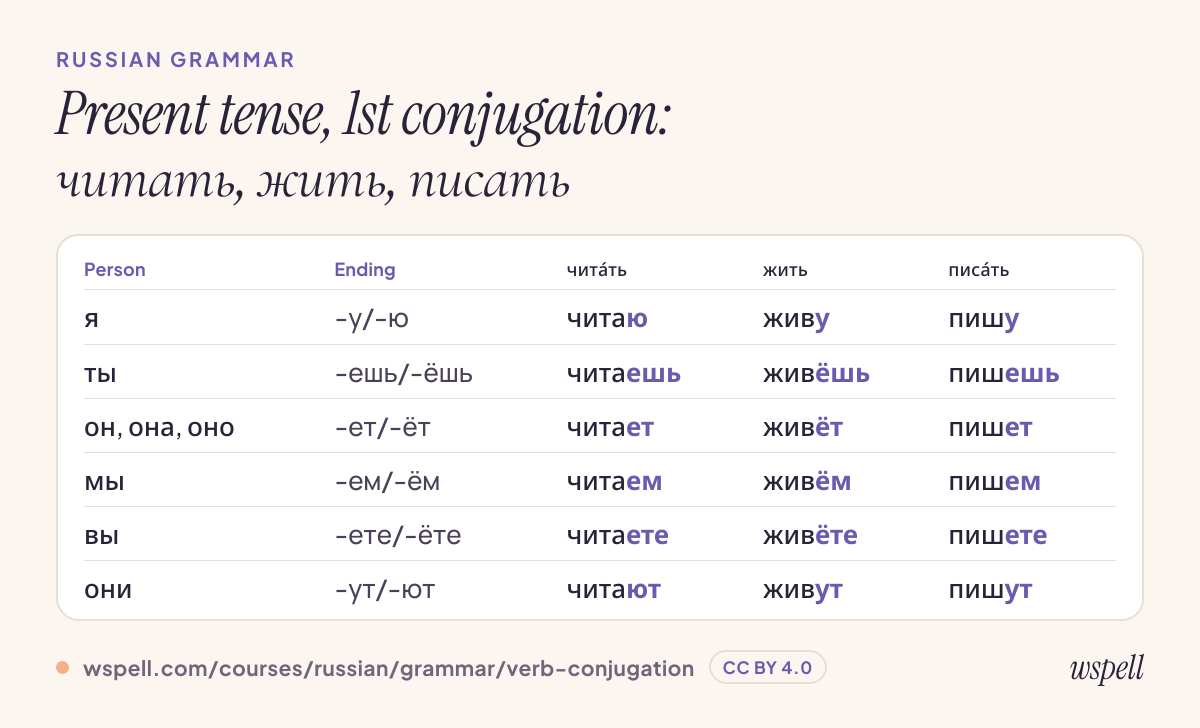
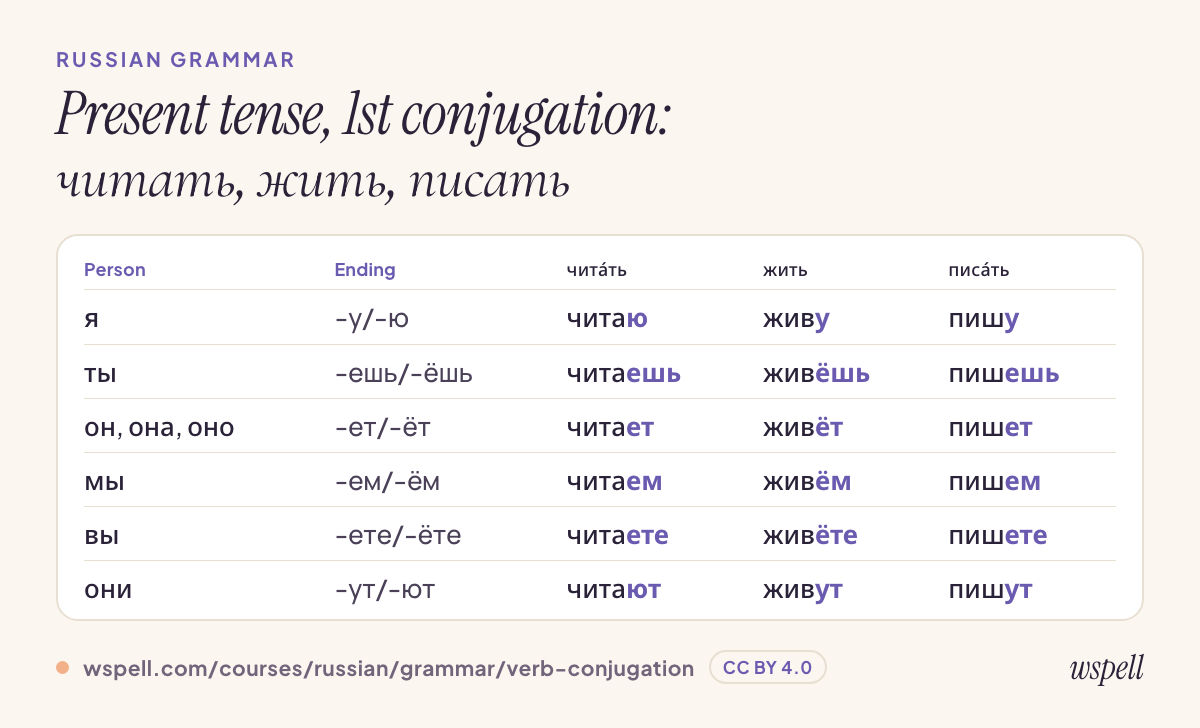
1st conjugation: -ешь, -ет, -ут/-ют
First-conjugation verbs (most -ать, -ять, -еть, plus -овать/-ти/-чь) take -у/-ю, -ешь, -ет, -ем, -ете, -ут/-ют. Stress-dependent -е- becomes -ё- when stressed (идёшь). Only imperfective (and perfective in future) verbs have present-tense person forms.
- Ты читаешь очень быстро. — You read very fast.
- Они живут в Москве. — They live in Moscow.
2nd conjugation: говорить, любить, смотреть
| Person | Ending | говори́ть | люби́ть | смотре́ть |
|---|---|---|---|---|
| я | -у/-ю | говорю | люблю | смотрю |
| ты | -ишь | говоришь | любишь | смотришь |
| он, она, оно | -ит | говорит | любит | смотрит |
| мы | -им | говорим | любим | смотрим |
| вы | -ите | говорите | любите | смотрите |
| они | -ат/-ят | говорят | любят | смотрят |
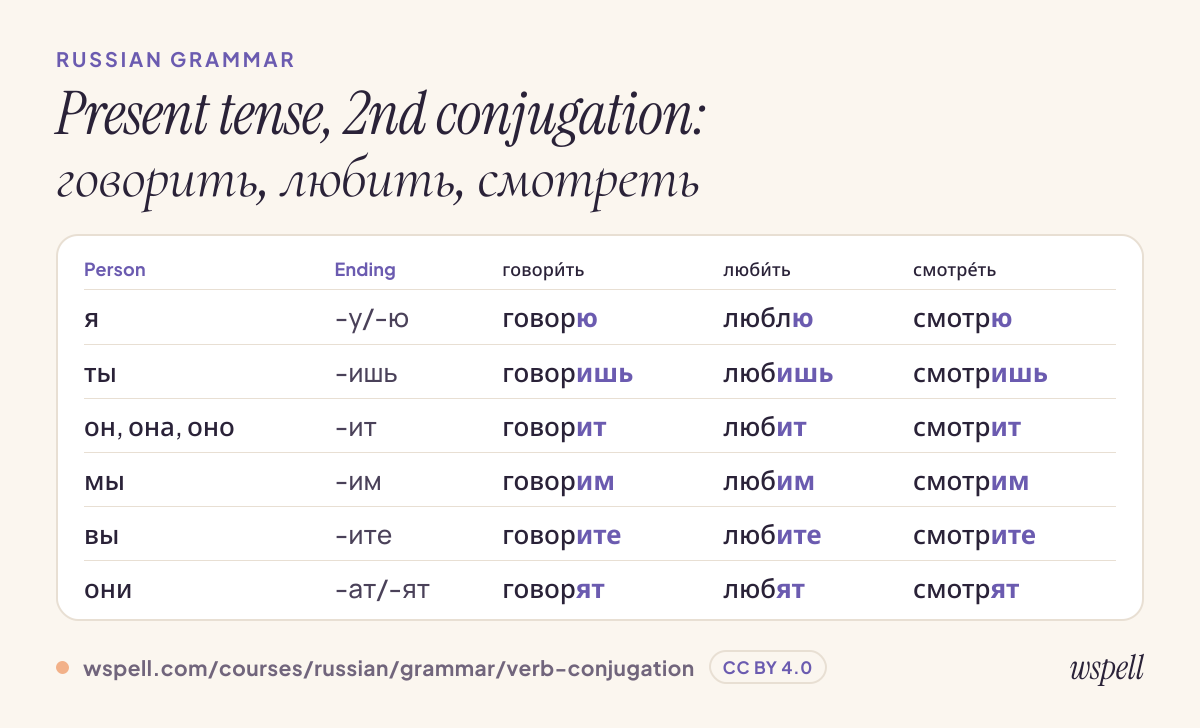
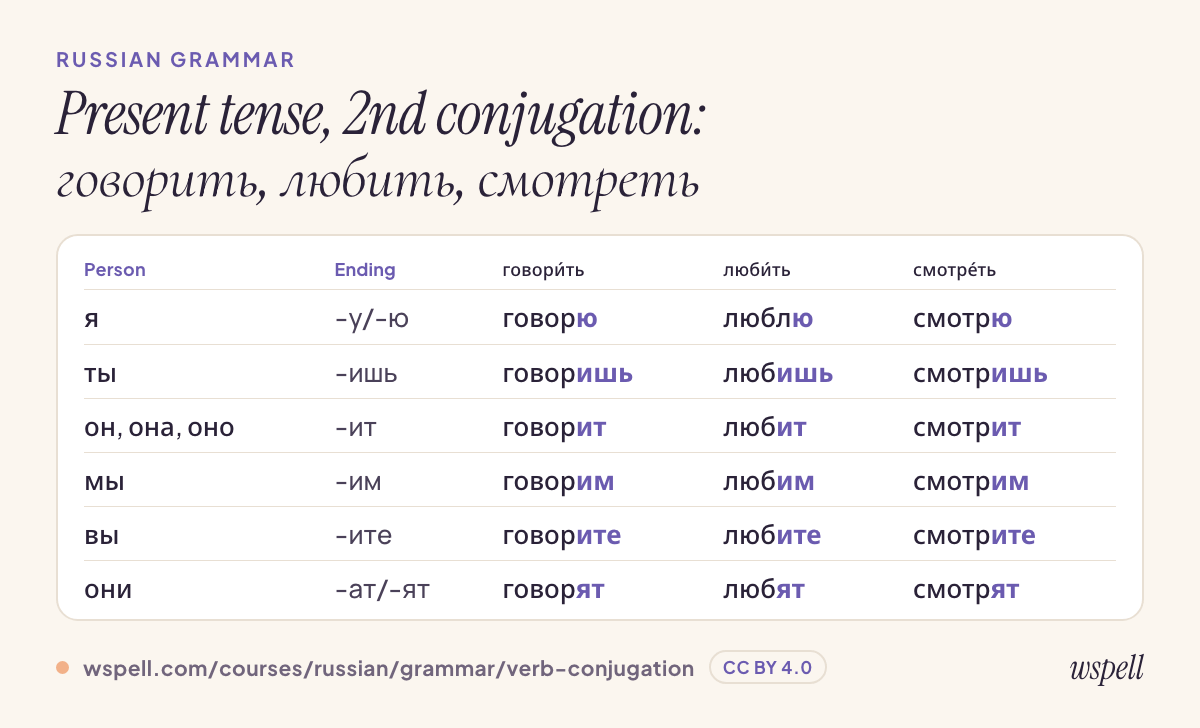
2nd conjugation: -ишь, -ит, -ат/-ят
Second-conjugation verbs (most -ить, plus a set of -еть/-ать like смотреть, слышать) take -у/-ю, -ишь, -ит, -им, -ите, -ат/-ят. The 1sg and 3pl endings follow the spelling rule: -у/-ат after ж ш щ ч, otherwise -ю/-ят.
- Ты говоришь по-русски? — Do you speak Russian?
- Они смотрят фильм. — They are watching a film.
Which conjugation? And consonant changes
1st or 2nd? Look at the они form
The infinitive is a hint, not a rule: most -ить verbs are 2nd conjugation, most others 1st. But learn the exceptions — 2nd-conj -еть/-ать (смотреть, слышать, дышать, держать, гнать) and 1st-conj -ить: the one-syllable жить, пить, бить, лить, шить, and брить, стелить. The reliable test is the 3pl ending: -ут/-ют → I, -ат/-ят → II.
- Дети видят море впервые. — The children see the sea for the first time.
Consonant changes: люблю, пишу, вожу
Present-stem consonants alternate predictably: verbs with a labial stem (б, п, в, м, ф) insert -л- (любить → люблю, спать → сплю), and dentals and velars mutate (писать → пишу, водить → вожу, видеть → вижу, платить → плачу). In the 2nd conjugation the mutation hits only the 1sg; in the 1st conjugation it usually runs through all persons (писать → пишу, пишешь… пишут; плакать → плачу… плачут), but in verbs in -чь the я and они forms keep к/г (могу, можешь… могут; пеку, печёшь… пекут).
- Я люблю зиму. — I love winter.
- Я пишу письмо. — I am writing a letter.
-ся verbs: учиться, заниматься
| Person | учи́ться | занима́ться |
|---|---|---|
| я | учусь | занимаюсь |
| ты | учишься | занимаешься |
| он, она, оно | учится | занимается |
| мы | учимся | занимаемся |
| вы | учитесь | занимаетесь |
| они | учатся | занимаются |
-ся after a consonant, -сь after a vowel
Reflexive verbs add the postfix -ся after a consonant and -сь after a vowel, kept in EVERY form: мыться → моюсь, моешься, мылся, мылась. The postfix comes after the person/gender ending.
- Я умываюсь холодной водой. — I wash (my face) with cold water.
- Он побрился утром. — He shaved in the morning.
Irregular and special verbs: хотеть, мочь, есть
| Person | хоте́ть | мочь | есть |
|---|---|---|---|
| я | хочу | могу | ем |
| ты | хочешь | можешь | ешь |
| он, она, оно | хочет | может | ест |
| мы | хотим | можем | едим |
| вы | хотите | можете | едите |
| они | хотят | могут | едят |
хотеть: хочу, хочешь, but хотим
хотеть (to want) is irregular: singular follows 1st conjugation with a т→ч mutation (хочу, хочешь, хочет), plural follows 2nd conjugation (хотим, хотите, хотят). One of a small set of heteroclitic verbs alongside бежать (бегу, бежишь… бегут).
- Я хочу спать. — I want to sleep.
- Они хотят есть. — They want to eat.
дать and есть: дам, ем
дать (give) and есть (eat) keep archaic athematic endings: дам, дашь, даст, дадим, дадите, дадут; ем, ешь, ест, едим, едите, едят. Their compounds inherit this (создать → создам, надоесть → надоем).
- Я дам тебе книгу. — I will give you the book.
- Что ты ешь на завтрак? — What do you eat for breakfast?
The imperative: читай!, говорите!
| Person | чита́ть | говори́ть | писа́ть | идти́ |
|---|---|---|---|---|
| ты | читай | говори | пиши | иди |
| вы | читайте | говорите | пишите | идите |
Forming the imperative
Take the present-tense stem (the они form minus its ending). After a vowel add -й (читают → чита- → читай); verbs in -авать keep -ва- (давать → давай). After a consonant, the я form decides: stressed on the ending, add -и (говорю́ → говори, пишу́ → пиши); stressed on the stem, add -ь after one consonant (гото́влю → готовь) and -и after two (по́мню → помни). Plural/polite adds -те.
- Читай медленнее! — Read more slowly!
- Говорите громче, пожалуйста. — Speak louder, please.
learn it step by step
save or print this chart
Under the main tables on this page sits a picture of each — keep one on your phone, share it or print it.
Free to share and adapt under CC BY 4.0 — credit wspell and link to this page. the licence
credit line to copy: Russian verb conjugation: the present tense — wspell, CC BY 4.0, https://wspell.com/courses/russian/grammar/verb-conjugation
questions
How many conjugations do Russian verbs have?
Two. The 1st has е in its endings (-ешь, -ет), the 2nd has и (-ишь, -ит); the они form ends in -ут/-ют or -ат/-ят.
How do I know a Russian verb's conjugation?
Most verbs in -ить are 2nd conjugation and most others 1st, with exceptions on both sides: смотреть and слышать are 2nd, жить and пить 1st. The reliable test is the они form: читают (1st), говорят (2nd).
Why is it пишу when the verb is писать?
Some verbs change the last consonant of the stem. In the 1st conjugation the change usually runs through every person (писать → пишу, пишешь, пишут); in the 2nd it touches only the я form (любить → люблю, but любишь).