grammar chart · Russian
Russian numbers and the noun after a number
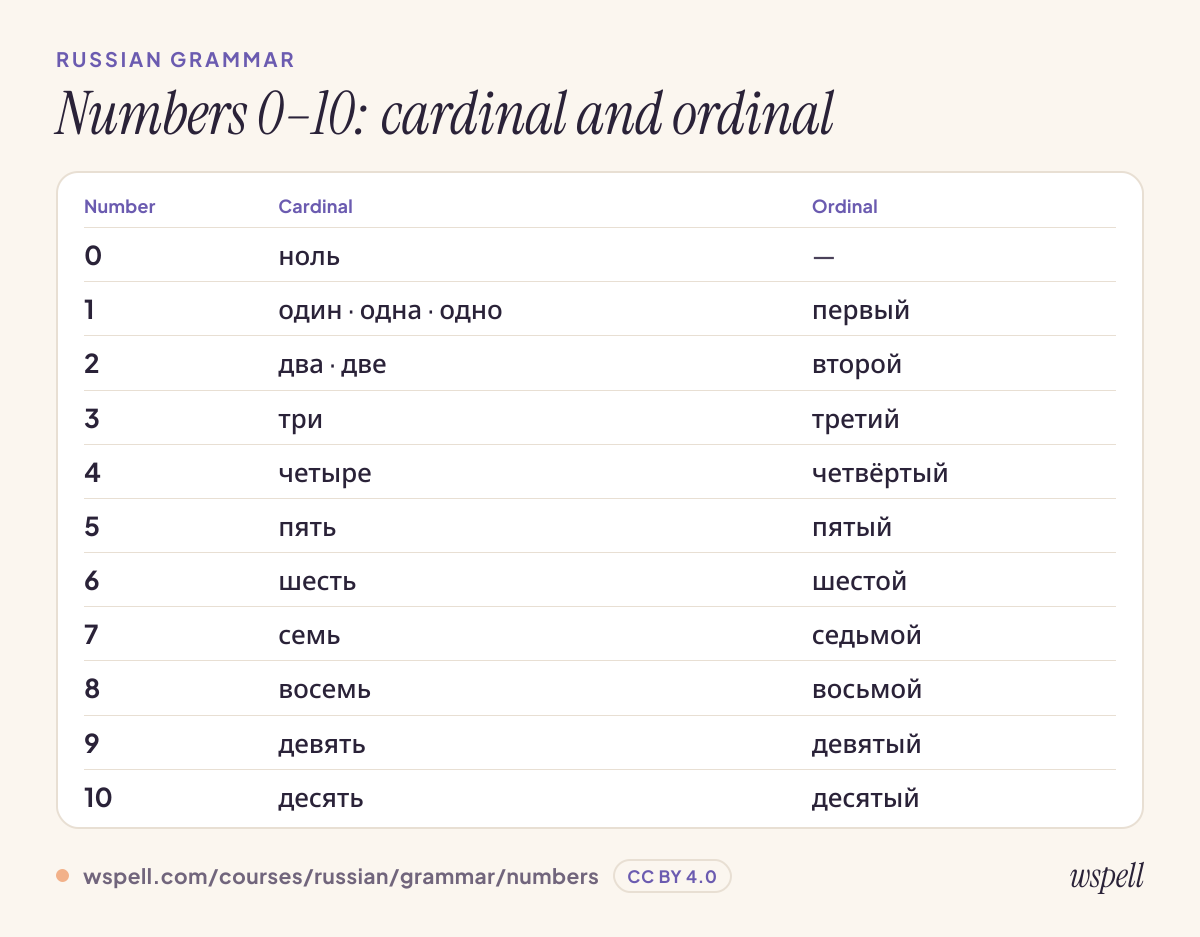
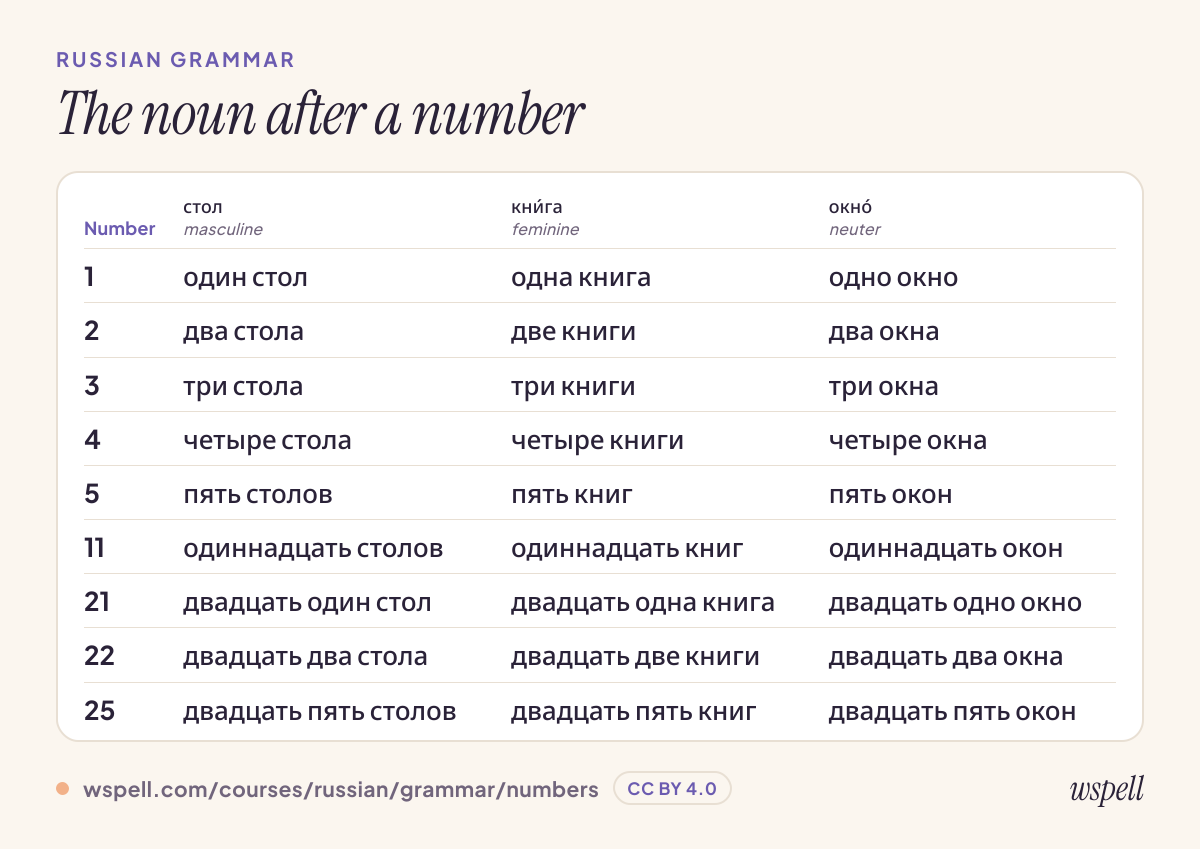
A Russian number decides the form of the noun after it: один стол, два стола, пять столов. One and two also change for gender (одна книга, две книги). The tables give the key numbers from 0 to 1000 with the ordinals from first to tenth, and the noun after 1, after 2–4 and after 5–20, compound numbers included.
Counting from ноль to тысяча
| Number | Cardinal | Ordinal |
|---|---|---|
| 0 | ноль | — |
| 1 | один · одна · одно | первый |
| 2 | два · две | второй |
| 3 | три | третий |
| 4 | четыре | четвёртый |
| 5 | пять | пятый |
| 6 | шесть | шестой |
| 7 | семь | седьмой |
| 8 | восемь | восьмой |
| 9 | девять | девятый |
| 10 | десять | десятый |
| Number | Cardinal |
|---|---|
| 11 | одиннадцать |
| 12 | двенадцать |
| 13 | тринадцать |
| 14 | четырнадцать |
| 15 | пятнадцать |
| 16 | шестнадцать |
| 17 | семнадцать |
| 18 | восемнадцать |
| 19 | девятнадцать |
| 20 | двадцать |
| 30 | тридцать |
| 40 | сорок |
| 50 | пятьдесят |
| 60 | шестьдесят |
| 70 | семьдесят |
| 80 | восемьдесят |
| 90 | девяносто |
| 100 | сто |
| 200 | двести |
| 300 | триста |
| 400 | четыреста |
| 500 | пятьсот |
| 600 | шестьсот |
| 700 | семьсот |
| 800 | восемьсот |
| 900 | девятьсот |
| 1 000 | тысяча |
The noun after a number
| Number | стол masculine | кни́га feminine | окно́ neuter |
|---|---|---|---|
| 1 | один стол | одна книга | одно окно |
| 2 | два стола | две книги | два окна |
| 3 | три стола | три книги | три окна |
| 4 | четыре стола | четыре книги | четыре окна |
| 5 | пять столов | пять книг | пять окон |
| 11 | одиннадцать столов | одиннадцать книг | одиннадцать окон |
| 21 | двадцать один стол | двадцать одна книга | двадцать одно окно |
| 22 | двадцать два стола | двадцать две книги | двадцать два окна |
| 25 | двадцать пять столов | двадцать пять книг | двадцать пять окон |
2, 3, 4 + genitive singular
In the nominative, and in the accusative of things, два/две, три, четыре require the counted noun in the GENITIVE SINGULAR: два дома, три книги, четыре окна. With people and animals the accusative is двух, трёх, четырёх + genitive plural (вижу двух студентов). An adjective between them takes the genitive plural with masculine and neuter nouns (два новых дома) and usually the nominative plural with feminine ones (две новые книги).
- Я купил три книги. — I bought three books.
- На улице стоят два новых дома. — Two new houses stand on the street.
5 to 20 + genitive plural
In the nominative and the accusative, after пять to двадцать (the teens 11–19 included) and after round numbers (тридцать, сто), the counted noun and its adjective stand in the GENITIVE PLURAL: пять домов, десять книг, двадцать новых машин, одиннадцать студентов, сто рублей. A compound number follows its last word (двадцать пять домов, but двадцать один дом). In the other cases number and noun share the case: о пяти книгах, с пятью студентами.
- В группе двадцать студентов. — There are twenty students in the group.
- У меня пять новых книг. — I have five new books.
Compound numbers follow their last word
A compound cardinal takes the case/number that its final digit-word would require alone: двадцать один дом (nom sg), двадцать два дома (gen sg), двадцать пять домов (gen pl), сто тридцать одна книга (nom sg fem).
- На складе двадцать один ящик. — There are twenty-one boxes in the warehouse.
- Прошло сто тридцать два дня. — A hundred and thirty-two days passed.
один and два change for gender
один, одна, одно, одни
The numeral один behaves like an adjective, agreeing with its noun in gender, number and case: один дом (m), одна книга (f), одно окно (n), одни очки (pl). It never triggers the genitive.
- У меня один брат и одна сестра. — I have one brother and one sister.
- На столе одно яблоко. — There is one apple on the table.
два or две
Two has a gendered nominative: два for masculine/neuter (два дома, два окна) and две for feminine (две книги). Три and четыре do not change for gender.
- У меня два брата и две сестры. — I have two brothers and two sisters.
Ordinals and dates
Ordinals decline like adjectives
Ordinals (первый, второй, третий, четвёртый, пятый, десятый, двадцатый, сотый) agree with their noun in gender, number and case like adjectives. Several are irregular: первый, второй, третий, четвёртый, седьмой, сороковой.
- Он живёт на пятом этаже. — He lives on the fifth floor.
- Это моя первая книга. — This is my first book.
Dates: первое сентября
To state today's date use the neuter ordinal (agreeing with the implied число) + the month in the genitive: Сегодня первое сентября. To say 'on' a date, put the ordinal itself into the genitive: первого сентября.
- Сегодня двадцать пятое декабря. — Today is the twenty-fifth of December.
- Я приеду первого сентября. — I will arrive on the first of September.
Age and the time
Age: год, года, лет
Age is expressed with the person in the DATIVE and the number governing год: один год, два/три/четыре года, пять … лет (лет is the suppletive genitive plural of год). Compounds follow their last word: двадцать один год, двадцать два года, двадцать пять лет.
- Мне двадцать один год. — I am twenty-one years old.
- Моей сестре двадцать два года. — My sister is twenty-two years old.
- Ему тридцать лет. — He is thirty years old.
The time: час, два часа, пять часов
'What time is it?' is Который час? / Сколько времени? The hour follows the count rules on час: час, два часа, пять часов. 'At' a time uses в + accusative: в час, в два часа, в семь часов.
- Сейчас пять часов. — It is five o'clock now.
- Встреча в два часа. — The meeting is at two o'clock.
learn it step by step
save or print this chart
Under the main tables on this page sits a picture of each — keep one on your phone, share it or print it.
Free to share and adapt under CC BY 4.0 — credit wspell and link to this page. the licence
credit line to copy: Russian numbers and the noun after a number — wspell, CC BY 4.0, https://wspell.com/courses/russian/grammar/numbers
questions
Which case comes after a number in Russian?
In the nominative, and in the accusative of things: after 1 the noun is singular and один agrees with it like an adjective (один стол, одну книгу), after 2, 3 and 4 it takes the genitive singular (два стола), and after 5 to 20 and round numbers (тридцать, сто) the genitive plural (пять столов). A compound number follows its last word: двадцать один стол, двадцать два стола. With people and animals the accusative after 2, 3 and 4 is двух, трёх, четырёх + the genitive plural: вижу двух студентов.
What is the difference between два and две?
два goes with masculine and neuter nouns (два стола, два окна), две with feminine ones (две книги). три and четыре do not change.
How do you say your age in Russian?
Put the person in the dative and count the years with год, года or лет: мне двадцать один год, ей двадцать два года, ему тридцать лет.