grammar chart · Russian
Russian personal pronouns in every case
Russian pronouns change with the case just as nouns do, and most change their stem: я — меня, мне, мной. After a preposition он, она, оно and они take an н- (у него, с ней, о них). The tables also decline the reflexive себя, the question words кто and что, and the demonstratives этот and тот.
Personal pronouns: я, ты, он, она, мы, вы, они
| Nominative | Genitive | Dative | Accusative | Instrumental | Prepositional |
|---|---|---|---|---|---|
| я | меня | мне | меня | мной | обо мне |
| ты | тебя | тебе | тебя | тобой | о тебе |
| он/оно | его | ему | его | им | о нём |
| она | её | ей | её | ей | о ней |
| мы | нас | нам | нас | нами | о нас |
| вы | вас | вам | вас | вами | о вас |
| они | их | им | их | ими | о них |
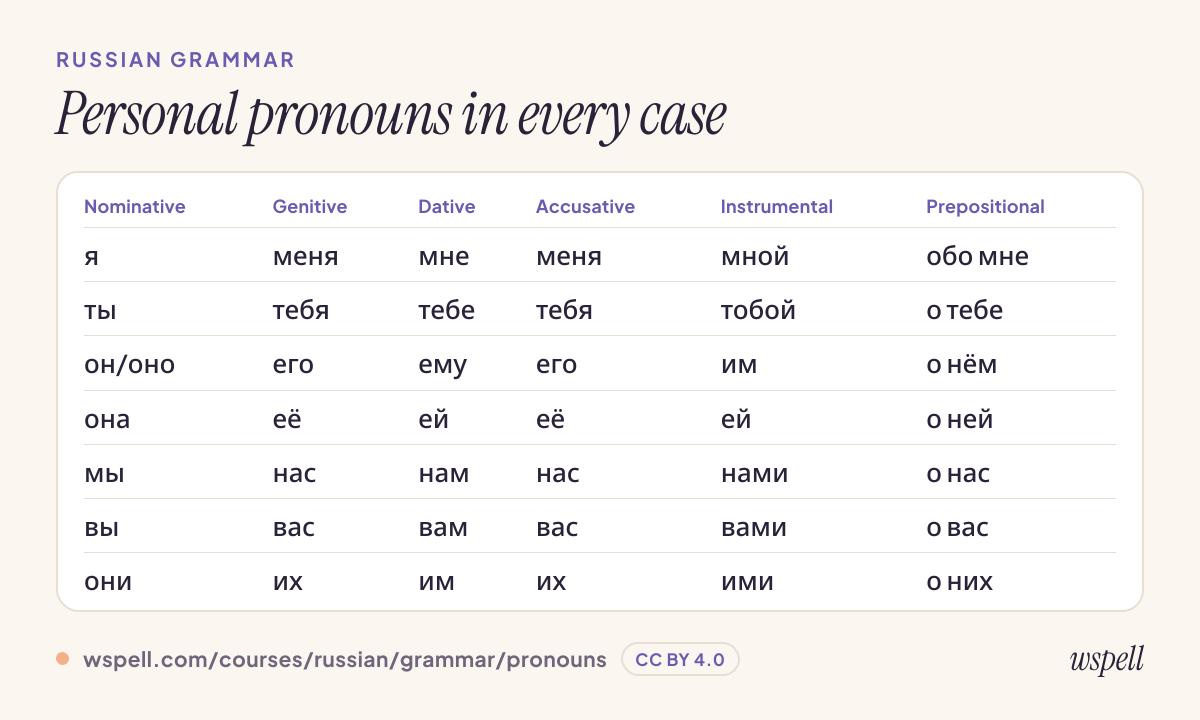
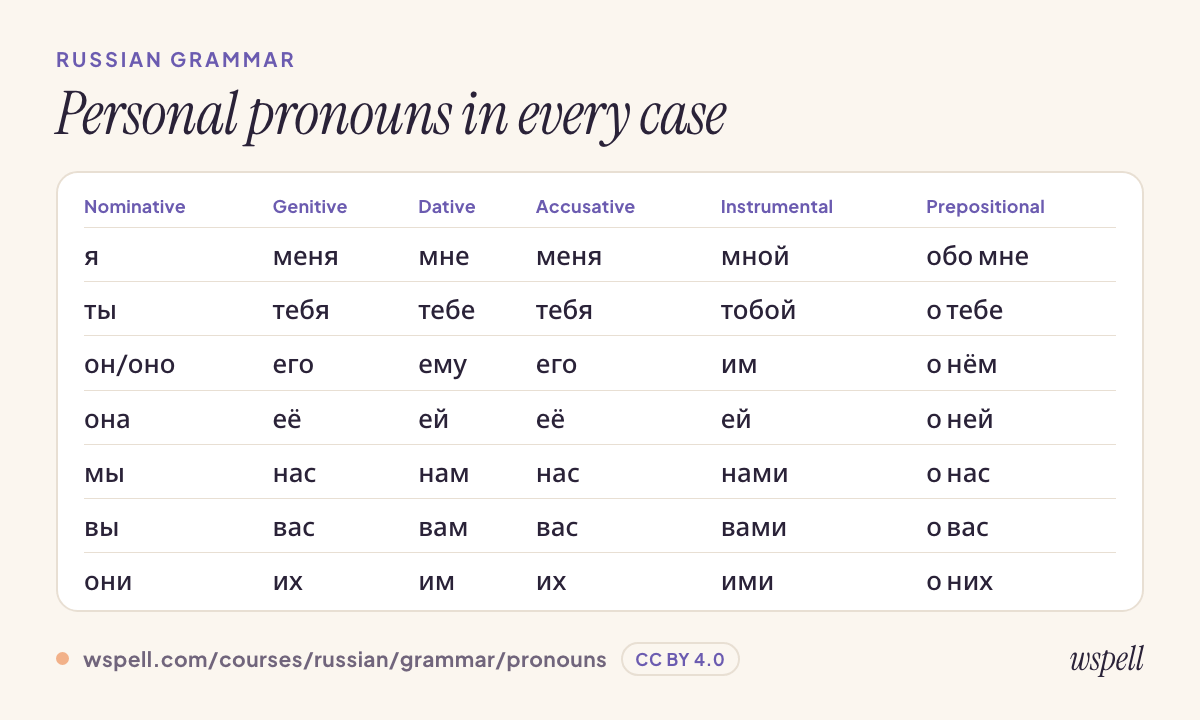
Every personal pronoun has a full six-case paradigm with suppletive stems: я → меня, мне, меня, мной, (обо) мне. Learn the object forms as a block — they are what most sentences actually use.
- Он позвонил мне и попросил меня прийти. — He called me and asked me to come.
н- after a preposition: у него, к ней
н- after a preposition: у него, к ней
After a preposition the oblique 3rd-person forms gain a prothetic н-: у него, к нему, с ним, о нём, для неё, между ними. Crucially the possessive его/её/их (his/her/their) is NOT a real pronoun here and never takes н- (у его брата, not у него брата).
- Я иду к нему. — I am going to him.
- У неё новая машина. — She has a new car.
- Я был у его брата. — I was at his brother's.
ты or вы?
ты and вы
ты is singular-informal (family, friends, children); вы is both the plural 'you' AND the polite singular for strangers, elders, and formal settings. Polite singular вы still takes plural verb agreement (Вы читаете), and in letters it is often capitalised as Вы.
- Здравствуйте, как вас зовут? — Hello, what is your name? (polite)
- Ты придёшь завтра? — Will you come tomorrow? (informal)
себя: myself, yourself, himself
| Nominative | Genitive | Dative | Accusative | Instrumental | Prepositional |
|---|---|---|---|---|---|
| — | себя | себе | себя | собой | о себе |
себя: the reflexive pronoun
себя refers back to the subject whoever it is (I/you/he/we…), so it has no nominative and never changes for person, gender, or number: Я вижу себя, Они любят себя. Use it when the object is the same as the subject.
- Она купила себе платье. — She bought herself a dress.
- Возьми себя в руки. — Pull yourself together.
кто and что in every case
| Nominative | Genitive | Dative | Accusative | Instrumental | Prepositional |
|---|---|---|---|---|---|
| кто | кого | кому | кого | кем | о ком |
| что | чего | чему | что | чем | о чём |
Both interrogatives take the case the verb/preposition needs: Кого ты видел? (acc), Чего ты боишься? (gen), Кому помочь? (dat), Чем писать? (ins), О ком/О чём? (prep). Note кого/кому use a к-stem, чего/чем a ч-stem.
- О чём ты думаешь? — What are you thinking about?
- Кому ты звонишь? — Whom are you calling?
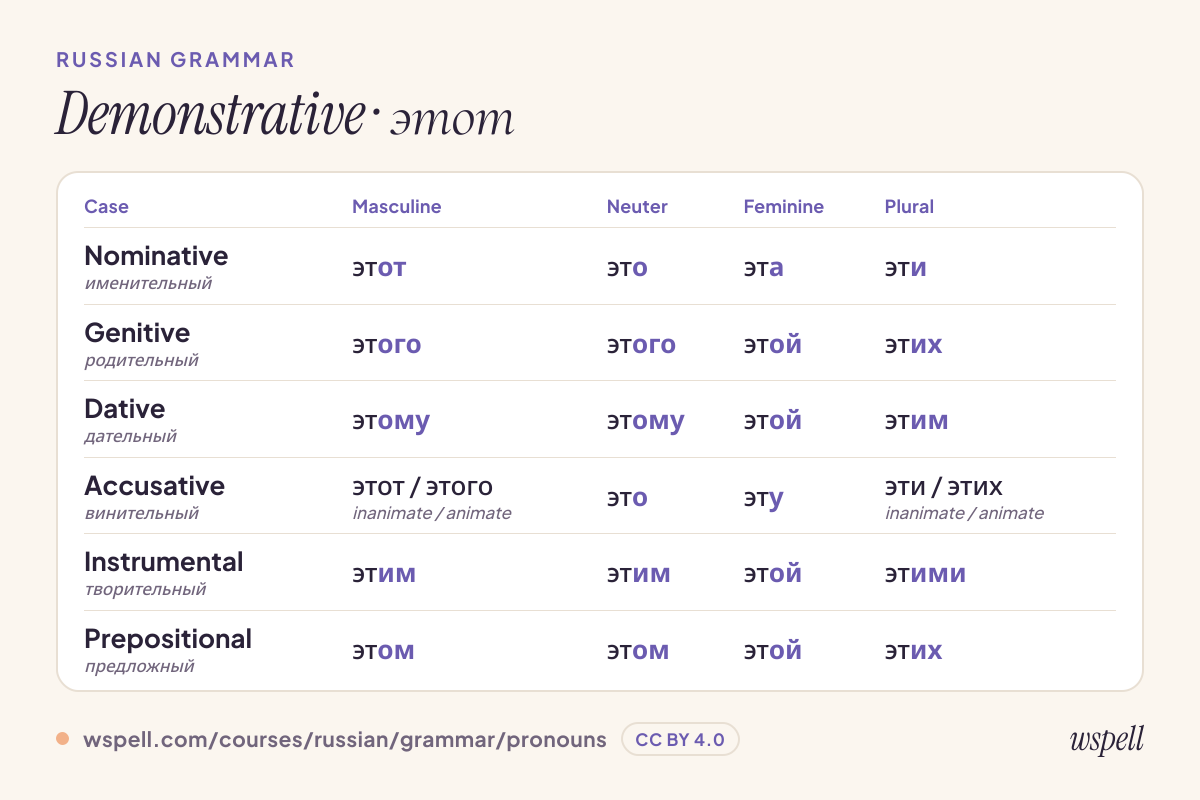
этот and тот: this and that
| Case | Masculine | Neuter | Feminine | Plural |
|---|---|---|---|---|
| Nominative именительный | этот | это | эта | эти |
| Genitive родительный | этого | этого | этой | этих |
| Dative дательный | этому | этому | этой | этим |
| Accusative винительный | этот / этого inanimate / animate | это | эту | эти / этих inanimate / animate |
| Instrumental творительный | этим | этим | этой | этими |
| Prepositional предложный | этом | этом | этой | этих |
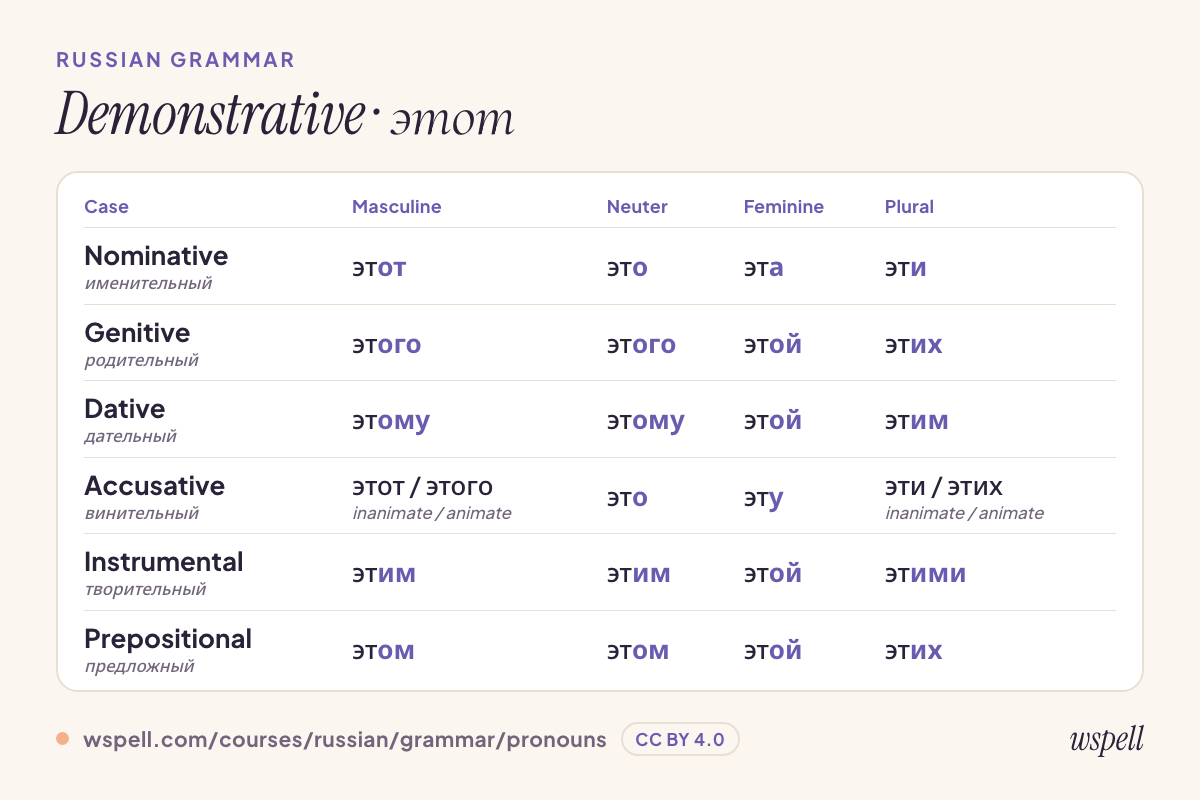
| Case | Masculine | Neuter | Feminine | Plural |
|---|---|---|---|---|
| Nominative именительный | тот | то | та | те |
| Genitive родительный | того | того | той | тех |
| Dative дательный | тому | тому | той | тем |
| Accusative винительный | тот / того inanimate / animate | то | ту | те / тех inanimate / animate |
| Instrumental творительный | тем | тем | той | теми |
| Prepositional предложный | том | том | той | тех |
этот and тот
этот = this/near the speaker, тот = that/further away or 'the other one'; both agree in gender, number, and case (этот дом, эта книга, это окно, эти люди; в том доме). тот also sets up relatives (тот, кто…).
- Этот дом новый, а тот старый. — This house is new, and that one is old.
- Я живу в этом городе. — I live in this city.
learn it step by step
save or print this chart
Under the main tables on this page sits a picture of each — keep one on your phone, share it or print it.
Free to share and adapt under CC BY 4.0 — credit wspell and link to this page. the licence
credit line to copy: Russian personal pronouns in every case — wspell, CC BY 4.0, https://wspell.com/courses/russian/grammar/pronouns
questions
How do Russian personal pronouns decline?
Each changes through all six cases, often with a new stem: я, меня, мне, меня, мной, обо мне; ты, тебя, тебе, тебя, тобой, о тебе; он, его, ему, его, им, о нём.
Why is it 'у него' and not 'у его'?
After a preposition the third-person pronouns add н-: у него, к нему, с ней, о них. The possessive его (his) never does: у его брата means 'at his brother's'.
When do you use вы instead of ты?
вы is the plural 'you' and also the polite 'you' for one person — a stranger, an older person, a teacher. It always takes the plural verb: Вы читаете.