grammar chart · Russian
Russian noun declension: a table for every noun type
A Russian noun's endings depend on its gender and on how its nominative ends. Here each common type is declined in full on an example word: masculine nouns ending in a consonant, -й or -ь, neuter nouns in -о and -е, nouns in -а and -я, and feminine nouns in -ь — six cases, singular and plural.
Gender: read it from the ending
Gender from the ending
Read gender off the nominative singular ending: a consonant → masculine (стол, дом), -а/-я → feminine (книга, неделя), -о/-е → neuter (окно, море). This covers the vast majority of nouns; nouns in -ь are the exception.
- новый стол, большая книга, синее море — a new table (m), a big book (f), a blue sea (n)
Nouns in -ь: masculine or feminine
A noun ending in soft sign -ь can be masculine (день, словарь, гость) or feminine (ночь, дверь, тетрадь) — the ending alone does not tell you. Two clues: nouns in -ость, and every noun with ь after ж, ш, ч, щ (ночь, мышь), are feminine. Learn the gender of the rest with the word.
- новый словарь — a new dictionary (m)
- тёмная ночь — a dark night (f)
Masculine nouns: стол, музей, студент
студент names a person, so its accusative is the genitive: студента, студентов.
Masculine nouns: стол, музей, конь
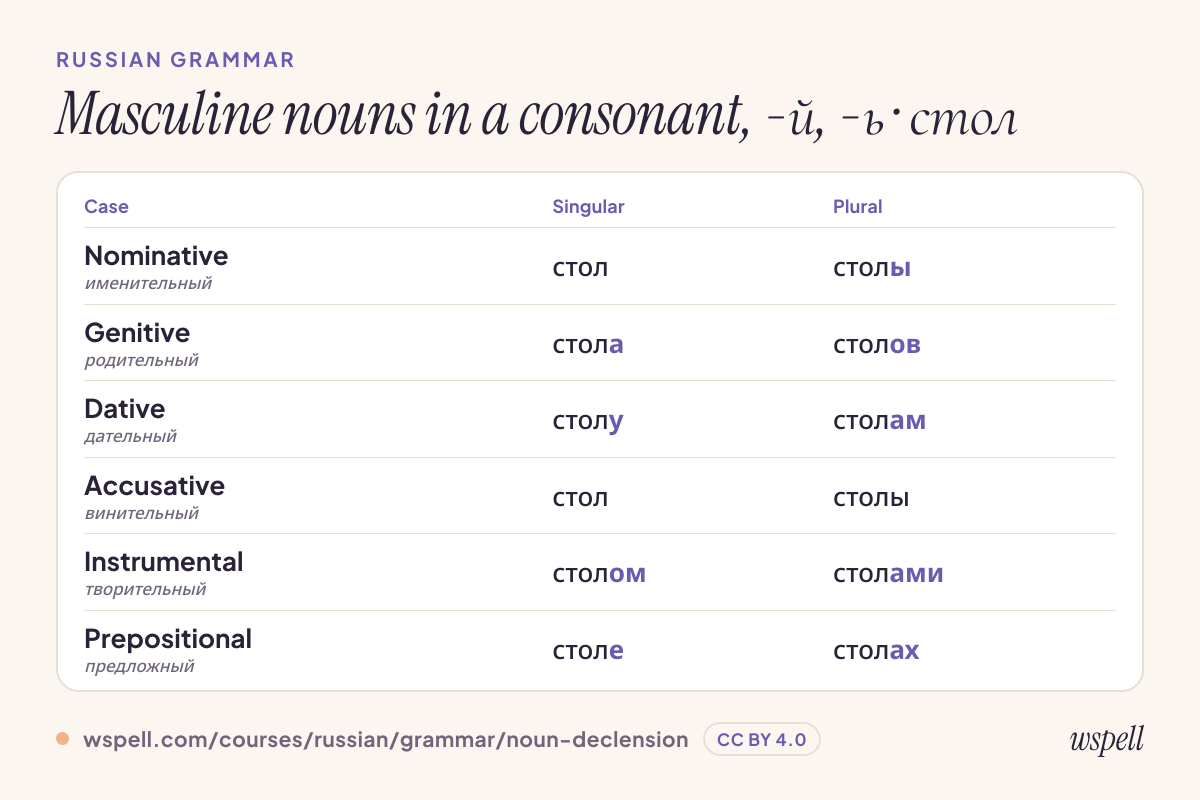
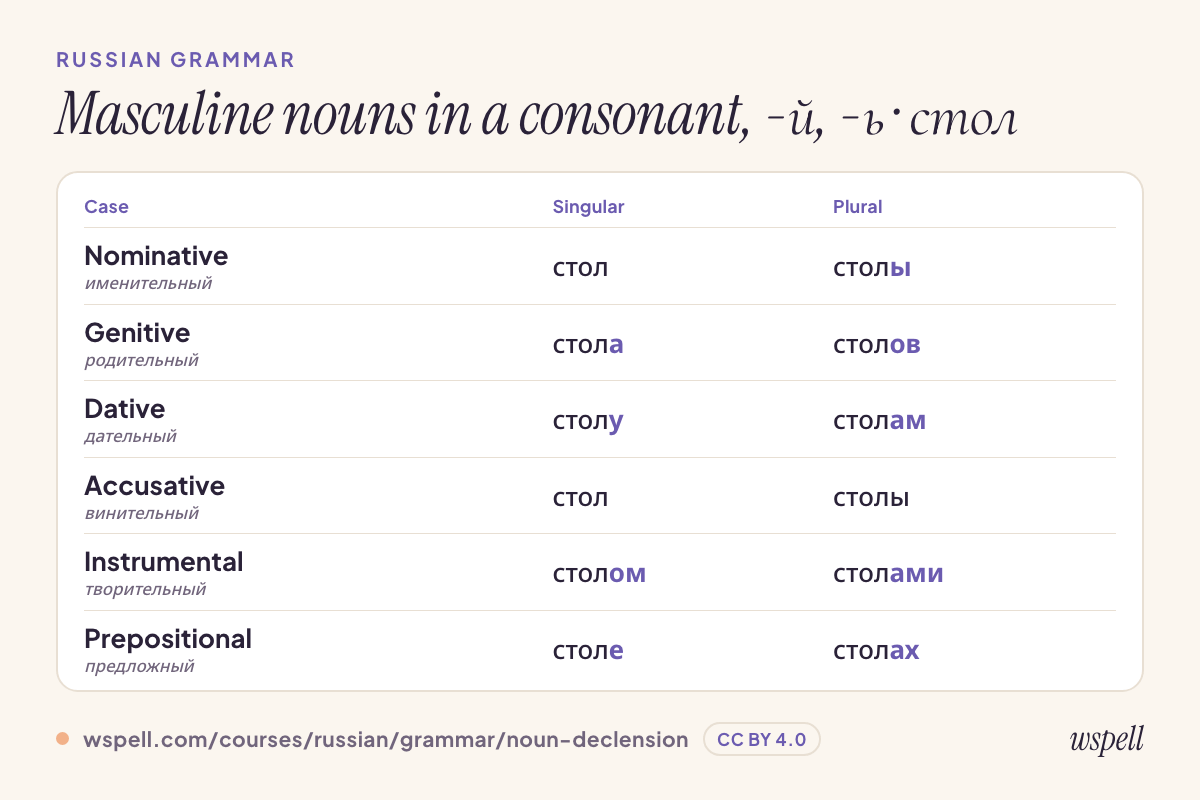
Masculine nouns ending in a consonant (стол), -й (музей) or soft -ь (конь). Genitive -а/-я, prepositional -е. Accusative singular follows animacy: inanimate = nominative (стол), animate = genitive (коня).
- стол, стола, столу, стол, столом, о столе — table through the six singular cases
| Case | Singular | Plural |
|---|---|---|
| Nominative именительный | стол | столы |
| Genitive родительный | стола | столов |
| Dative дательный | столу | столам |
| Accusative винительный | стол | столы |
| Instrumental творительный | столом | столами |
| Prepositional предложный | столе | столах |
| Case | Singular | Plural |
|---|---|---|
| Nominative именительный | музей | музеи |
| Genitive родительный | музея | музеев |
| Dative дательный | музею | музеям |
| Accusative винительный | музей | музеи |
| Instrumental творительный | музеем | музеями |
| Prepositional предложный | музее | музеях |
| Case | Singular | Plural |
|---|---|---|
| Nominative именительный | студент | студенты |
| Genitive родительный | студента | студентов |
| Dative дательный | студенту | студентам |
| Accusative винительный | студента | студентов |
| Instrumental творительный | студентом | студентами |
| Prepositional предложный | студенте | студентах |
Neuter nouns: окно, поле
Neuter nouns in -о and -е
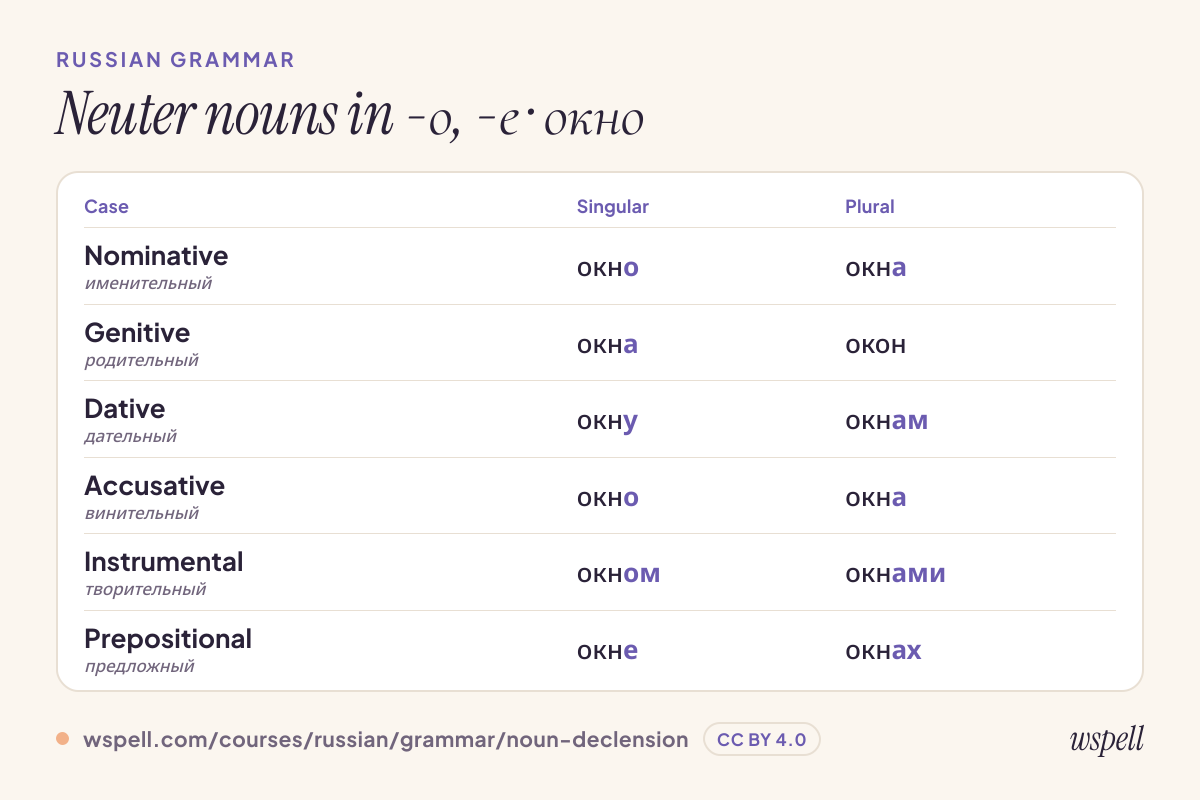
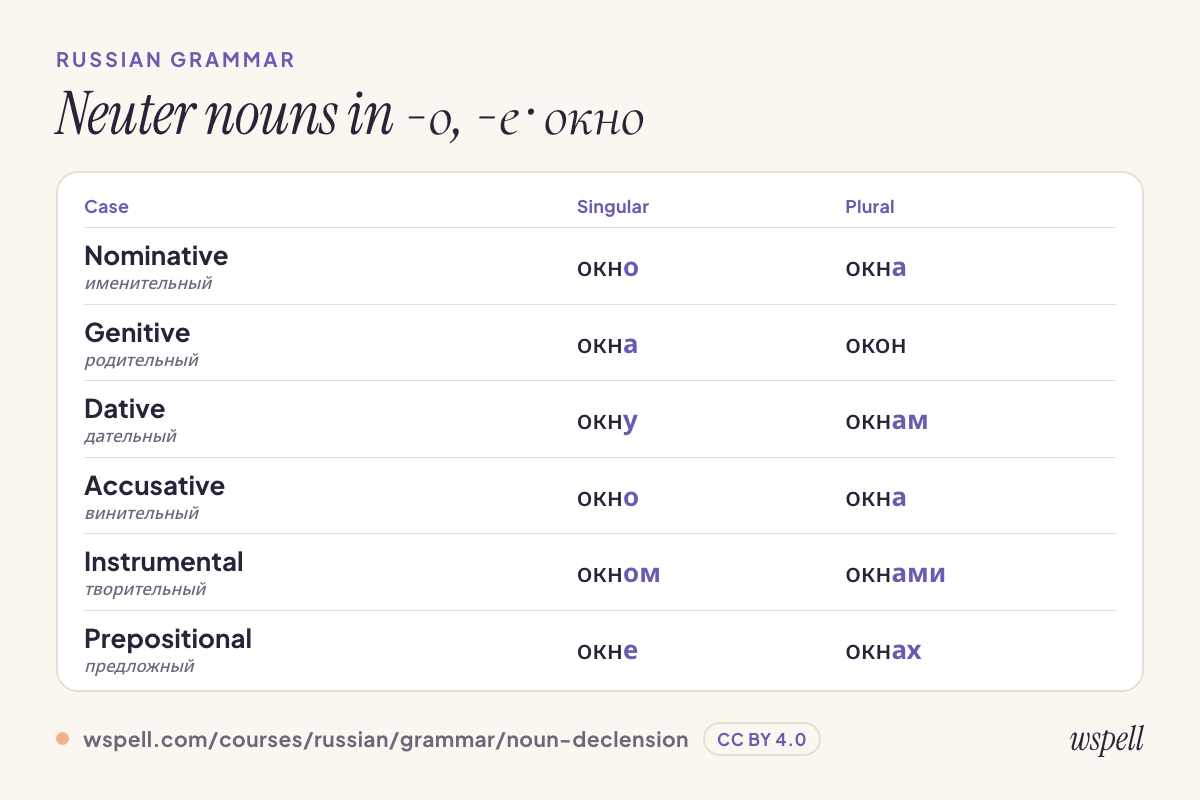
Neuter nouns in -о/-е. Nominative = accusative (окно, окно). Nominative plural is -а/-я and often stressed differently (о́кна). The -мя subtype (имя, время) inserts -ен-: имени, времени.
- окно, окна, окну, окно, окном, об окне — window through the six singular cases
- Сколько сейчас времени? — What time is it now?
| Case | Singular | Plural |
|---|---|---|
| Nominative именительный | окно | окна |
| Genitive родительный | окна | окон |
| Dative дательный | окну | окнам |
| Accusative винительный | окно | окна |
| Instrumental творительный | окном | окнами |
| Prepositional предложный | окне | окнах |
| Case | Singular | Plural |
|---|---|---|
| Nominative именительный | поле | поля |
| Genitive родительный | поля | полей |
| Dative дательный | полю | полям |
| Accusative винительный | поле | поля |
| Instrumental творительный | полем | полями |
| Prepositional предложный | поле | полях |
Nouns in -а and -я: книга, неделя
Nouns in -а and -я
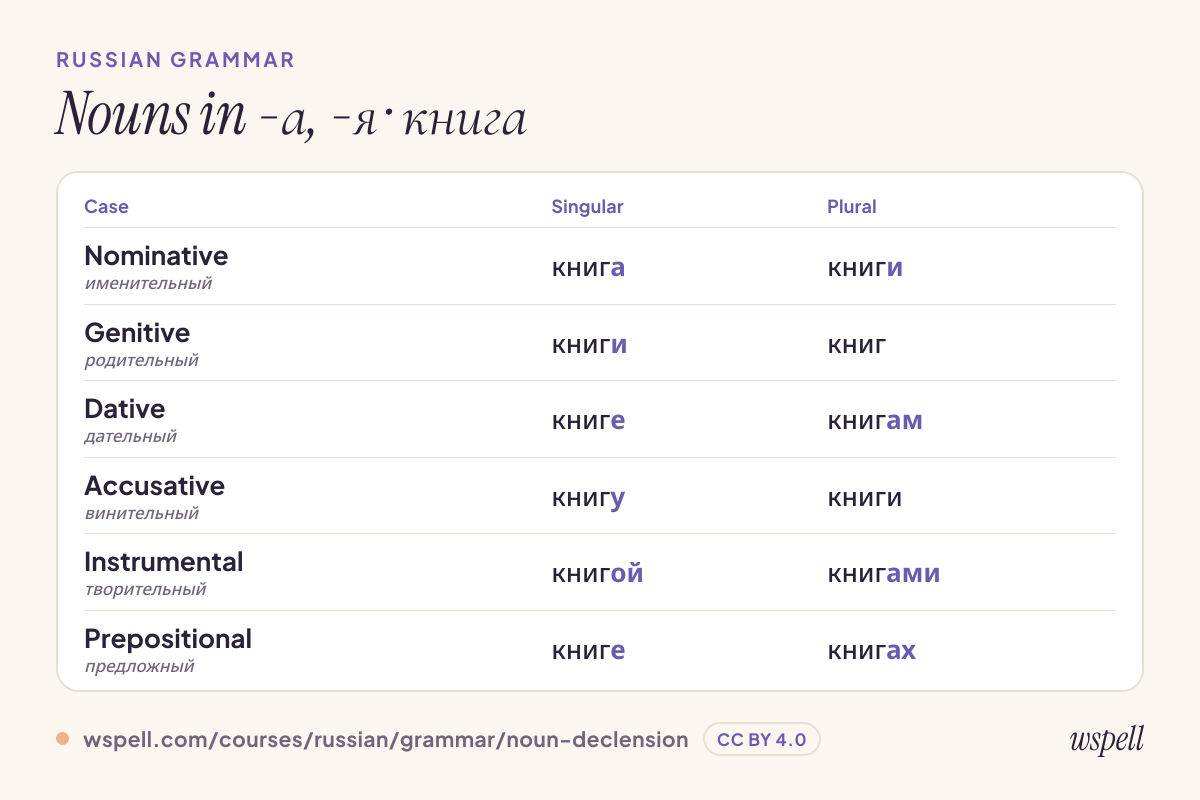
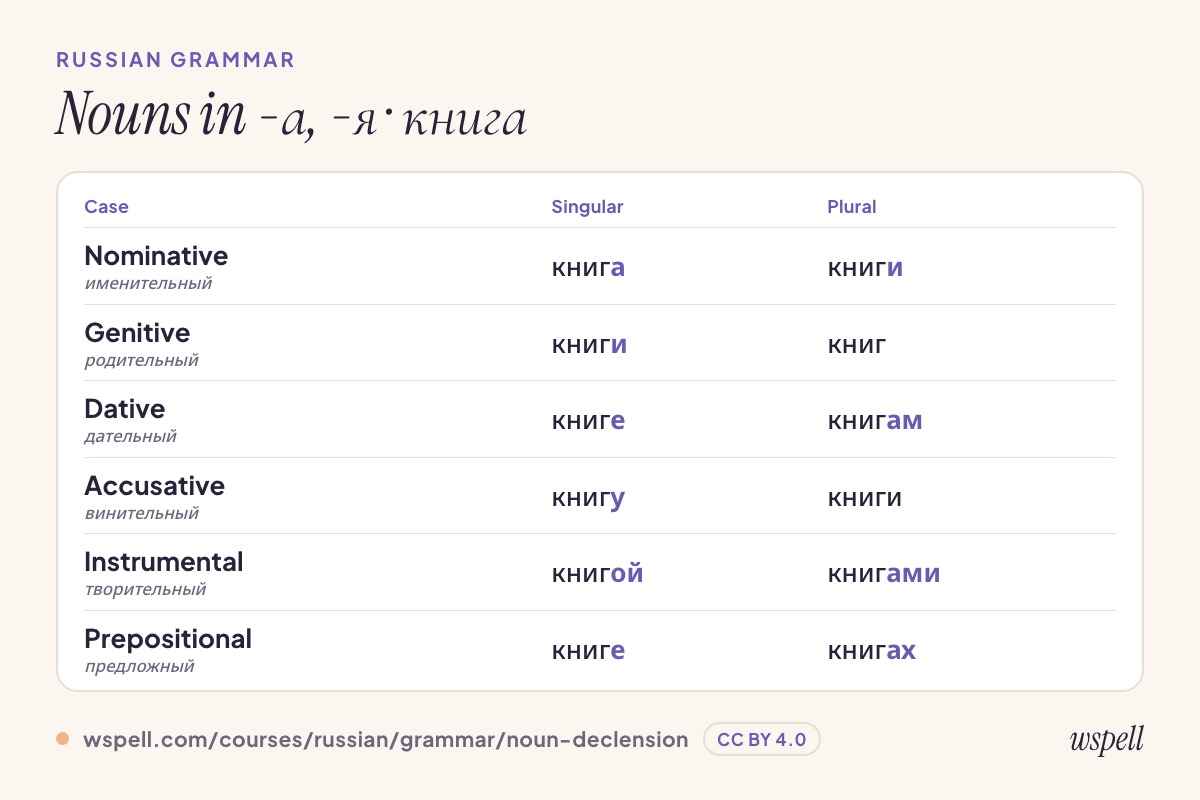
Feminine (and some masculine, e.g. папа, дядя) nouns in -а/-я. Watch the paired accusative -у/-ю vs instrumental -ой/-ей, and the genitive -ы (hard) / -и (soft, and after к, г, х, ж, ш, ч, щ): книги, not книгы.
- мама, мамы, маме, маму, мамой, о маме — mum through the six singular cases
| Case | Singular | Plural |
|---|---|---|
| Nominative именительный | книга | книги |
| Genitive родительный | книги | книг |
| Dative дательный | книге | книгам |
| Accusative винительный | книгу | книги |
| Instrumental творительный | книгой | книгами |
| Prepositional предложный | книге | книгах |
| Case | Singular | Plural |
|---|---|---|
| Nominative именительный | неделя | недели |
| Genitive родительный | недели | недель |
| Dative дательный | неделе | неделям |
| Accusative винительный | неделю | недели |
| Instrumental творительный | неделей | неделями |
| Prepositional предложный | неделе | неделях |
Feminine nouns in -ь: тетрадь
Feminine nouns in -ь
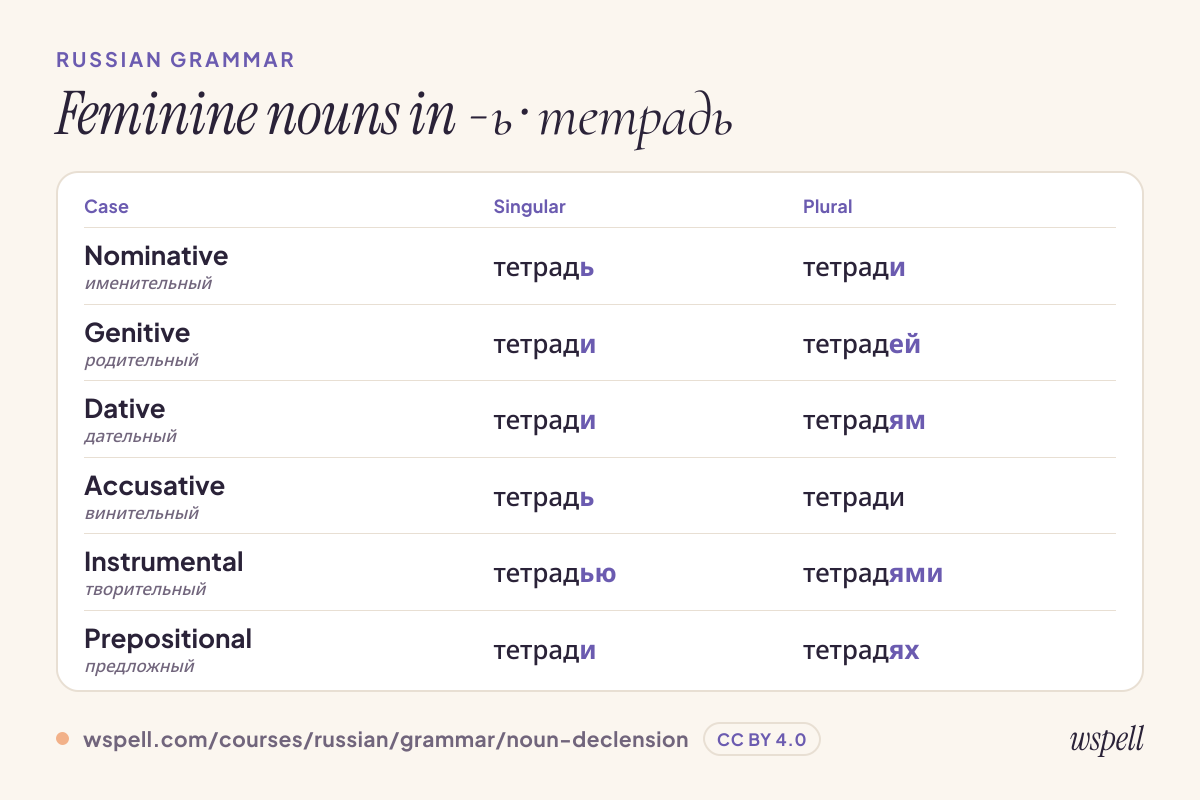
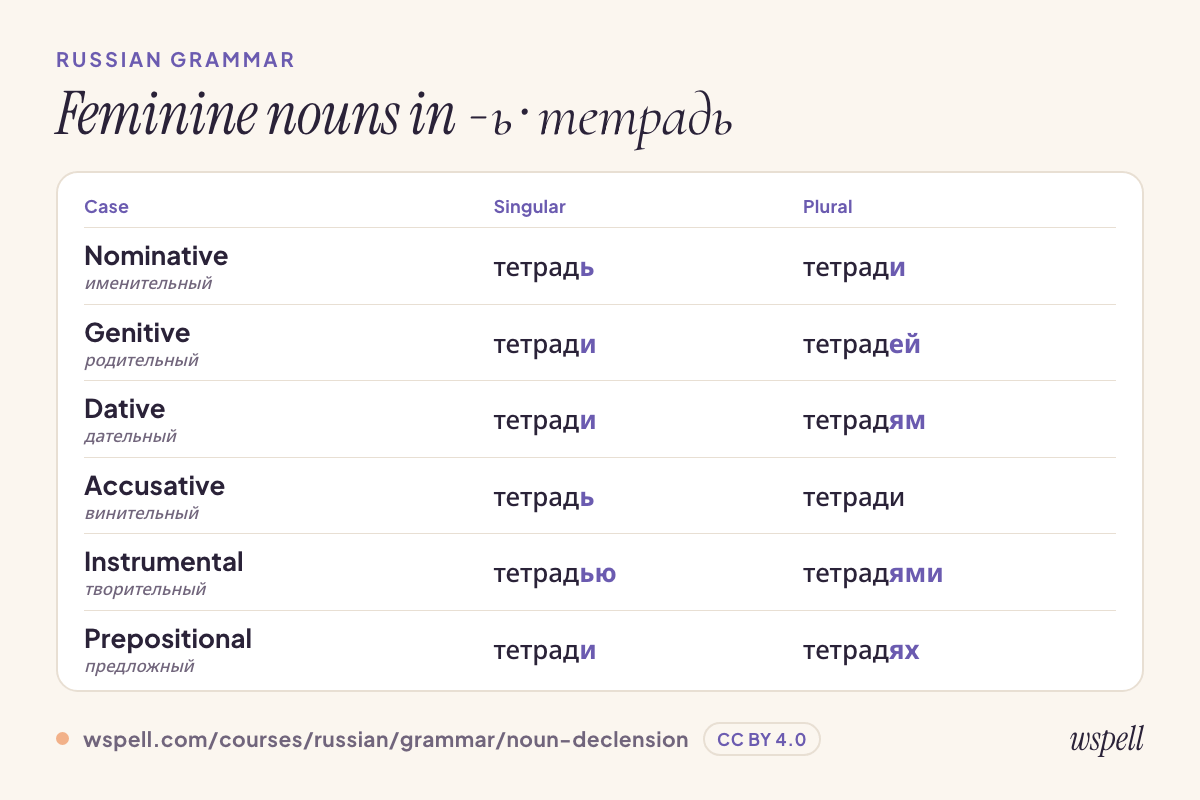
Feminine nouns ending in -ь. Genitive, dative and prepositional singular all end in -и; the instrumental is the distinctive -ью (ночью). Do not confuse with masculine soft -ь nouns (конь), which belong to the 2nd declension.
- ночь, ночи, ночи, ночь, ночью, о ночи — night through the six singular cases
| Case | Singular | Plural |
|---|---|---|
| Nominative именительный | тетрадь | тетради |
| Genitive родительный | тетради | тетрадей |
| Dative дательный | тетради | тетрадям |
| Accusative винительный | тетрадь | тетради |
| Instrumental творительный | тетрадью | тетрадями |
| Prepositional предложный | тетради | тетрадях |
Forming the plural
The plural in -ы / -и
Hard masculine and feminine nouns form the nominative plural in -ы (стол → столы, газета → газеты); soft stems and nouns in -я/-ь take -и (музей → музеи, неделя → недели, дверь → двери).
- На улице стоят машины. — There are cars in the street.
- В городе есть музеи. — There are museums in the city.
The neuter plural in -а / -я
Neuter nouns swap their singular ending for -а (окно → окна, слово → слова) or -я for soft stems (море → моря, поле → поля). Stress often shifts between singular and plural (окно́ → о́кна).
- Все окна открыты. — All the windows are open.
- Это трудные слова. — These are difficult words.
и, not ы, after к, г, х, ж, ш, щ, ч
Spelling rule 1: ы is never written after к, г, х or the sibilants ж, ш, щ, ч — write и instead. So stems in these letters form the plural in -и regardless of hardness: книга → книги, ручка → ручки, нож → ножи, карандаш → карандаши.
- У меня новые книги. — I have new books.
- Где мои карандаши? — Where are my pencils?
The genitive plural
The genitive plural: -ов, -ей or no ending
Genitive plural, the hardest slot: masculine hard stems take -ов (столов), stems in -й take -ев (музеев), stems in -ь or a sibilant take -ей (словарей, ключей), and so do neuter soft stems such as поле, море (полей, морей); neuter nouns in -ие end in -ий (здание → зданий). Feminine -а and neuter -о take a ZERO ending, often with an inserted vowel (книг, окон, девочек); -я nouns usually take a zero ending too, written with ь (недель), or with й after a vowel (лекция → лекций). Feminine nouns in -ь take -ей (ночей, тетрадей).
- В классе двадцать студентов. — There are twenty students in the class.
- У неё нет книг. — She has no books.
Vowels that come and go: отец → отца, окно → окон
Many nouns have a 'fleeting' о or е that appears in the nominative singular but drops when an ending is added: отец → отца, день → дня, сон → сна. The reverse happens in the zero-ending genitive plural, where the vowel is inserted: окно → окон, сестра → сестёр.
- Мой отец — врач; я жду отца. — My father is a doctor; I'm waiting for my father.
- В доме много окон. — There are many windows in the house.
Nouns that never change
кофе, метро, такси: nouns that never change
Borrowed nouns ending in -о, -е, -и, -у (метро, кафе, такси, меню) and many foreign names do NOT decline — the same form serves all six cases. Agreement still shows the case on any adjective: в новом кафе, о моём пальто.
- Я еду на метро. — I am going by metro.
- Мы сидели в уютном кафе. — We were sitting in a cosy café.
learn it step by step
save or print this chart
Under the main tables on this page sits a picture of each — keep one on your phone, share it or print it.
Free to share and adapt under CC BY 4.0 — credit wspell and link to this page. the licence
credit line to copy: Russian noun declension: a table for every noun type — wspell, CC BY 4.0, https://wspell.com/courses/russian/grammar/noun-declension
questions
How many noun declensions does Russian have?
Three, in the numbering Russian schools use: the 1st holds nouns in -а/-я (книга, неделя, and a few masculine ones such as папа), the 2nd masculine nouns ending in a consonant, -й or -ь (стол, музей) and neuter nouns in -о/-е (окно, поле), the 3rd feminine nouns in -ь (тетрадь). Some textbooks number them differently, so these charts name each type by its gender and ending.
Is a Russian noun in -ь masculine or feminine?
It can be either — словарь and день are masculine, тетрадь and ночь feminine — so learn the gender with the word. Nouns in -ость are feminine, and so are nouns with ь after ж, ш, ч or щ (ночь, мышь).
Why is the genitive plural of окно 'окон'?
Neuter nouns in -о and feminine nouns in -а take no ending in the genitive plural, and when the stem then ends in two consonants a vowel is often inserted between them: окно → окон, сестра → сестёр, ручка → ручек. Not always, though (карта → карт, место → мест), and книга → книг needs none.