grammar chart · Russian
Russian possessive pronouns in every case
Russian мой, твой, наш, ваш and свой agree with the thing owned, not with the owner: мой брат, моя сестра, моё окно, мои книги. They decline much like adjectives — the tables give мой and наш in full; твой and свой follow мой, and ваш follows наш. The third-person его, её and их never change.
Agreement with the thing owned
The nominative of all five: masculine, neuter, feminine and plural.
мой, твой, наш, ваш agree with the thing owned
Possessives for 1st/2nd person agree in gender, number, and case with the possessed noun — NOT with the owner: мой брат, моя сестра, моё окно, мои книги. So «my» changes shape by what is owned.
- Моя сестра и мой брат дома. — My sister and my brother are home.
- Я взял твои книги. — I took your books.
| Masculine | Neuter | Feminine | Plural |
|---|---|---|---|
| мой | моё | моя | мои |
| твой | твоё | твоя | твои |
| наш | наше | наша | наши |
| ваш | ваше | ваша | ваши |
| свой | своё | своя | свои |
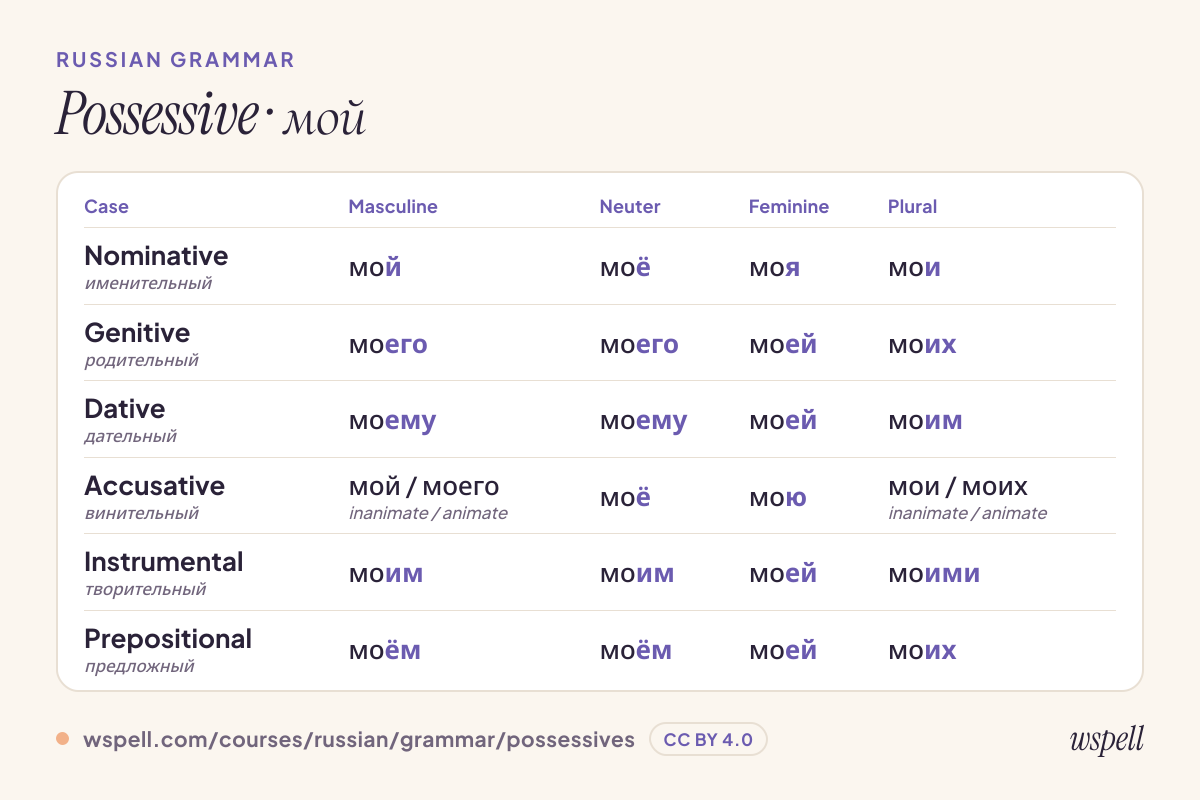
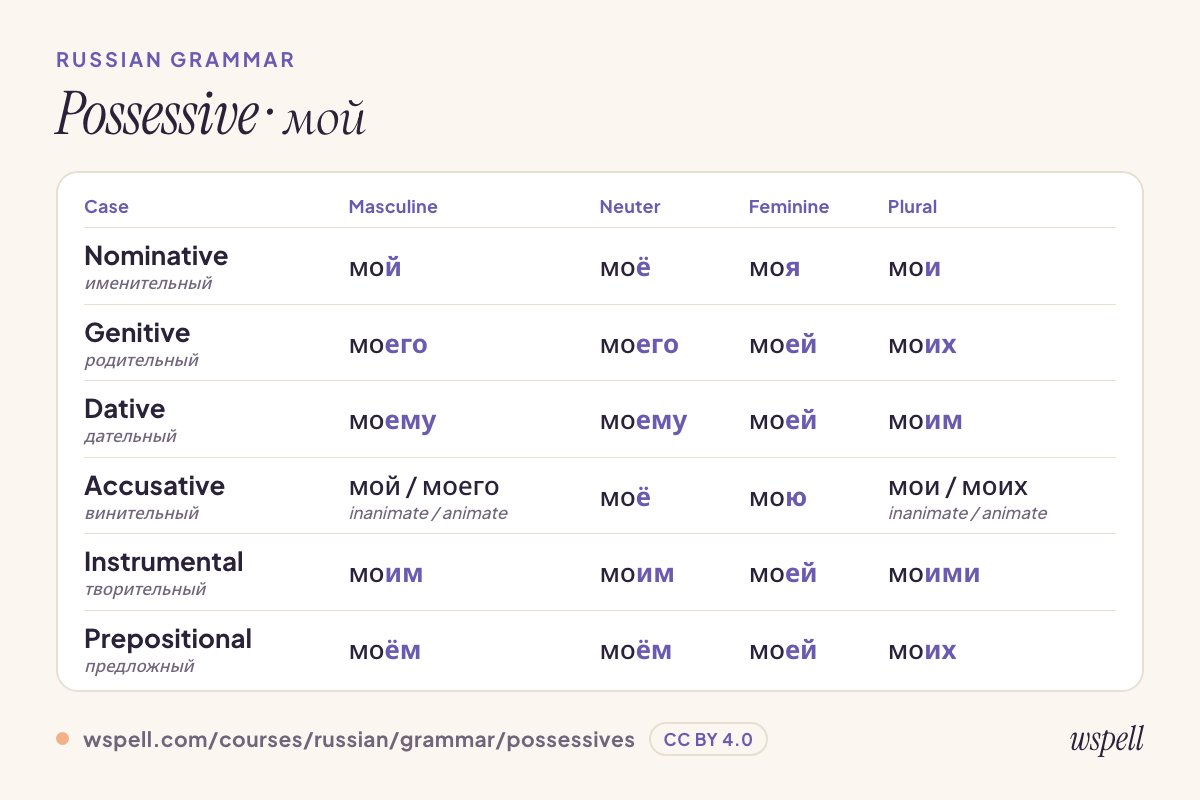
мой, твой, свой in every case
| Case | Masculine | Neuter | Feminine | Plural |
|---|---|---|---|---|
| Nominative именительный | мой | моё | моя | мои |
| Genitive родительный | моего | моего | моей | моих |
| Dative дательный | моему | моему | моей | моим |
| Accusative винительный | мой / моего inanimate / animate | моё | мою | мои / моих inanimate / animate |
| Instrumental творительный | моим | моим | моей | моими |
| Prepositional предложный | моём | моём | моей | моих |
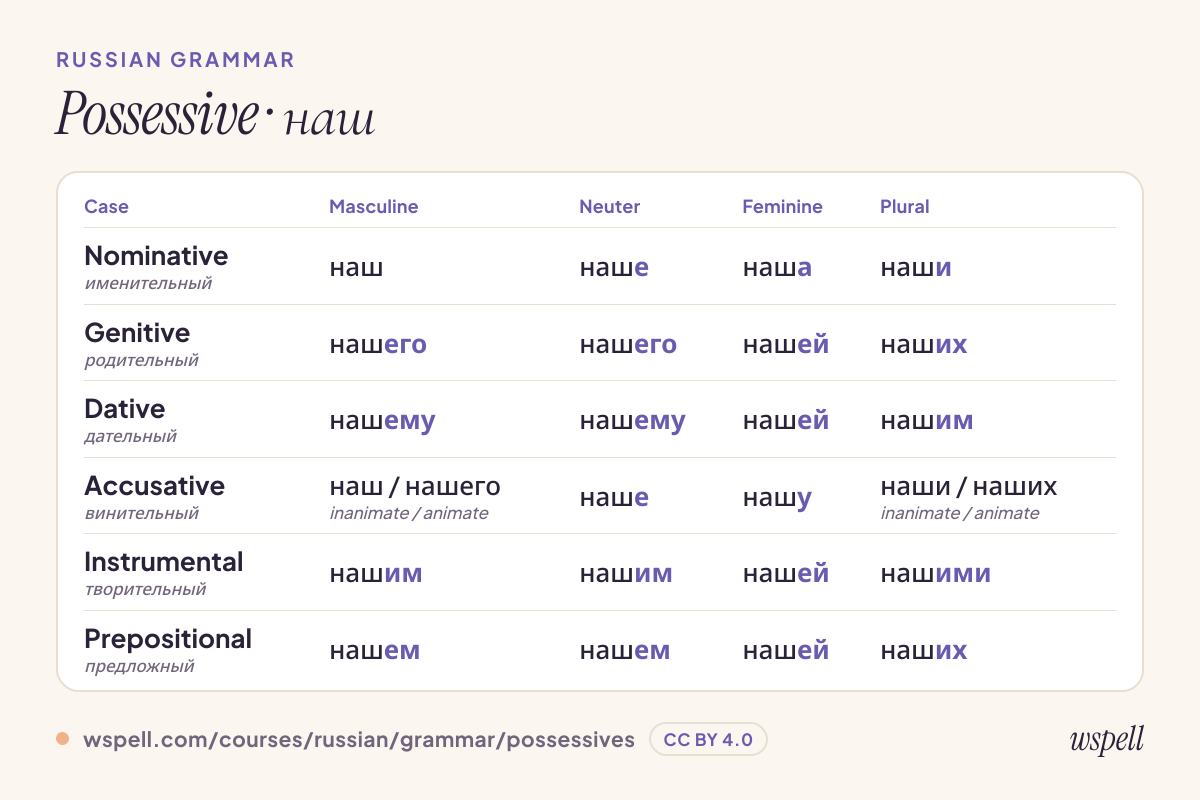
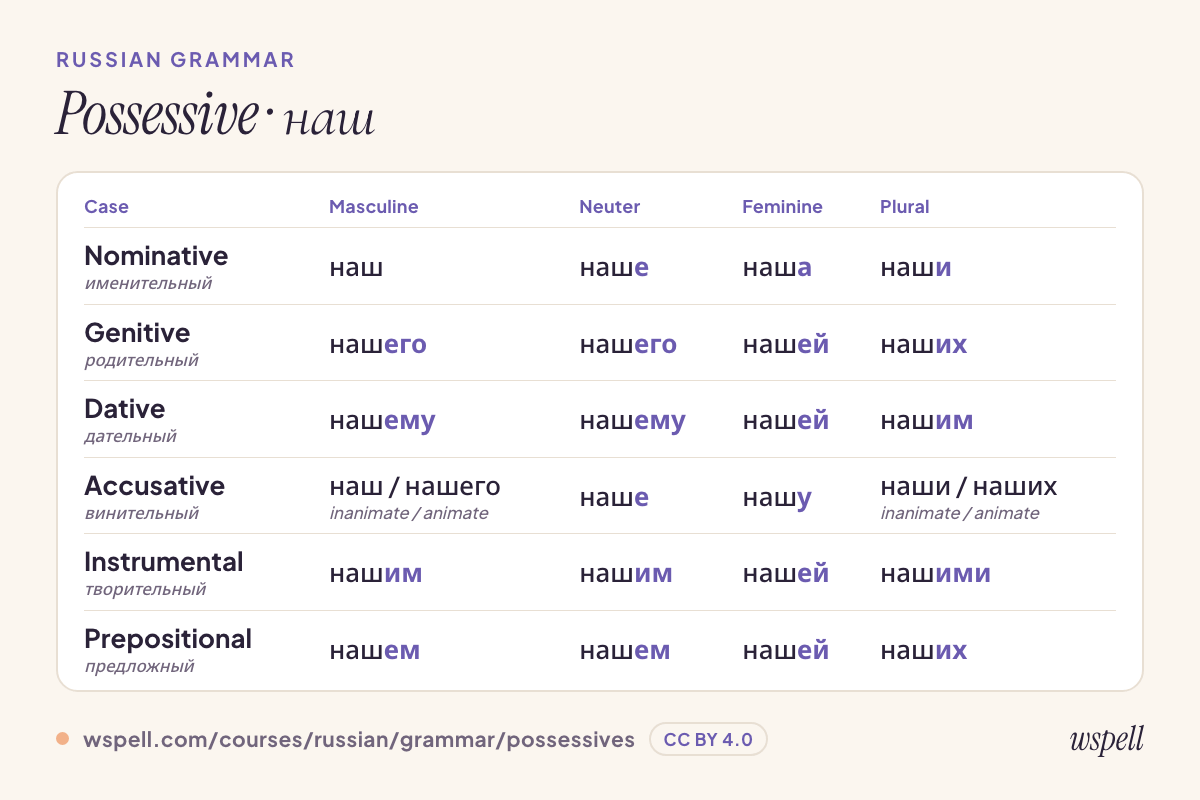
наш, ваш in every case
| Case | Masculine | Neuter | Feminine | Plural |
|---|---|---|---|---|
| Nominative именительный | наш | наше | наша | наши |
| Genitive родительный | нашего | нашего | нашей | наших |
| Dative дательный | нашему | нашему | нашей | нашим |
| Accusative винительный | наш / нашего inanimate / animate | наше | нашу | наши / наших inanimate / animate |
| Instrumental творительный | нашим | нашим | нашей | нашими |
| Prepositional предложный | нашем | нашем | нашей | наших |
его, её, их never change
3rd-person possessives его (his/its), её (her), их (their) NEVER change form — they ignore the gender, number, and case of the possessed noun: его дом, его машина, его книги, в его доме. They also never take the prepositional н-.
- Его дом и его машина новые. — His house and his car are new.
- Мы были в их квартире. — We were in their apartment.
свой: one's own
свой replaces a possessive when the owner is the clause's SUBJECT, for any person: Я люблю свою работу, Он взял свой зонт, Они продали свой дом. It agrees with the possessed noun like мой and covers 'my/your/his/our own' depending on the subject.
- Я забыл свой телефон. — I forgot my (own) phone.
- Каждый взял свою сумку. — Everyone took their (own) bag.
learn it step by step
save or print this chart
Under the main tables on this page sits a picture of each — keep one on your phone, share it or print it.
Free to share and adapt under CC BY 4.0 — credit wspell and link to this page. the licence
credit line to copy: Russian possessive pronouns in every case — wspell, CC BY 4.0, https://wspell.com/courses/russian/grammar/possessives
questions
Does мой change with the owner's gender?
No. It follows the noun it describes: a woman says мой брат and a man says моя сестра.
How do you say 'his', 'her' and 'their' in Russian?
его, её and их. They never change, whatever the noun: его дом, его машина, в его доме.
When do you use свой?
When the owner is the subject of the same clause: Он взял свой зонт — he took his own umbrella. Он взял его зонт means someone else's umbrella.