grammar chart · Russian
Russian prepositions and the cases they take
A Russian preposition decides the case of the noun after it, so learn the two together: без + genitive, к + dative, через + accusative, над + instrumental, о + prepositional. A few take two cases with two meanings: в and на take the prepositional for where something is and the accusative for where it is going, and с, за, под and по change their case with their meaning.
The prepositions to learn first
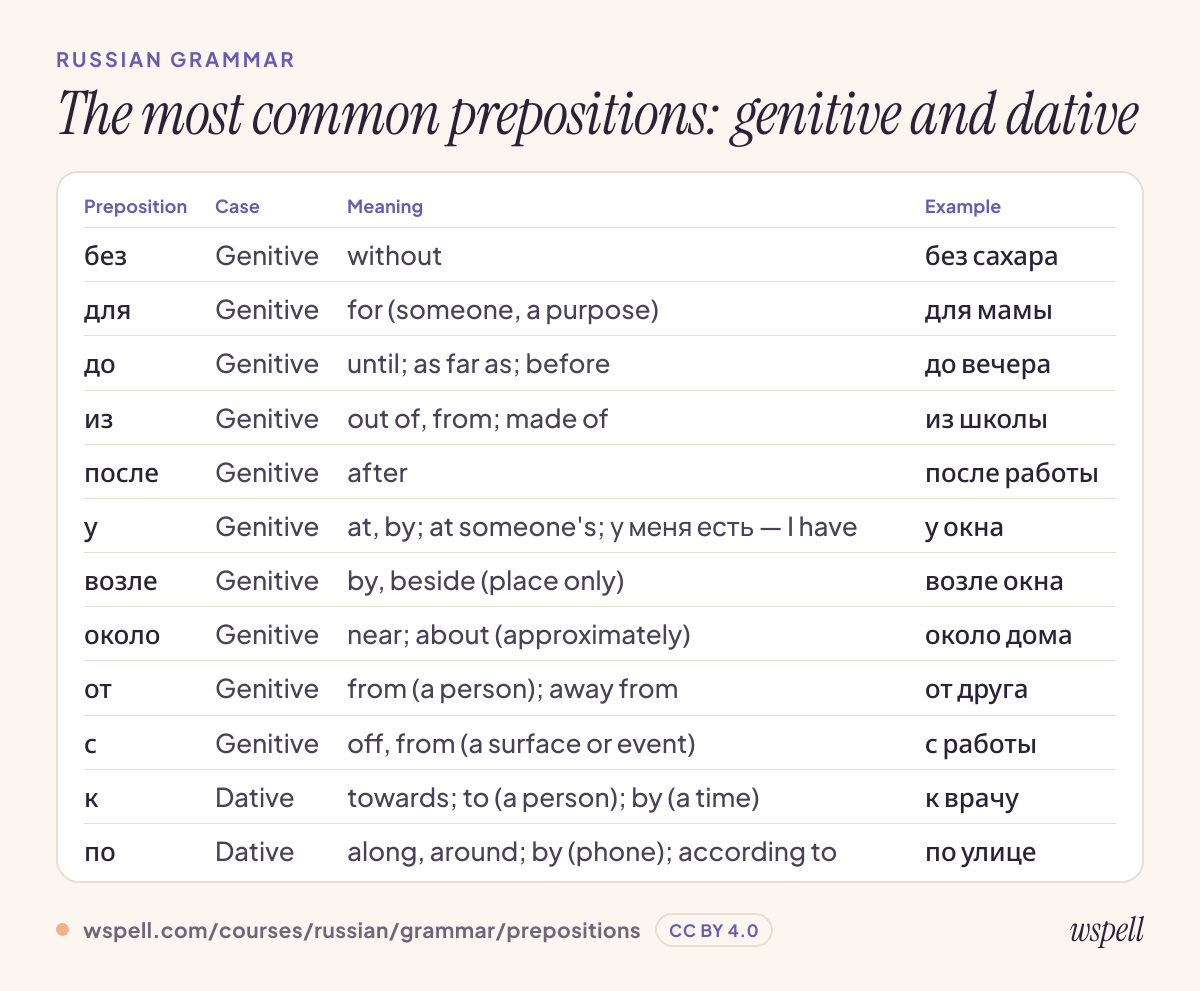
| Preposition | Case | Meaning | Example |
|---|---|---|---|
| без | Genitive | without | без сахара |
| для | Genitive | for (someone, a purpose) | для мамы |
| до | Genitive | until; as far as; before | до вечера |
| из | Genitive | out of, from; made of | из школы |
| после | Genitive | after | после работы |
| у | Genitive | at, by; at someone's; у меня есть — I have | у окна |
| возле | Genitive | by, beside (place only) | возле окна |
| около | Genitive | near; about (approximately) | около дома |
| от | Genitive | from (a person); away from | от друга |
| с | Genitive | off, from (a surface or event) | с работы |
| к | Dative | towards; to (a person); by (a time) | к врачу |
| по | Dative | along, around; by (phone); according to | по улице |
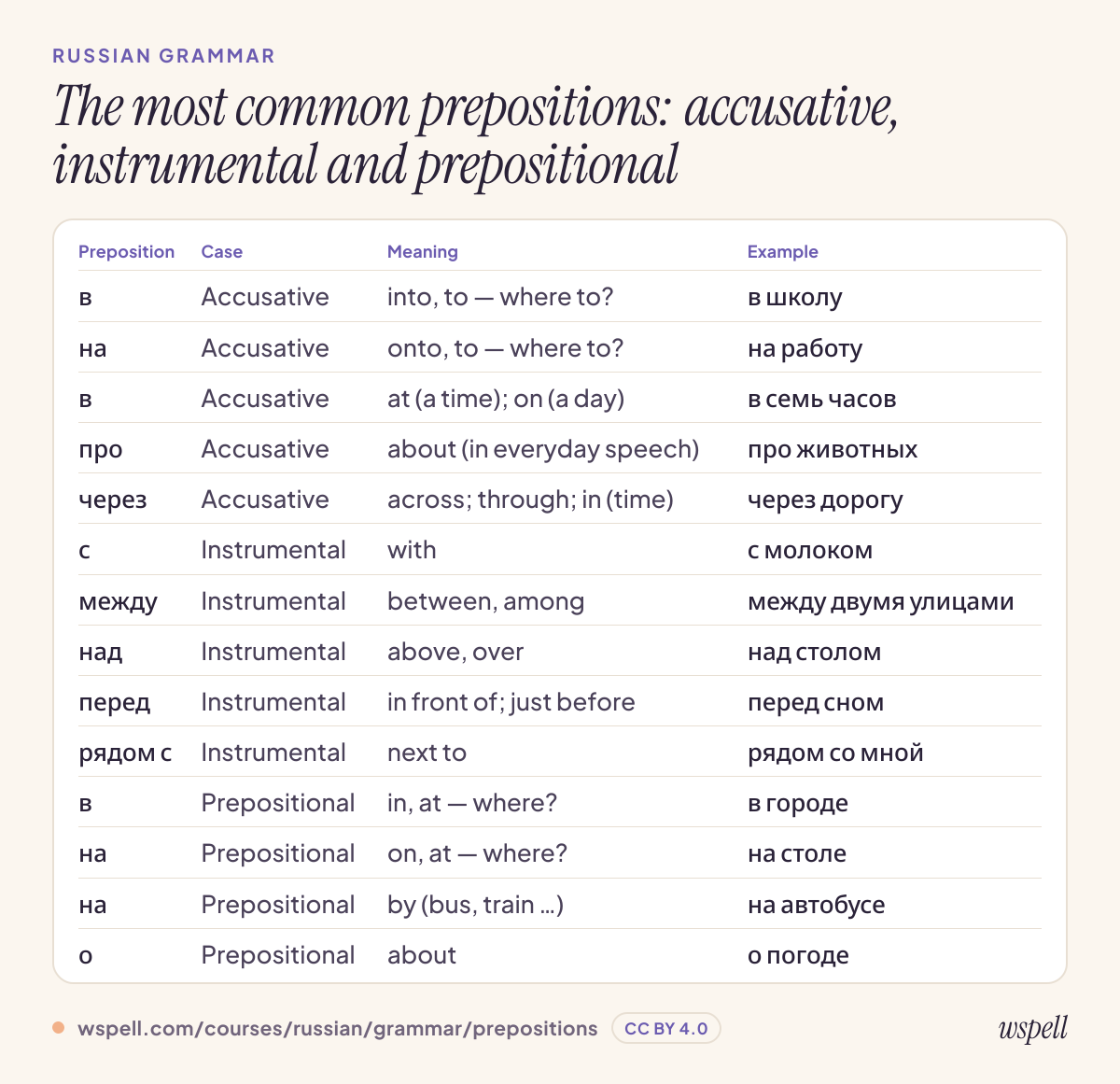
| Preposition | Case | Meaning | Example |
|---|---|---|---|
| в | Accusative | into, to — where to? | в школу |
| на | Accusative | onto, to — where to? | на работу |
| в | Accusative | at (a time); on (a day) | в семь часов |
| про | Accusative | about (in everyday speech) | про животных |
| через | Accusative | across; through; in (time) | через дорогу |
| с | Instrumental | with | с молоком |
| между | Instrumental | between, among | между двумя улицами |
| над | Instrumental | above, over | над столом |
| перед | Instrumental | in front of; just before | перед сном |
| рядом с | Instrumental | next to | рядом со мной |
| в | Prepositional | in, at — where? | в городе |
| на | Prepositional | on, at — where? | на столе |
| на | Prepositional | by (bus, train …) | на автобусе |
| о | Prepositional | about | о погоде |
в or на, из or с
в or на: в театре, на концерте
в = inside a bounded space (в театре — inside the building); на = on a surface or at an event/open area (на концерте — at the show). A fixed list takes на despite feeling enclosed: на вокзале, на почте, на заводе, на факультете. Learn these as vocabulary.
- Он в театре. — He is in the theatre (building).
- Он на концерте. — He is at the concert.
- Я купил марки на почте. — I bought stamps at the post office.
из or с: из театра, с почты
'From' is not one word: use из if the place takes в (в театр → из театра) and с if it takes на (на почту → с почты). The choice of the source preposition is locked to the destination preposition of that noun.
- Он вышел из театра. — He came out of the theatre.
- Она вернулась с почты. — She came back from the post office.
Prepositions with the genitive
| Preposition | Meaning | Example |
|---|---|---|
| без | without | без сахара |
| для | for (someone, a purpose) | для мамы |
| до | until; as far as; before | до вечера |
| из | out of, from; made of | из школы |
| после | after | после работы |
| у | at, by; at someone's; у меня есть — I have | у окна |
| возле | by, beside (place only) | возле окна |
| около | near; about (approximately) | около дома |
| от | from (a person); away from | от друга |
| с | off, from (a surface or event) | с работы |
| вдоль | along | вдоль реки |
| вместо | instead of | вместо сахара |
| внутри | inside | внутри коробки |
| во время | during | во время урока |
| вокруг | around | вокруг озера |
| из-за | from behind; because of | из-за дождя |
| кроме | except; besides | кроме Ивана |
| мимо | past, by | мимо меня |
| против | against; opposite | против течения |
| ради | for the sake of | ради детей |
| среди | among; in the middle of | среди ночи |
| в течение | during, within (a period) | в течение недели |
| вне | outside, beyond | вне закона |
| из-под | from under | из-под кровати |
| насчёт | about, regarding | насчёт работы |
| ввиду | in view of (formal) | ввиду плохой погоды |
| вследствие | as a result of (formal) | вследствие аварии |
Prepositions with the dative
| Preposition | Meaning | Example |
|---|---|---|
| к | towards; to (a person); by (a time) | к врачу |
| по | along, around; by (phone); according to | по улице |
| благодаря | thanks to | благодаря тебе |
| вопреки | contrary to, despite | вопреки всему |
| навстречу | towards (to meet) | мне навстречу |
| по | (one) each | по яблоку |
| согласно | according to (formal) | согласно закону |
Prepositions with the accusative
| Preposition | Meaning | Example |
|---|---|---|
| в | into, to — where to? | в школу |
| на | onto, to — where to? | на работу |
| в | at (a time); on (a day) | в семь часов |
| про | about (in everyday speech) | про животных |
| через | across; through; in (time) | через дорогу |
| за | (to) behind; for, in return for | за помощь |
| на | by (how much) | на пять градусов |
| на | for (a planned period) | на неделю |
| под | (to) under | под стол |
| сквозь | through (something dense) | сквозь толпу |
| несмотря на | despite | несмотря на дождь |
| по | (a number) each | по сто рублей |
| по | up to and including | по пятницу |
| спустя | after, later | спустя год |
Prepositions with the instrumental
| Preposition | Meaning | Example |
|---|---|---|
| с | with | с молоком |
| между | between, among | между двумя улицами |
| над | above, over | над столом |
| перед | in front of; just before | перед сном |
| рядом с | next to | рядом со мной |
| за | (go) for, to fetch | за хлебом |
| за | behind; following | за домом |
| под | under | под столом |
Prepositions with the prepositional
| Preposition | Meaning | Example |
|---|---|---|
| в | in, at — where? | в городе |
| на | on, at — where? | на столе |
| на | by (bus, train …) | на автобусе |
| о | about | о погоде |
| в | in (a month, a year) | в мае |
| при | attached to; in the presence of; in the time of | при детях |
с, за, под: one preposition, two cases
с + genitive or с + instrumental
The one word с governs two cases with opposite meanings: с + genitive = off/from (с крыши, с работы), с + instrumental = together with (с братом). Only the case tells them apart, so decline the noun deliberately.
- Снег падает с крыши. — Snow is falling off the roof.
- Я иду с братом. — I am going with my brother.
за + accusative or за + instrumental
за + accusative = motion to behind, 'for/in exchange', or grabbing (сесть за стол, спасибо за помощь, взять за руку); за + instrumental = static location behind or 'after/following' (стоять за домом, идти за мной). Direction vs position picks the case.
- Спасибо за помощь. — Thanks for the help.
- Машина стоит за домом. — The car is behind the house.
под + accusative or под + instrumental
под + accusative = motion to under (кот залез под стол); под + instrumental = static location under (кот спит под столом). Mirrors the за direction/position split.
- Кот залез под стол. — The cat climbed under the table.
- Кот спит под столом. — The cat is sleeping under the table.
во, со, ко, обо: an extra -о
Consonant-final prepositions add -о before an awkward cluster or the same consonant, for pronounceability: во Франции, со мной, ко мне, изо рта, надо мной, передо мной. о becomes об before a vowel sound and обо in fixed groups (обо всём). The case is unchanged — only the form vocalizes.
- Он живёт во Франции. — He lives in France.
- Иди со мной. — Come with me.
learn it step by step
save or print this chart
Under the main tables on this page sits a picture of each — keep one on your phone, share it or print it.
Free to share and adapt under CC BY 4.0 — credit wspell and link to this page. the licence
credit line to copy: Russian prepositions and the cases they take — wspell, CC BY 4.0, https://wspell.com/courses/russian/grammar/prepositions
questions
Which case follows a preposition in Russian?
It depends on the preposition: most take the genitive (без, для, до, из, от, у, после), к and по the dative, через and про the accusative, над, перед, между and с ('with') the instrumental, and о and при the prepositional.
Which Russian prepositions take more than one case?
в and на: the prepositional for where something is (в школе), the accusative for where it is going (в школу). с: the genitive for 'off, from' (с работы), the instrumental for 'with' (с братом). за and под: the accusative for movement (под стол), the instrumental for position (под столом). по: the dative (по улице), and the accusative for 'up to and including' (по пятницу).
Why is it на почте but в театре?
в is for being inside an enclosed space, на for surfaces, events and open areas — and a fixed list of places takes на anyway: на вокзале, на почте, на заводе. Learn those with the noun.