grammar chart · Russian
The Russian past tense
The Russian past tense has no person endings: drop -ть and add -л, -ла, -ло or -ли to agree with the subject's gender and number — я читал (said by a man), я читала (said by a woman), мы читали. A few verbs have no -л in the masculine (мог, нёс), and идти has a past of its own: шёл, шла.
-л, -ла, -ло, -ли
я and ты take the gender of the person meant: я читал (a man), я читала (a woman); мы, вы and они always take -ли — even a polite вы said to one person: вы читали.
| Gender, number | Ending | чита́ть | говори́ть | жить | быть |
|---|---|---|---|---|---|
| он Masculine | -л | читал | говорил | жил | был |
| она Feminine | -ла | читала | говорила | жила | была |
| оно Neuter | -ло | читало | говорило | жило | было |
| они Plural | -ли | читали | говорили | жили | были |
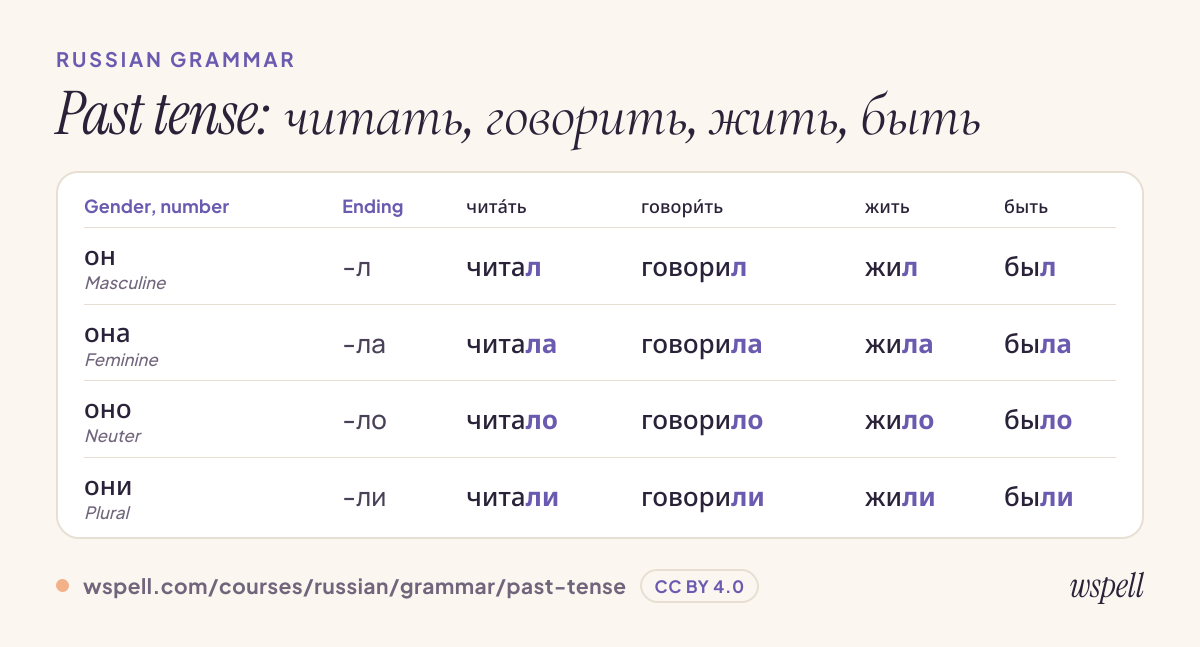
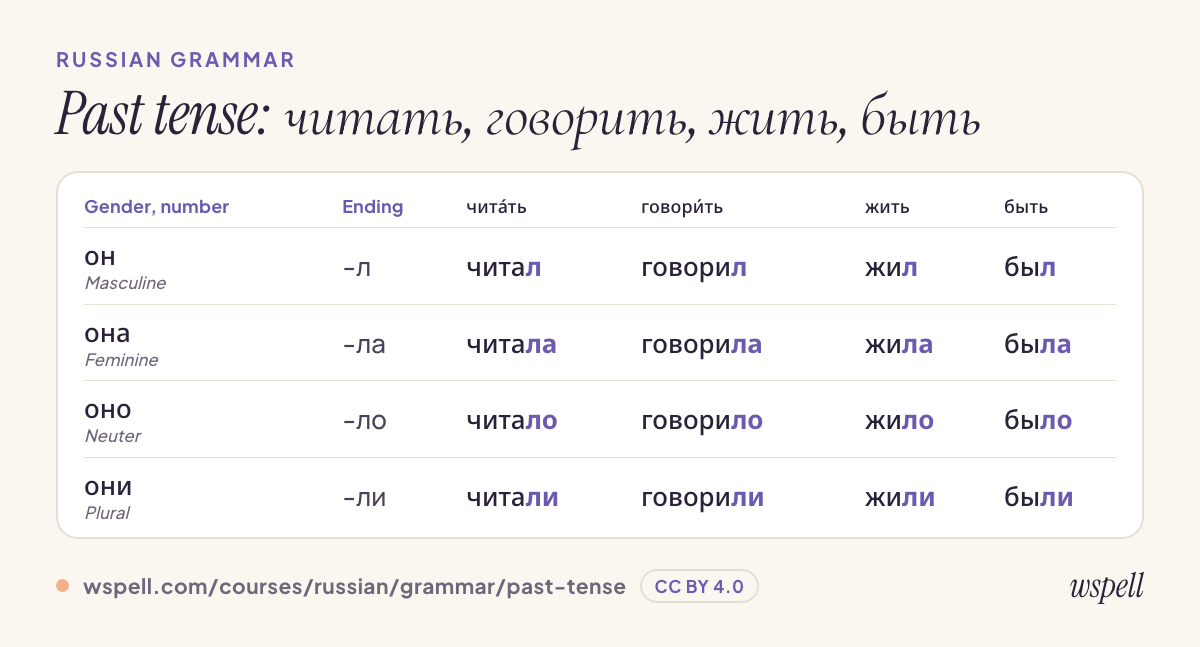
Past endings -л, -ла, -ло, -ли
The past drops -ть and adds -л (masc), -ла (fem), -ло (neut), -ли (plural) — agreeing with the SUBJECT's gender/number, not the person. It carries no person ending, so a pronoun or context is needed: я читал / я читала.
- Она читала письмо. — She was reading the letter.
- Мы уже поужинали. — We have already had dinner.
Pasts off the pattern: мог, нёс and шёл
| Gender, number | идти́ | мочь | нести́ |
|---|---|---|---|
| он Masculine | шёл | мог | нёс |
| она Feminine | шла | могла | несла |
| оно Neuter | шло | могло | несло |
| они Plural | шли | могли | несли |
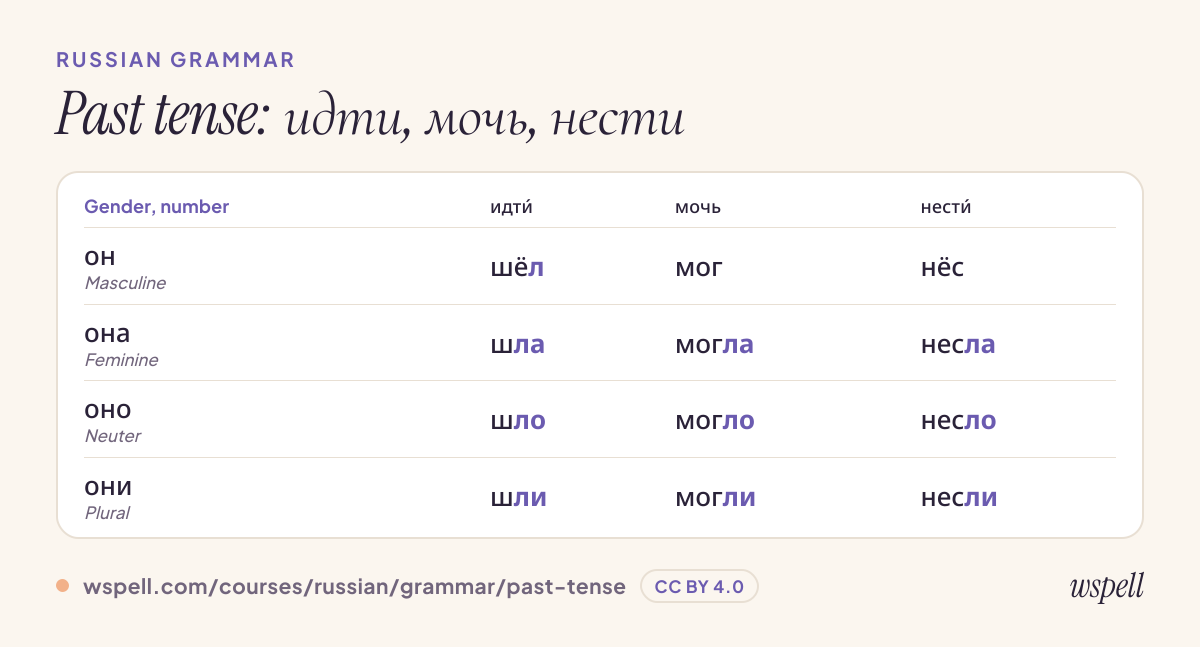
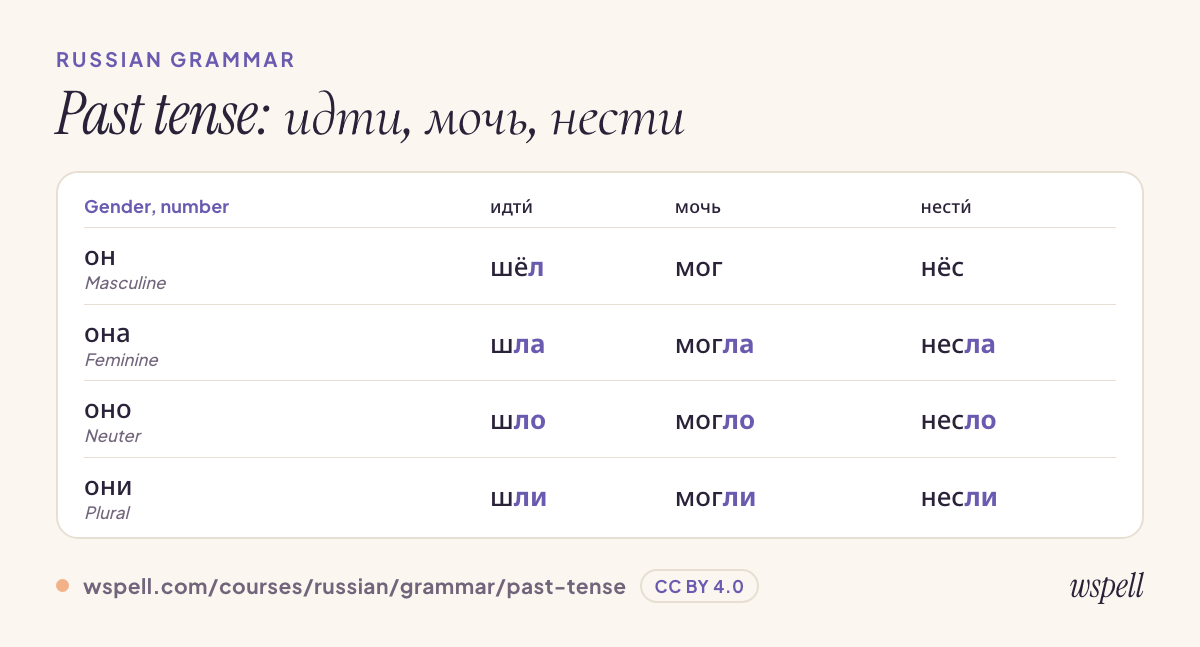
No -л in the masculine: нёс, мог
Verbs whose stem ends in a consonant drop -л in the masculine but keep it elsewhere: -сти and -зти verbs whose stem ends in с or з (нести → нёс, несла; везти → вёз, везла), -чь verbs (мочь → мог, могла), -ереть verbs (умереть → умер, умерла) and some -нуть verbs. But вести → вёл, вела keeps it.
- Он нёс тяжёлую сумку. — He was carrying a heavy bag.
- Она не могла прийти. — She could not come.
идти: шёл, шла, шло, шли
идти (to go on foot) has a regular present (иду, идёшь… идут) but a suppletive past on the stem ш-: шёл, шла, шло, шли. All its prefixed perfectives inherit it: прийти → пришёл/пришла, уйти → ушёл/ушла.
- Он шёл по улице. — He was walking down the street.
- Куда ты идёшь? — Where are you going?
Imperfective or perfective past?
Process or result in the past
Imperfective past = an action seen as process, repetition, or background (я делал уроки — I was doing homework). Perfective past = a completed act with a result or a single whole (я сделал уроки — I finished the homework). Same time frame, opposite viewpoint.
- Вчера я весь день готовил ужин. — Yesterday I was cooking dinner all day.
- Я приготовил ужин к семи. — I had dinner ready by seven.
learn it step by step
save or print this chart
Under the main tables on this page sits a picture of each — keep one on your phone, share it or print it.
Free to share and adapt under CC BY 4.0 — credit wspell and link to this page. the licence
credit line to copy: The Russian past tense — wspell, CC BY 4.0, https://wspell.com/courses/russian/grammar/past-tense
questions
How do you form the past tense in Russian?
Take the infinitive, drop -ть and add -л (masculine), -ла (feminine), -ло (neuter) or -ли (plural): читать → читал, читала, читало, читали.
Does the Russian past tense change for я and ты?
Not for the person, only for gender and number: a man says я читал, a woman я читала; мы, вы and они all take читали.
What is the past tense of идти?
шёл, шла, шло, шли — a different stem from the present иду. Its prefixed verbs follow it: пришёл, ушла.