grammar chart · Russian
Russian adjective endings in every case
A Russian adjective agrees with its noun in gender, number and case, and in the plural it has one form for all three genders. The tables decline three model adjectives: новый (a hard stem), синий (a soft stem) and хороший, whose ending vowel follows the spelling rules after ж, ш, ч and щ.
Agreement: one adjective, four forms
The nominative of five common adjectives: masculine, neuter, feminine and plural.
An adjective copies its noun's gender, number and case
A Russian adjective must match its noun in gender and number (singular) and in case, taking a full set of endings: новый дом, новая книга, новое окно, новые дома, о новом доме. The adjective's features are copied from the noun.
- новый дом / новая машина / новое окно — a new house / a new car / a new window
- Я живу в новом доме. — I live in a new house.
| Masculine | Neuter | Feminine | Plural |
|---|---|---|---|
| новый | новое | новая | новые |
| синий | синее | синяя | синие |
| хороший | хорошее | хорошая | хорошие |
| большой | большое | большая | большие |
| русский | русское | русская | русские |
Hard stems: новый
In the accusative, the masculine and the plural follow animacy: новый стол but нового студента, новые столы but новых студентов.
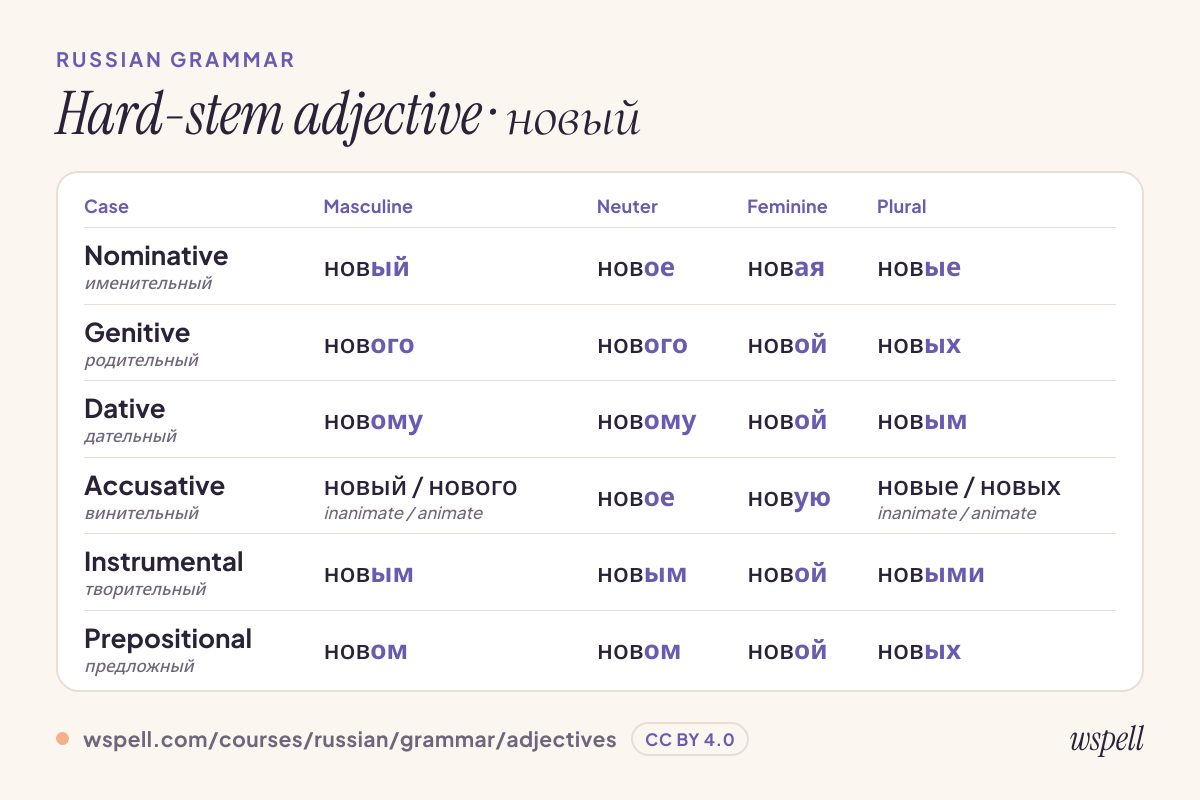
Hard-stem adjectives: новый
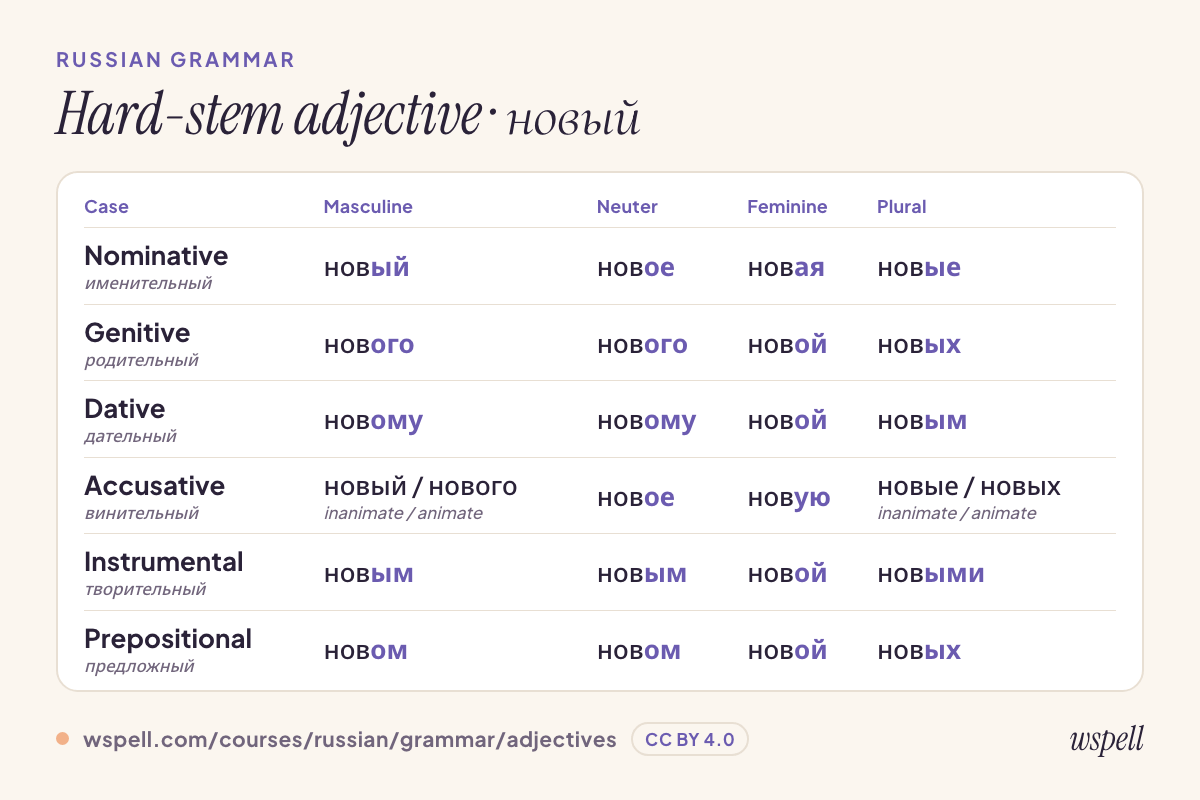
Hard-stem adjectives (новый, красивый) agree with the noun in gender, number and case. Note the genitive masculine/neuter -ого (also the animate masculine accusative), pronounced -ово (г = в). Feminine collapses many slots into -ой (gen/dat/ins/prep all -ой).
- новый дом, в новом доме, новых домов — a new house, in the new house, of new houses
- Я купил новую машину. — I bought a new car.
| Case | Masculine | Neuter | Feminine | Plural |
|---|---|---|---|---|
| Nominative именительный | новый | новое | новая | новые |
| Genitive родительный | нового | нового | новой | новых |
| Dative дательный | новому | новому | новой | новым |
| Accusative винительный | новый / нового inanimate / animate | новое | новую | новые / новых inanimate / animate |
| Instrumental творительный | новым | новым | новой | новыми |
| Prepositional предложный | новом | новом | новой | новых |
Soft stems: синий
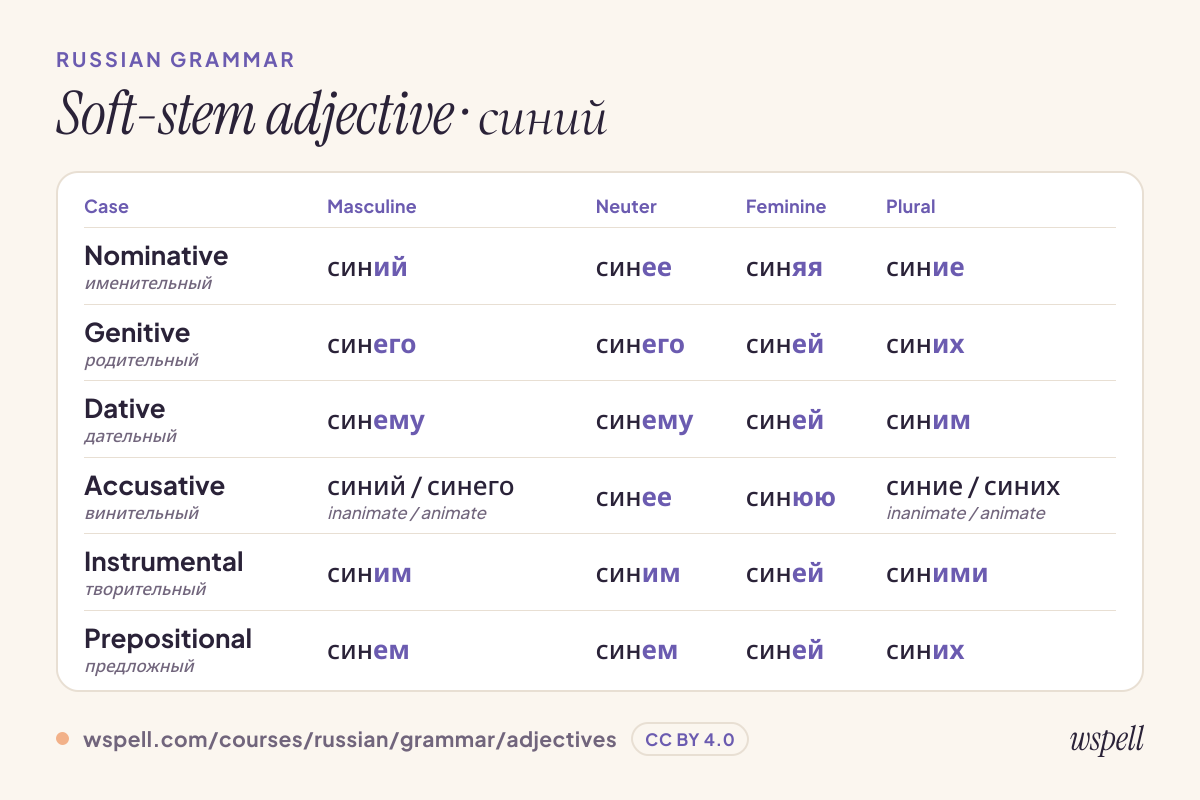
Soft-stem adjectives: синий
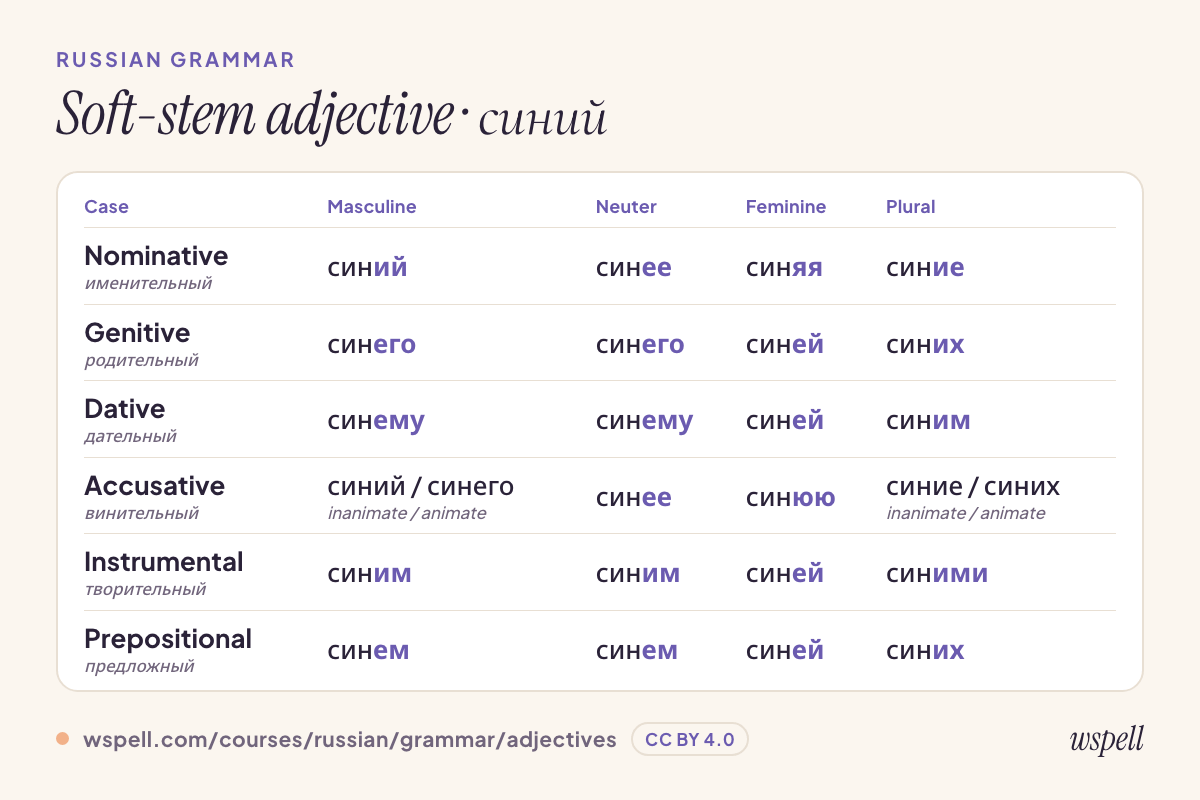
Soft-stem adjectives ending in -ний (синий, последний, домашний) take soft-vowel endings throughout: masc -ий/-его/-ему/-им/-ем, fem -яя/-ей/-юю, neut -ее, plural -ие/-их/-им/-ими.
- синий шарф, синяя рубашка, синее небо — a blue scarf / shirt / sky
- Мы говорили о последнем экзамене. — We talked about the last exam.
| Case | Masculine | Neuter | Feminine | Plural |
|---|---|---|---|---|
| Nominative именительный | синий | синее | синяя | синие |
| Genitive родительный | синего | синего | синей | синих |
| Dative дательный | синему | синему | синей | синим |
| Accusative винительный | синий / синего inanimate / animate | синее | синюю | синие / синих inanimate / animate |
| Instrumental творительный | синим | синим | синей | синими |
| Prepositional предложный | синем | синем | синей | синих |
After к, г, х and ж, ш, ч, щ: хороший, русский, большой
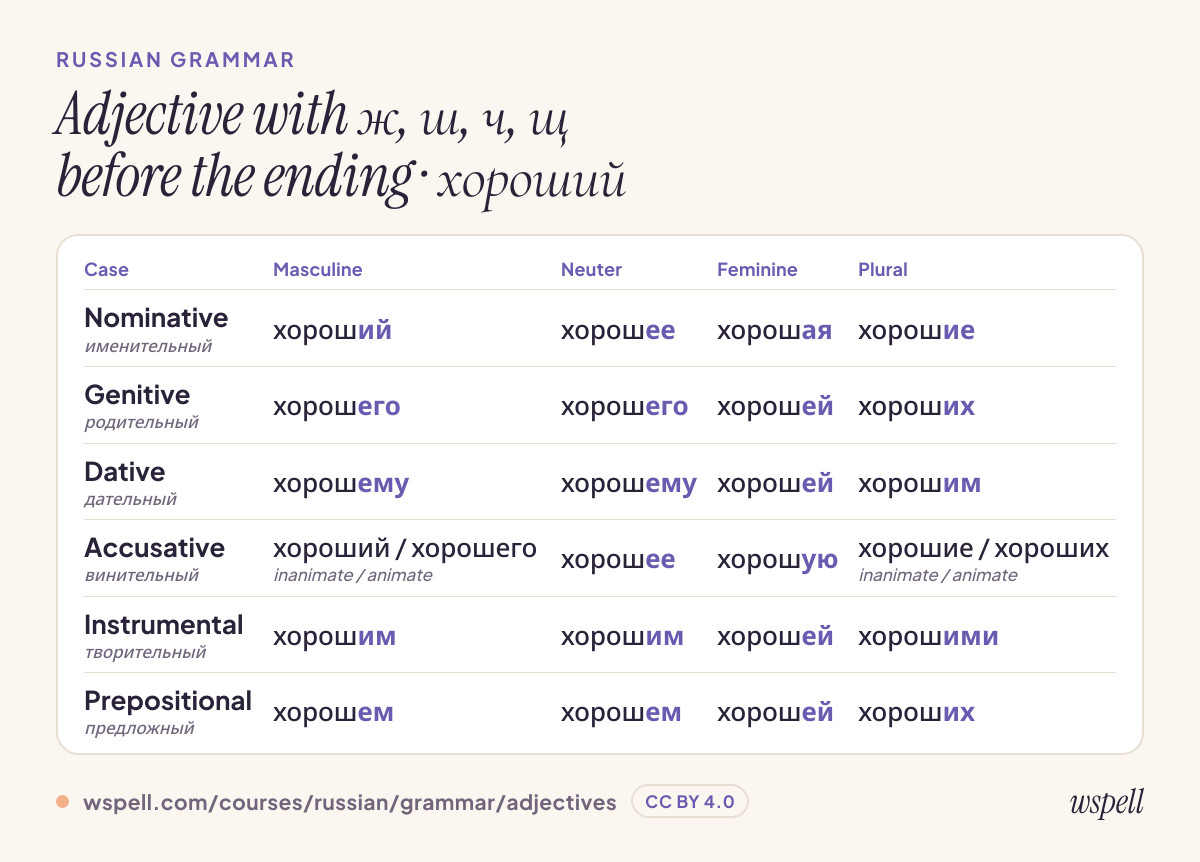
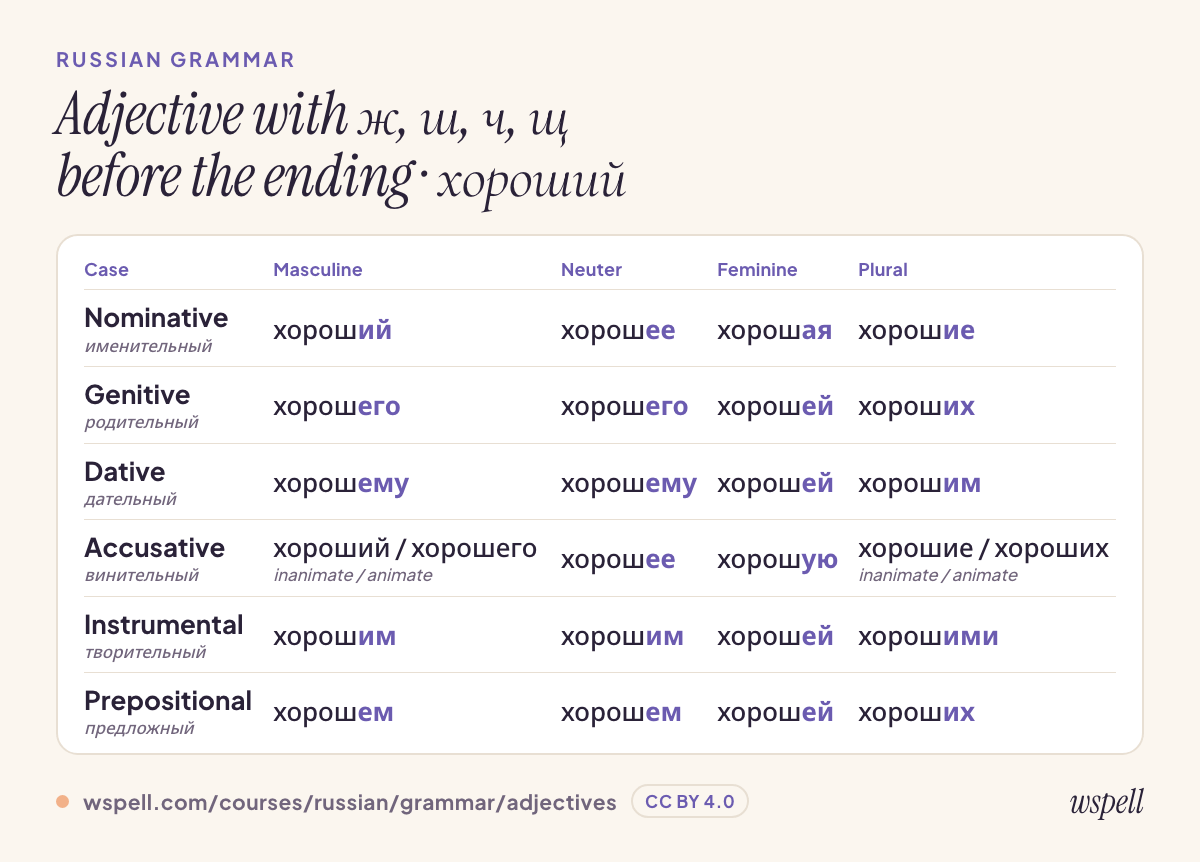
Spelling after к, г, х and ж, ш, ч, щ
After к, г, х and the sibilants ж, ш, щ, ч the ending vowel obeys the spelling rules: write -ий not -ый (русский, тихий), and о is written only under stress after a sibilant (большо́е but хоро́шее). So русская, русские; хороший, хорошая, хорошее.
- Он хороший человек. — He is a good person.
- Это русские книги. — These are Russian books.
| Case | Masculine | Neuter | Feminine | Plural |
|---|---|---|---|---|
| Nominative именительный | хороший | хорошее | хорошая | хорошие |
| Genitive родительный | хорошего | хорошего | хорошей | хороших |
| Dative дательный | хорошему | хорошему | хорошей | хорошим |
| Accusative винительный | хороший / хорошего inanimate / animate | хорошее | хорошую | хорошие / хороших inanimate / animate |
| Instrumental творительный | хорошим | хорошим | хорошей | хорошими |
| Prepositional предложный | хорошем | хорошем | хорошей | хороших |
-ой under stress: большой, молодой
When the adjective's ending is stressed, the masculine nominative is -ой, not -ый: большой, молодой, плохой, другой. The feminine, neuter, and plural endings are unaffected (большая, большое, большие).
- Это большой стол. — This is a big table.
- Он ещё молодой. — He is still young.
Short forms: красив, красива
Short forms: красив, красива, красиво, красивы
Qualitative adjectives have a short predicative form marking only gender and number: красив, красива, красиво, красивы. It is used only as a predicate (Она красива), never before a noun, and often inserts a fleeting vowel in the masculine (умный → умён, интересный → интересен).
- Эта задача трудна. — This problem is difficult.
- Он умён и талантлив. — He is clever and talented.
Comparatives and superlatives
The comparative in -ее: быстрее, интереснее
The one-word comparative adds -ее (or colloquial -ей) to the stem: быстрый → быстрее, красивый → красивее, интересный → интереснее. Stems in a velar or dental often take -е with a consonant mutation: громкий → громче, дорогой → дороже. This form is invariable and predicative.
- Сегодня теплее, чем вчера. — It is warmer today than yesterday.
- Метро быстрее автобуса. — The metro is faster than the bus.
лучше, хуже, больше, меньше
A few high-frequency adjectives have suppletive comparatives: хороший → лучше, плохой → хуже, большой → больше, маленький → меньше. These must be memorised; they are among the most-used words in the language.
- Так будет лучше. — It will be better this way.
- Мне нужно меньше сахара. — I need less sugar.
The superlative with самый
The everyday superlative is самый + the full agreeing adjective, and самый itself agrees in gender, number, and case: самый большой дом, самая красивая девушка, в самом центре. This is the default, productive way to say 'the most…'.
- Это самый высокий дом в городе. — This is the tallest building in the city.
- Она моя самая близкая подруга. — She is my closest friend.
learn it step by step
save or print this chart
Under the main tables on this page sits a picture of each — keep one on your phone, share it or print it.
Free to share and adapt under CC BY 4.0 — credit wspell and link to this page. the licence
credit line to copy: Russian adjective endings in every case — wspell, CC BY 4.0, https://wspell.com/courses/russian/grammar/adjectives
questions
How many endings does a Russian adjective have?
In the nominative four: masculine -ый/-ий/-ой, neuter -ое/-ее, feminine -ая/-яя and plural -ые/-ие (новый, новое, новая, новые). Across the six cases a hard-stem adjective like новый has twelve different endings.
When is it -ый and when -ой?
-ой when the ending is stressed (большо́й, молодо́й), -ый when it is not (но́вый, краси́вый). After к, г, х and ж, ш, ч, щ an unstressed ending is -ий: русский, хороший.
Do Russian adjectives have a gender in the plural?
No. In the plural an adjective agrees in number and case only, so one form serves all three genders: новые столы, новые книги, новые окна.