grammar chart · Russian
The Russian future tense
Russian forms the future in two ways, and the verb's aspect decides which. An imperfective verb takes the future of быть plus its infinitive: я буду читать (I will be reading, I will read regularly). A perfective verb uses its own present-tense endings with a future meaning: я прочитаю (I will read it through).
буду + infinitive: the imperfective future
| Person | чита́ть | говори́ть |
|---|---|---|
| я | буду читать | буду говорить |
| ты | будешь читать | будешь говорить |
| он, она, оно | будет читать | будет говорить |
| мы | будем читать | будем говорить |
| вы | будете читать | будете говорить |
| они | будут читать | будут говорить |
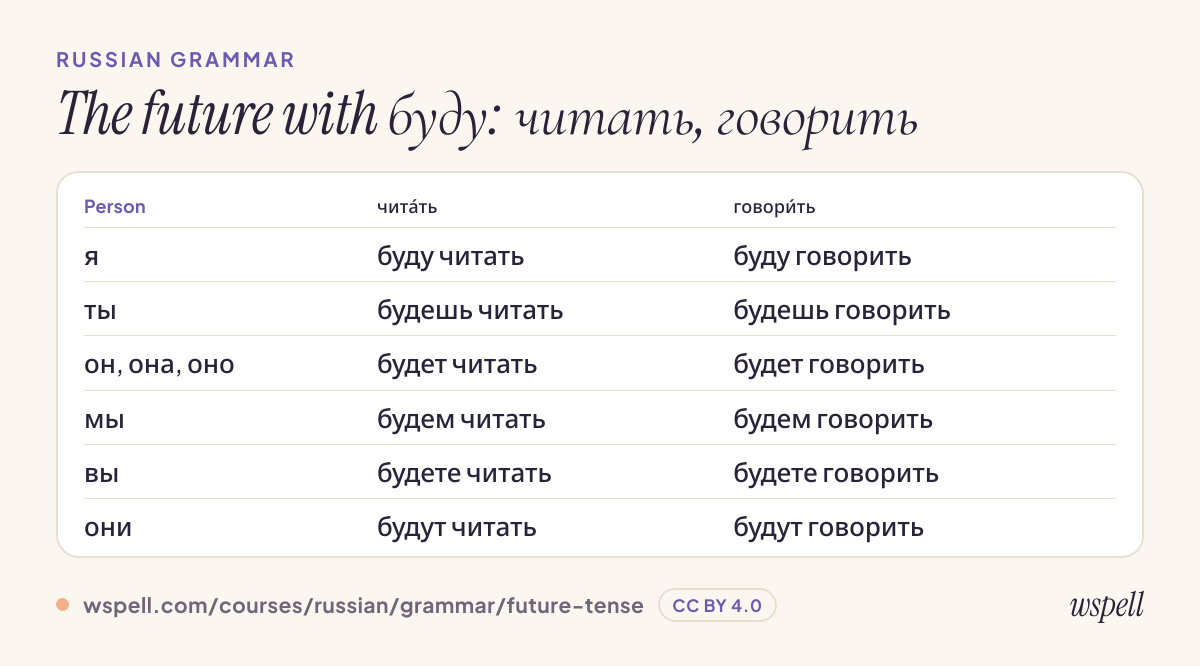
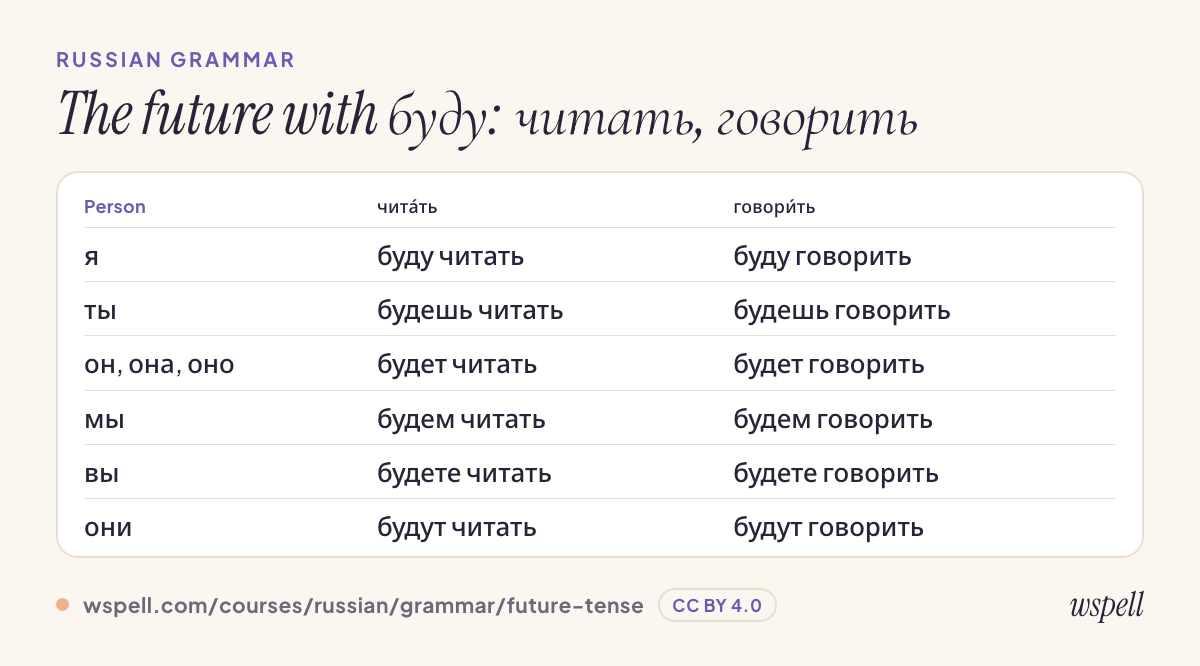
буду + infinitive
The imperfective future is analytic: conjugated буду, будешь, будет, будем, будете, будут + the imperfective infinitive. It expresses a future process or repeated/ongoing action: я буду читать (I will read/be reading).
- Завтра я буду работать дома. — Tomorrow I will be working at home.
- Мы будем изучать русский язык. — We will study Russian.
The perfective future: прочитаю, скажу, куплю
| Person | прочита́ть | сказа́ть | купи́ть |
|---|---|---|---|
| я | прочитаю | скажу | куплю |
| ты | прочитаешь | скажешь | купишь |
| он, она, оно | прочитает | скажет | купит |
| мы | прочитаем | скажем | купим |
| вы | прочитаете | скажете | купите |
| они | прочитают | скажут | купят |
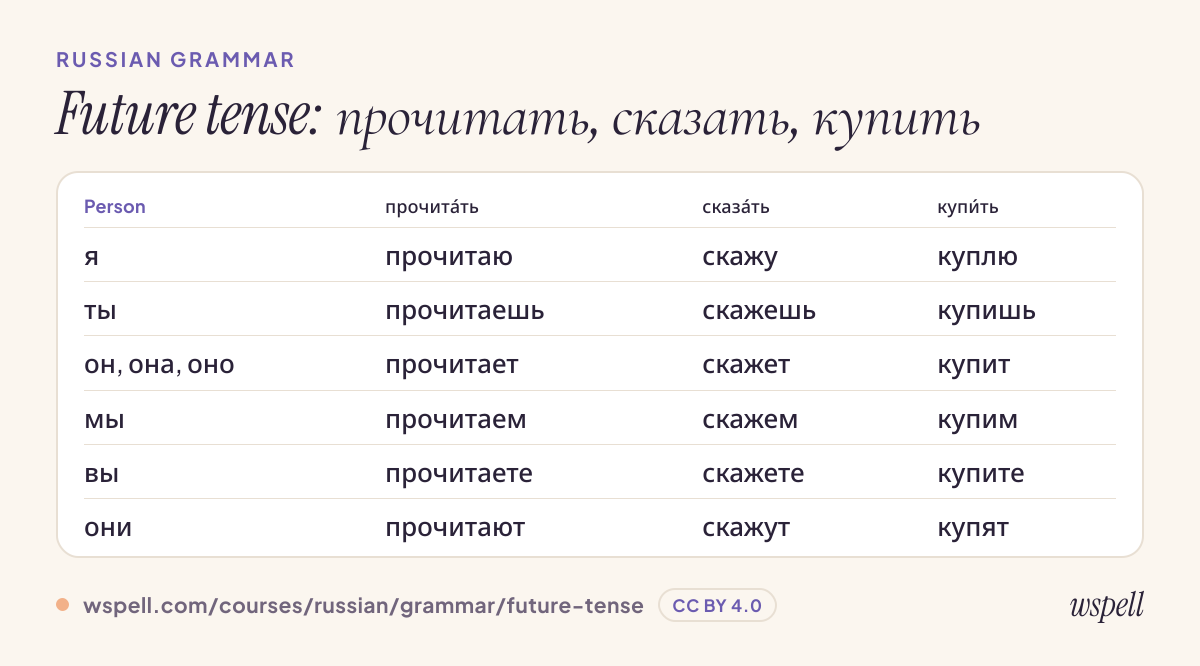
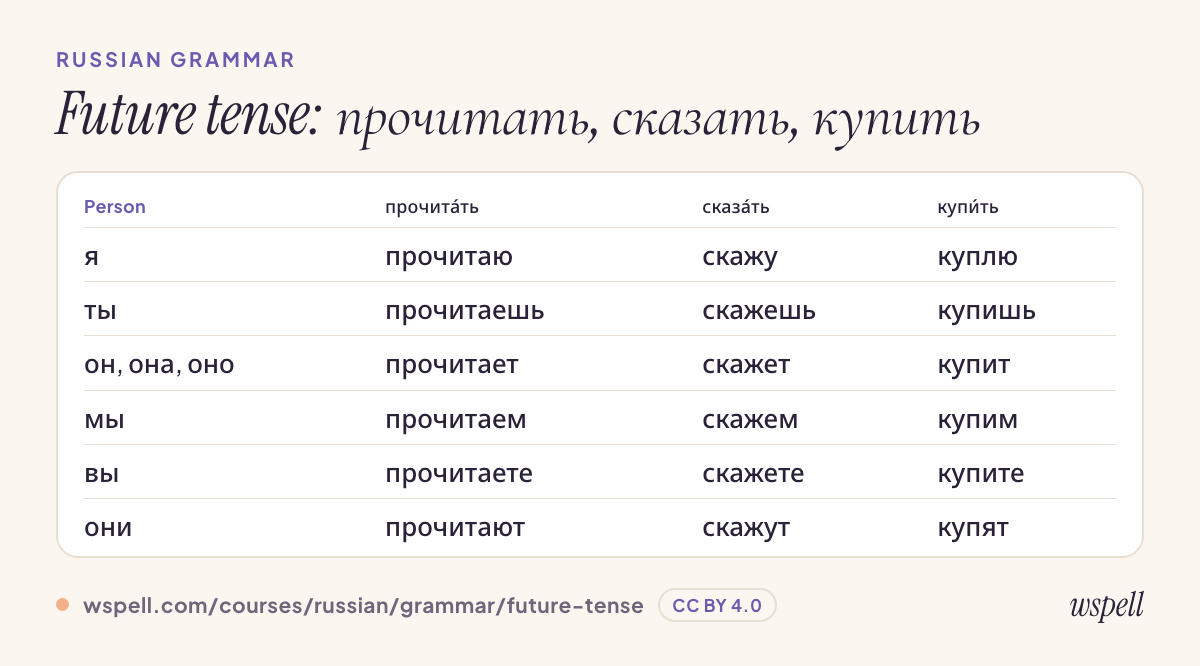
The perfective future: прочитаю, напишу
A perfective verb has NO present tense; its present-tense endings carry FUTURE meaning: я прочитаю (I will read/finish reading), я напишу (I will write). So the same conjugated form is present for an imperfective and future for a perfective.
- Я напишу тебе завтра. — I will write to you tomorrow.
- Она всё поймёт. — She will understand everything.
Which future?
буду решать or решу?
Imperfective future (буду + inf) for process/repetition/general intention; perfective simple future for a single completed result. Contrast: я буду решать задачу (I'll work on it) vs я решу задачу (I'll solve it).
- Я буду звонить каждый день. — I will call every day.
- Я позвоню тебе вечером. — I will call you (once) in the evening.
быть: nothing in the present, был and буду
быть: nothing, был, буду
The present tense of быть (to be) is normally zero: Я студент (I am a student). The old form есть survives for emphatic existence/possession (у меня есть…). Past = был/была/было/были; future = буду/будешь… and also serves as the imperfective future auxiliary.
- Вчера я был дома. — Yesterday I was at home.
- У меня есть вопрос. — I have a question.
learn it step by step
save or print this chart
Under the main tables on this page sits a picture of each — keep one on your phone, share it or print it.
Free to share and adapt under CC BY 4.0 — credit wspell and link to this page. the licence
credit line to copy: The Russian future tense — wspell, CC BY 4.0, https://wspell.com/courses/russian/grammar/future-tense
questions
How do you form the future tense in Russian?
With an imperfective verb, use буду, будешь, будет, будем, будете, будут + the infinitive: я буду работать. A perfective verb needs no helper — its conjugated form is already future: я сделаю.
Can you say 'буду прочитать'?
No. буду goes only with an imperfective infinitive (буду читать); a perfective verb forms its future on its own (прочитаю).
Why does прочитаю mean 'I will read'?
Perfective verbs have no present tense, so their present-tense endings carry the future: я прочитаю, ты прочитаешь, они прочитают.