grammar chart · Russian
Russian cases: all six cases in one chart
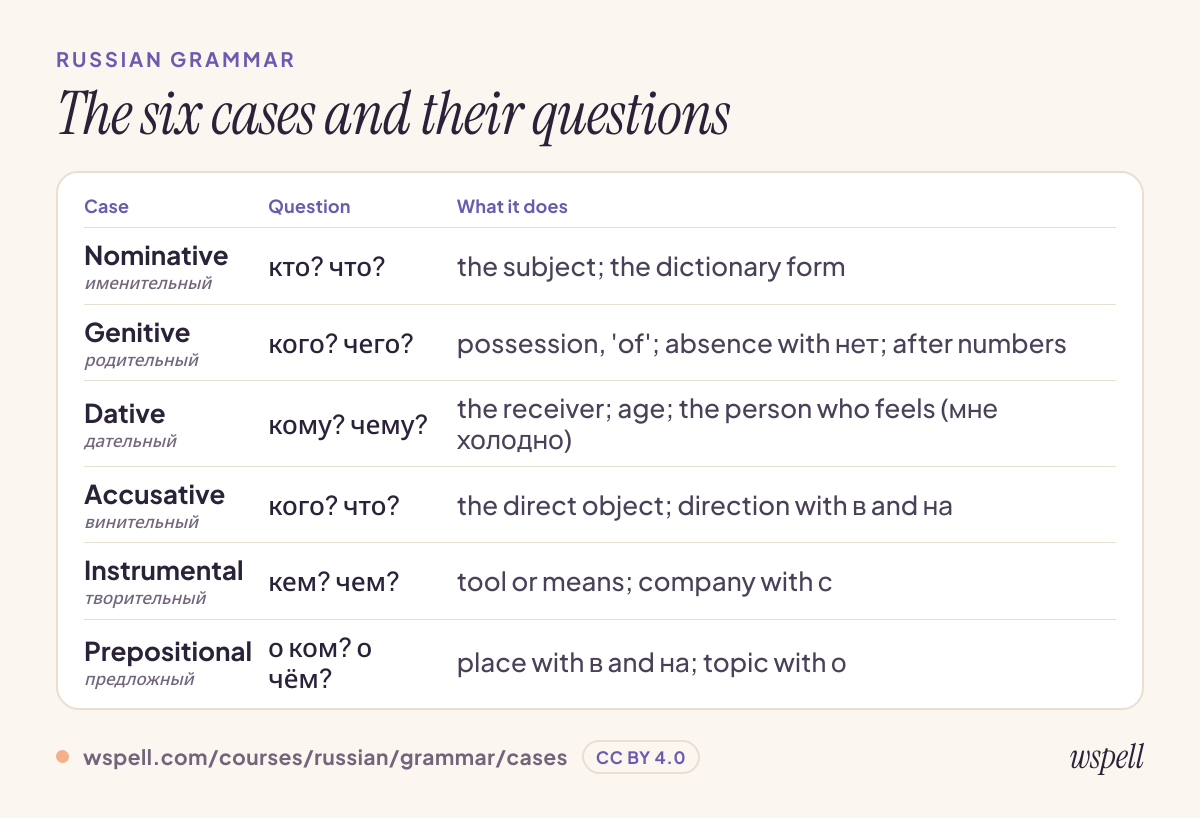
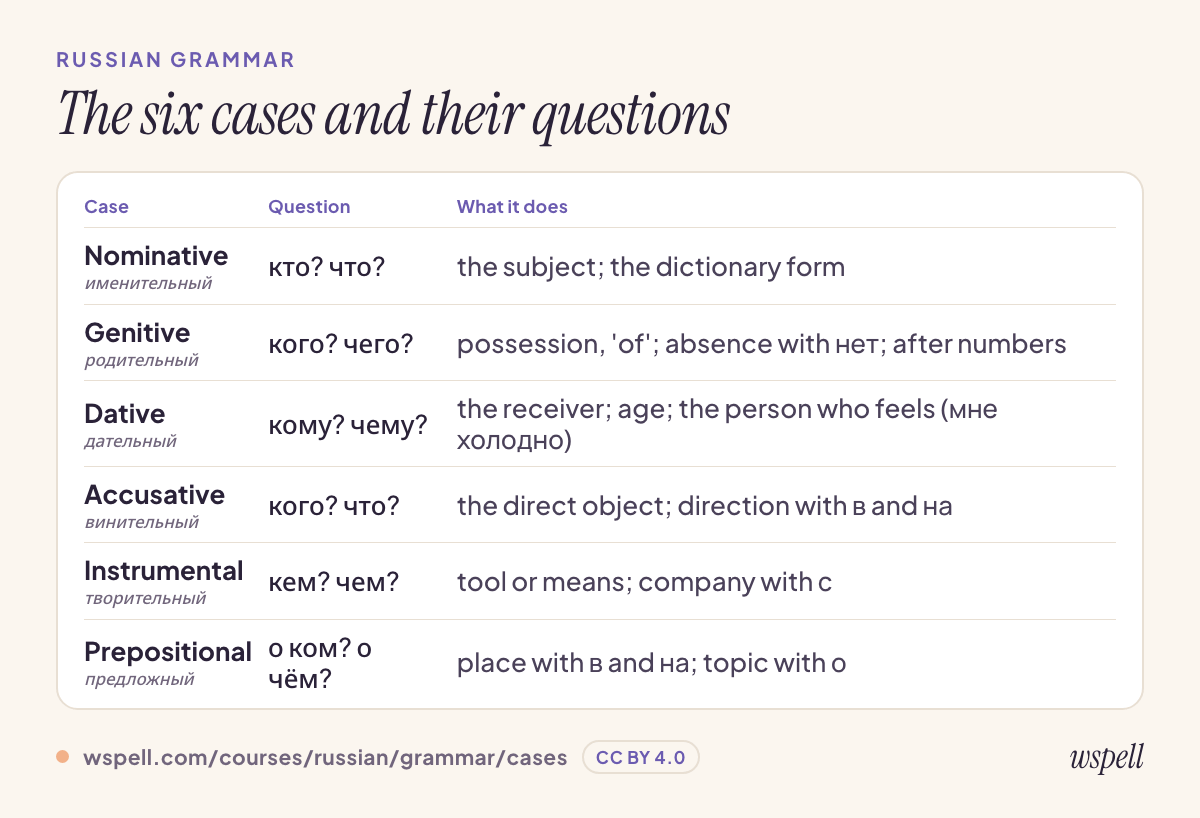
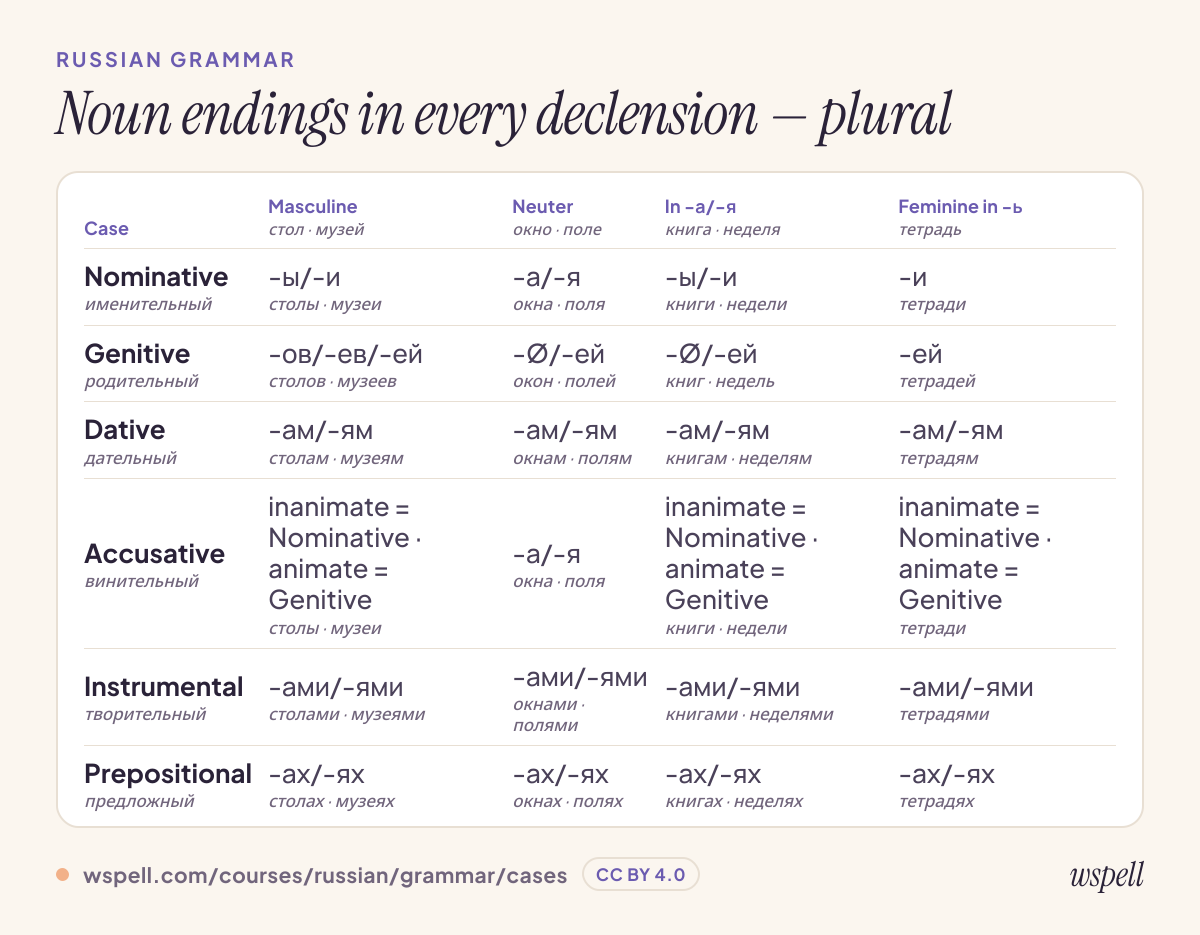
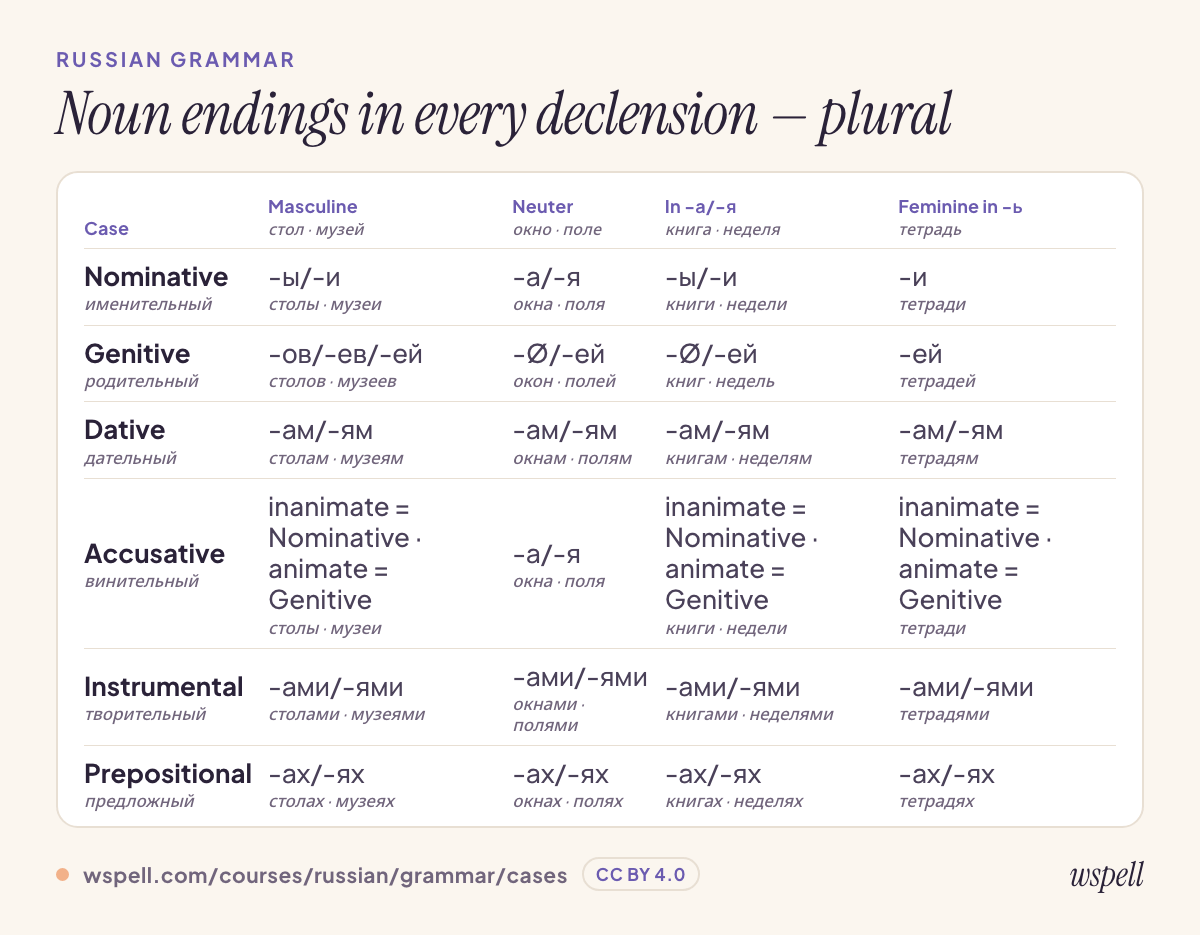
Russian has six cases, and a noun's ending changes from case to case. The first table gives every case its question and its job; the two below list the endings of masculine, neuter and feminine nouns in the singular and the plural, each with its example words. Further down, each case is explained with examples.
The six cases and their questions
| Case | Question | What it does |
|---|---|---|
| Nominative именительный | кто? что? | the subject; the dictionary form |
| Genitive родительный | кого? чего? | possession, 'of'; absence with нет; after numbers |
| Dative дательный | кому? чему? | the receiver; age; the person who feels (мне холодно) |
| Accusative винительный | кого? что? | the direct object; direction with в and на |
| Instrumental творительный | кем? чем? | tool or means; company with с |
| Prepositional предложный | о ком? о чём? | place with в and на; topic with о |
Singular endings
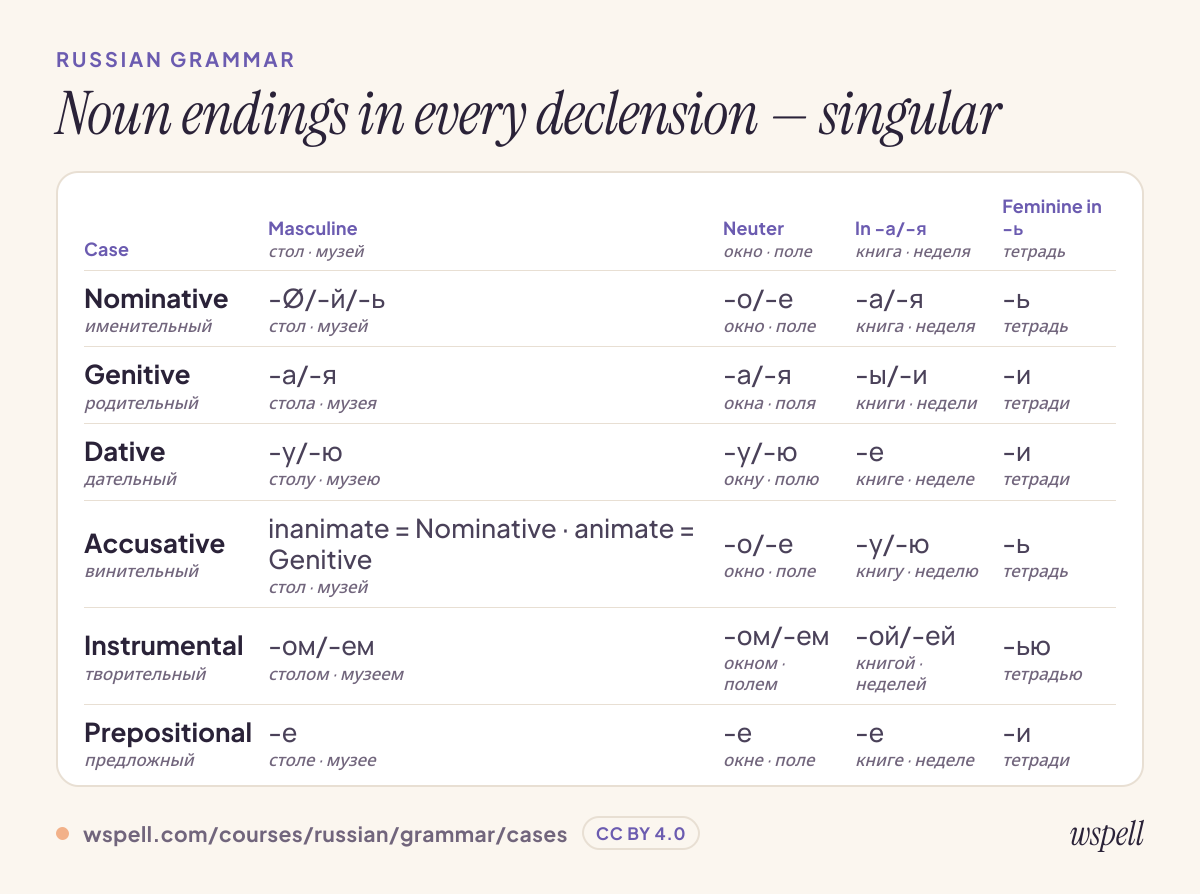
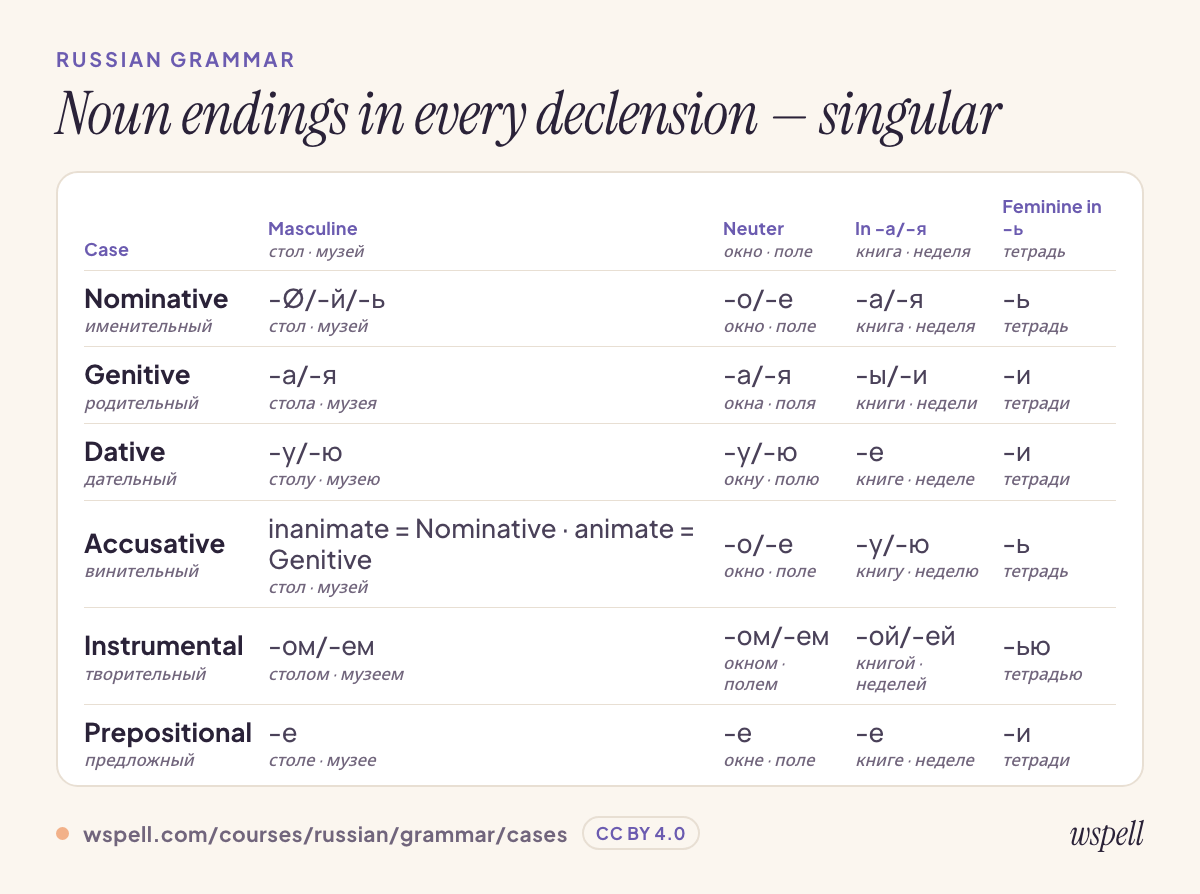
Each column is one noun type — masculine (стол, музей), neuter (окно, поле), nouns in -а/-я (книга, неделя) and feminine nouns in -ь (тетрадь). Ø means no ending.
| Case | Masculine стол · музей | Neuter окно · поле | In -а/-я книга · неделя | Feminine in -ь тетрадь |
|---|---|---|---|---|
| Nominative именительный | -Ø/-й/-ь стол · музей | -о/-е окно · поле | -а/-я книга · неделя | -ь тетрадь |
| Genitive родительный | -а/-я стола · музея | -а/-я окна · поля | -ы/-и книги · недели | -и тетради |
| Dative дательный | -у/-ю столу · музею | -у/-ю окну · полю | -е книге · неделе | -и тетради |
| Accusative винительный | inanimate = Nominative · animate = Genitive стол · музей | -о/-е окно · поле | -у/-ю книгу · неделю | -ь тетрадь |
| Instrumental творительный | -ом/-ем столом · музеем | -ом/-ем окном · полем | -ой/-ей книгой · неделей | -ью тетрадью |
| Prepositional предложный | -е столе · музее | -е окне · поле | -е книге · неделе | -и тетради |
Plural endings
| Case | Masculine стол · музей | Neuter окно · поле | In -а/-я книга · неделя | Feminine in -ь тетрадь |
|---|---|---|---|---|
| Nominative именительный | -ы/-и столы · музеи | -а/-я окна · поля | -ы/-и книги · недели | -и тетради |
| Genitive родительный | -ов/-ев/-ей столов · музеев | -Ø/-ей окон · полей | -Ø/-ей книг · недель | -ей тетрадей |
| Dative дательный | -ам/-ям столам · музеям | -ам/-ям окнам · полям | -ам/-ям книгам · неделям | -ам/-ям тетрадям |
| Accusative винительный | inanimate = Nominative · animate = Genitive столы · музеи | -а/-я окна · поля | inanimate = Nominative · animate = Genitive книги · недели | inanimate = Nominative · animate = Genitive тетради |
| Instrumental творительный | -ами/-ями столами · музеями | -ами/-ями окнами · полями | -ами/-ями книгами · неделями | -ами/-ями тетрадями |
| Prepositional предложный | -ах/-ях столах · музеях | -ах/-ях окнах · полях | -ах/-ях книгах · неделях | -ах/-ях тетрадях |
The accusative: animate or inanimate?
Animate or inanimate: стол but студента
For masculine nouns ending in a consonant, -й or -ь, and for ALL plurals, the accusative form depends on animacy: animate accusative = genitive (вижу студента, вижу студентов), inanimate accusative = nominative (вижу стол, вижу столы). Nouns in -а/-я (мама, папа) have their own -у/-ю in the singular.
- Я вижу брата. — I see my brother.
- Я вижу стол. — I see the table.
Nominative: the subject
Nominative: the subject and the dictionary form
The nominative (именительный) names the subject that performs the action and is the dictionary form. Answers кто? / что? (who/what?).
- Студент читает книгу. — The student is reading a book.
Мой брат — врач: no verb 'to be' in the present
Russian leaves out 'to be' in the present, so the subject and the noun that describes it both stand in the nominative; in writing a dash often marks the missing verb: Мой брат — врач. With был, будет or the infinitive быть the noun usually goes into the instrumental: был врачом, будет врачом, хочет быть врачом.
- Это моя сестра. — This is my sister.
- Мой брат — врач. — My brother is a doctor.
Genitive: 'of', and 'there is no'
Genitive: possession and 'of'
The genitive (родительный) marks the possessor and the English 'of' relation, standing AFTER the thing possessed: книга брата (brother's book), центр города. Answers кого? / чего? (of whom/what?).
- Это машина отца. — This is father's car.
- Мы в центре города. — We are in the centre of the city.
нет, не было, не будет + genitive
Non-existence is expressed with нет (present), не было (past, always neuter), не будет (future) + genitive; the missing thing is NOT a nominative subject: нет времени, не было денег.
- У меня нет времени. — I have no time.
- Вчера его не было дома. — He was not at home yesterday.
Dative: to whom, and how old
Dative: to whom
The dative (дательный) marks the recipient or addressee of verbs like дать, сказать, показать, помочь, звонить: дать другу, помочь маме. Answers кому? / чему? (to whom/what?).
- Я подарил другу книгу. — I gave my friend a book.
- Позвони маме. — Call mum.
Мне двадцать лет: age in the dative
Age puts the person in the dative: the literal sense is 'to me [there are] N years'. Мне двадцать лет, ей три года. There is no verb in the present.
- Моему брату двадцать лет. — My brother is twenty years old.
- Сколько тебе лет? — How old are you?
Мне холодно, мне нравится: the person who feels
In impersonal state constructions the person who feels the state is dative, not nominative: мне холодно, ей скучно, нам нравится. With нравиться the liked thing is the grammatical subject (nominative).
- Мне нравится эта музыка. — I like this music.
- Ребёнку холодно. — The child is cold.
Accusative: the direct object
The accusative (винительный) marks the direct object of a transitive verb: читаю книгу, вижу дом. Answers кого? / что? (whom/what?).
- Я читаю газету. — I am reading the newspaper.
книга → книгу: the -у/-ю ending
The first visible case ending most learners meet: nouns in -а/-я — feminine ones and masculine ones such as папа and дядя — change to -у/-ю in the accusative singular: книга → книгу, Аня → Аню, папа → папу. An adjective with a feminine noun takes -ую/-юю (русскую музыку, синюю рубашку); with папа or дядя it takes the masculine animate ending (моего папу, доброго дядю).
- Я люблю русскую музыку. — I love Russian music.
Instrumental: with what, and with whom
Instrumental: the tool or means
The instrumental (творительный) marks the tool or means by which the action is done, with NO preposition: писать ручкой, резать ножом, ехать поездом. Answers кем? / чем? (with what?).
- Я пишу карандашом. — I write with a pencil.
- Мы едем поездом. — We are going by train.
с + instrumental: with whom
Company and 'with X' as an added ingredient use с + instrumental: с другом, кофе с молоком. Note the contrast with the bare instrumental of means — писать ручкой (means) has no с, but иду с братом (company) requires it.
- Я иду в кино с сестрой. — I am going to the cinema with my sister.
- Дайте кофе с молоком. — Give me coffee with milk.
Prepositional: where, and about what
Prepositional: where, with в and на
The prepositional (предложный) never appears without a preposition. After в and на it answers где? (where, static location): в городе, на работе, в Москве. Motion toward uses the accusative instead (в школу, на работу).
- Я живу в Москве. — I live in Moscow.
- Книга на столе. — The book is on the table.
о, об, обо + prepositional: about
The theme of speaking/thinking uses о + prepositional (о книге). Use об before a vowel sound (об этом, об Анне) and обо in a few fixed phrases (обо мне, обо всём).
- Мы говорим о работе. — We are talking about work.
- Расскажи мне об экзамене. — Tell me about the exam.
learn it step by step
save or print this chart
Under the main tables on this page sits a picture of each — keep one on your phone, share it or print it.
Free to share and adapt under CC BY 4.0 — credit wspell and link to this page. the licence
credit line to copy: Russian cases: all six cases in one chart — wspell, CC BY 4.0, https://wspell.com/courses/russian/grammar/cases
questions
How many cases are there in Russian?
Six: nominative (именительный), genitive (родительный), dative (дательный), accusative (винительный), instrumental (творительный) and prepositional (предложный).
Which case follows в and на in Russian?
Two, depending on the meaning: the prepositional for where something is (в школе, на работе) and the accusative for where it is going (в школу, на работу).
Why is it вижу стол but вижу студента?
In the accusative, masculine nouns ending in a consonant, -й or -ь, and all plural nouns, look like the nominative when they name a thing (стол, столы) and like the genitive when they name a person or an animal (студента, студентов). Nouns in -а/-я have their own -у/-ю in the singular: книгу, маму.