cheat sheet · Russian
Russian grammar cheat sheet: the essentials on one page
Everything a learner of Russian looks up most, on one page: what each of the six cases does and the question it answers, the noun endings in the singular and the plural, the adjective новый in every case, the personal pronouns, the prepositions with their cases, читать in every tense and the noun forms that follow a number. Print it, save the pictures, or tap any word to hear it.
What each case does
| Case | Question | What it does |
|---|---|---|
| Nominative именительный | кто? что? | the subject; the dictionary form |
| Genitive родительный | кого? чего? | possession, 'of'; absence with нет; after numbers |
| Dative дательный | кому? чему? | the receiver; age; the person who feels (мне холодно) |
| Accusative винительный | кого? что? | the direct object; direction with в and на |
| Instrumental творительный | кем? чем? | tool or means; company with с |
| Prepositional предложный | о ком? о чём? | place with в and на; topic with о |
Noun endings, singular and plural
Each column is one noun type with its example words; Ø means no ending (стол).
| Case | Masculine стол · музей | Neuter окно · поле | In -а/-я книга · неделя | Feminine in -ь тетрадь |
|---|---|---|---|---|
| Nominative именительный | -Ø/-й/-ь стол · музей | -о/-е окно · поле | -а/-я книга · неделя | -ь тетрадь |
| Genitive родительный | -а/-я стола · музея | -а/-я окна · поля | -ы/-и книги · недели | -и тетради |
| Dative дательный | -у/-ю столу · музею | -у/-ю окну · полю | -е книге · неделе | -и тетради |
| Accusative винительный | inanimate = Nominative · animate = Genitive стол · музей | -о/-е окно · поле | -у/-ю книгу · неделю | -ь тетрадь |
| Instrumental творительный | -ом/-ем столом · музеем | -ом/-ем окном · полем | -ой/-ей книгой · неделей | -ью тетрадью |
| Prepositional предложный | -е столе · музее | -е окне · поле | -е книге · неделе | -и тетради |
| Case | Masculine стол · музей | Neuter окно · поле | In -а/-я книга · неделя | Feminine in -ь тетрадь |
|---|---|---|---|---|
| Nominative именительный | -ы/-и столы · музеи | -а/-я окна · поля | -ы/-и книги · недели | -и тетради |
| Genitive родительный | -ов/-ев/-ей столов · музеев | -Ø/-ей окон · полей | -Ø/-ей книг · недель | -ей тетрадей |
| Dative дательный | -ам/-ям столам · музеям | -ам/-ям окнам · полям | -ам/-ям книгам · неделям | -ам/-ям тетрадям |
| Accusative винительный | inanimate = Nominative · animate = Genitive столы · музеи | -а/-я окна · поля | inanimate = Nominative · animate = Genitive книги · недели | inanimate = Nominative · animate = Genitive тетради |
| Instrumental творительный | -ами/-ями столами · музеями | -ами/-ями окнами · полями | -ами/-ями книгами · неделями | -ами/-ями тетрадями |
| Prepositional предложный | -ах/-ях столах · музеях | -ах/-ях окнах · полях | -ах/-ях книгах · неделях | -ах/-ях тетрадях |
Adjective endings: новый
| Case | Masculine | Neuter | Feminine | Plural |
|---|---|---|---|---|
| Nominative именительный | новый | новое | новая | новые |
| Genitive родительный | нового | нового | новой | новых |
| Dative дательный | новому | новому | новой | новым |
| Accusative винительный | новый / нового inanimate / animate | новое | новую | новые / новых inanimate / animate |
| Instrumental творительный | новым | новым | новой | новыми |
| Prepositional предложный | новом | новом | новой | новых |
Personal pronouns
After a preposition он, она, оно and они take н-: у него, к ней, с ними — and the prepositional, which always follows a preposition, always has it (о нём).
| Nominative | Genitive | Dative | Accusative | Instrumental | Prepositional |
|---|---|---|---|---|---|
| я | меня | мне | меня | мной | обо мне |
| ты | тебя | тебе | тебя | тобой | о тебе |
| он/оно | его | ему | его | им | о нём |
| она | её | ей | её | ей | о ней |
| мы | нас | нам | нас | нами | о нас |
| вы | вас | вам | вас | вами | о вас |
| они | их | им | их | ими | о них |
The most common prepositions and their cases
| Preposition | Case | Meaning | Example |
|---|---|---|---|
| без | Genitive | without | без сахара |
| для | Genitive | for (someone, a purpose) | для мамы |
| до | Genitive | until; as far as; before | до вечера |
| из | Genitive | out of, from; made of | из школы |
| после | Genitive | after | после работы |
| у | Genitive | at, by; at someone's; у меня есть — I have | у окна |
| возле | Genitive | by, beside (place only) | возле окна |
| около | Genitive | near; about (approximately) | около дома |
| от | Genitive | from (a person); away from | от друга |
| с | Genitive | off, from (a surface or event) | с работы |
| к | Dative | towards; to (a person); by (a time) | к врачу |
| по | Dative | along, around; by (phone); according to | по улице |
| Preposition | Case | Meaning | Example |
|---|---|---|---|
| в | Accusative | into, to — where to? | в школу |
| на | Accusative | onto, to — where to? | на работу |
| в | Accusative | at (a time); on (a day) | в семь часов |
| про | Accusative | about (in everyday speech) | про животных |
| через | Accusative | across; through; in (time) | через дорогу |
| с | Instrumental | with | с молоком |
| между | Instrumental | between, among | между двумя улицами |
| над | Instrumental | above, over | над столом |
| перед | Instrumental | in front of; just before | перед сном |
| рядом с | Instrumental | next to | рядом со мной |
| в | Prepositional | in, at — where? | в городе |
| на | Prepositional | on, at — where? | на столе |
| на | Prepositional | by (bus, train …) | на автобусе |
| о | Prepositional | about | о погоде |
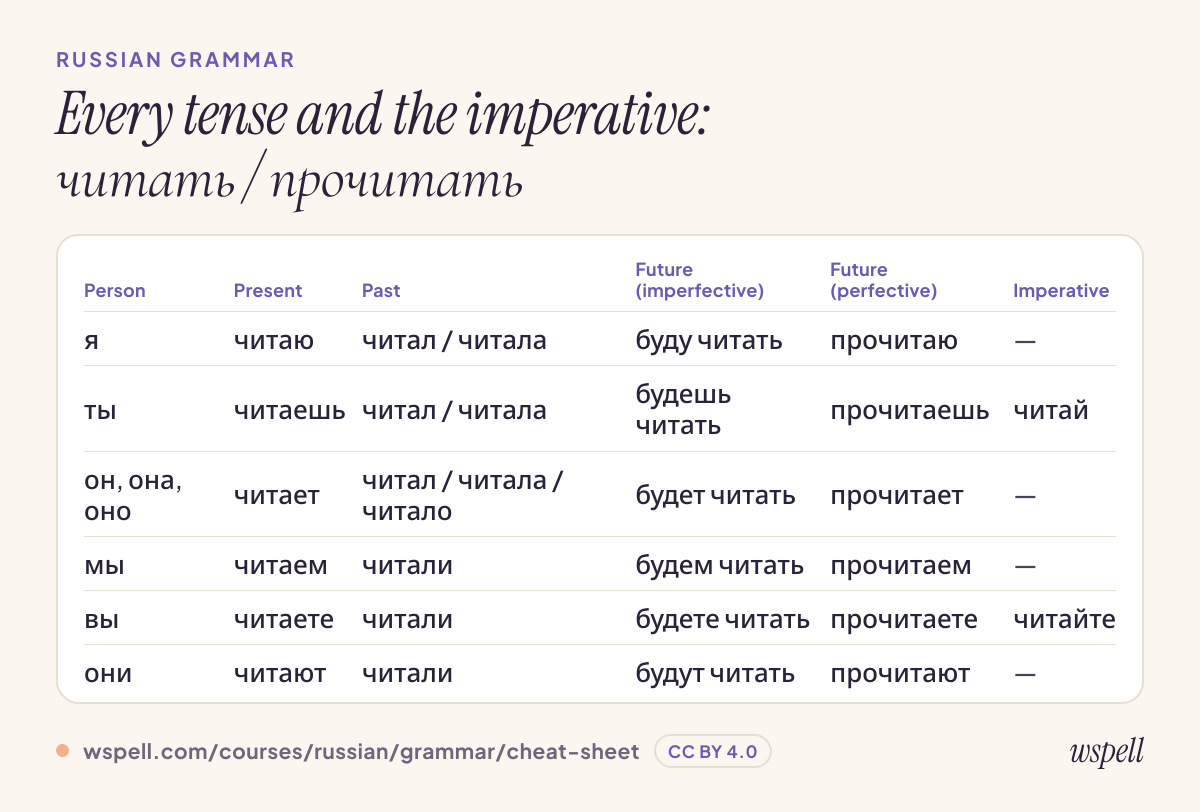
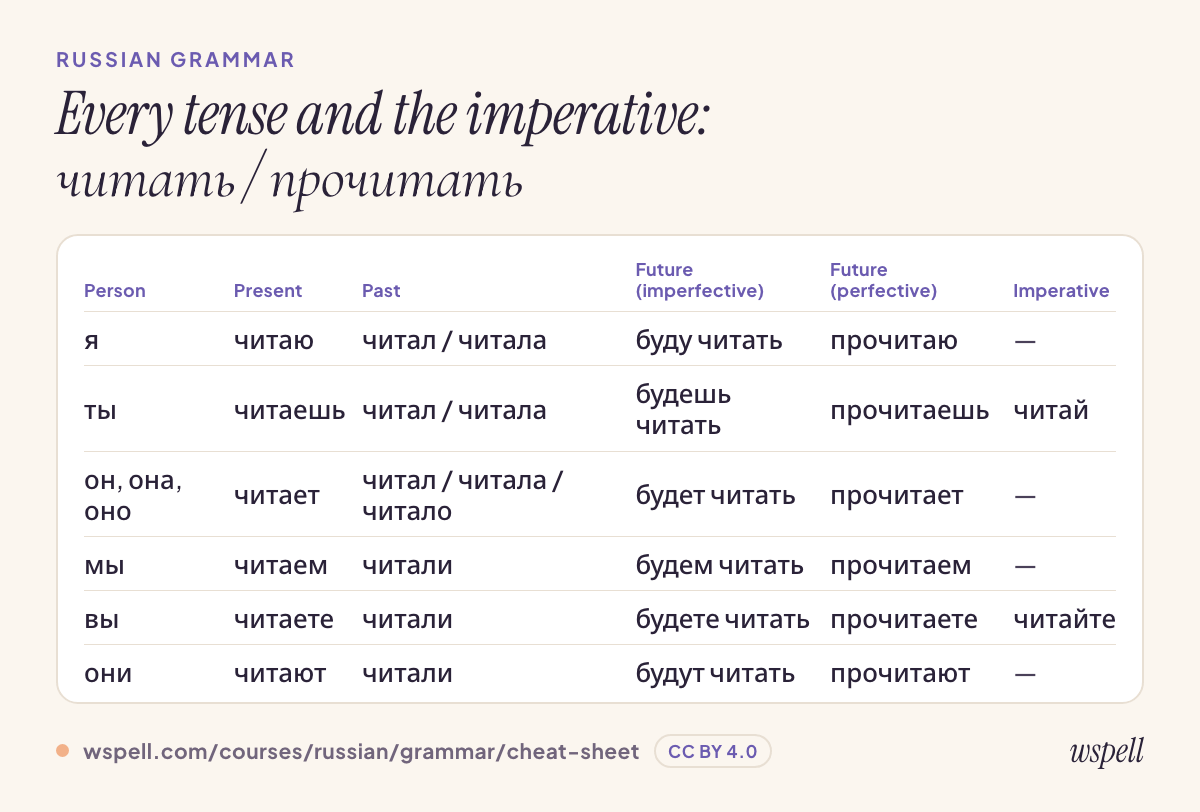
One verb in every tense: читать / прочитать
| Person | Present | Past | Future (imperfective) | Future (perfective) | Imperative |
|---|---|---|---|---|---|
| я | читаю | читал / читала | буду читать | прочитаю | — |
| ты | читаешь | читал / читала | будешь читать | прочитаешь | читай |
| он, она, оно | читает | читал / читала / читало | будет читать | прочитает | — |
| мы | читаем | читали | будем читать | прочитаем | — |
| вы | читаете | читали | будете читать | прочитаете | читайте |
| они | читают | читали | будут читать | прочитают | — |
The noun after a number
| Number | стол masculine | кни́га feminine | окно́ neuter |
|---|---|---|---|
| 1 | один стол | одна книга | одно окно |
| 2 | два стола | две книги | два окна |
| 3 | три стола | три книги | три окна |
| 4 | четыре стола | четыре книги | четыре окна |
| 5 | пять столов | пять книг | пять окон |
| 11 | одиннадцать столов | одиннадцать книг | одиннадцать окон |
| 21 | двадцать один стол | двадцать одна книга | двадцать одно окно |
| 22 | двадцать два стола | двадцать две книги | двадцать два окна |
| 25 | двадцать пять столов | двадцать пять книг | двадцать пять окон |
learn it step by step
save or print this chart
Under the main tables on this page sits a picture of each — keep one on your phone, share it or print it.
Free to share and adapt under CC BY 4.0 — credit wspell and link to this page. the licence
credit line to copy: Russian grammar cheat sheet: the essentials on one page — wspell, CC BY 4.0, https://wspell.com/courses/russian/grammar/cheat-sheet
questions
Can I print this Russian grammar cheat sheet?
Yes. Print the page, or download the pictures below — they are free to share and adapt under CC BY 4.0, with a credit and a link to wspell.
Which question does each Russian case answer?
Each of the six cases has its own: nominative кто? что?, genitive кого? чего?, dative кому? чему?, accusative кого? что?, instrumental кем? чем? and prepositional о ком? о чём?
Why does a Russian noun change after a number?
The number decides the form — in a compound number, its last word. In the nominative, один keeps the noun in the nominative (один стол, двадцать один стол), два, три and четыре take the genitive singular (два стола, двадцать два стола), and пять to двадцать and round numbers such as тридцать or сто take the genitive plural (пять столов, двадцать пять столов).