grammar chart · German
German word order: where the verb goes
German word order turns on the verb. In a statement the conjugated verb is always second, whatever comes first (a yes/no question puts it first), and its second part — an infinitive, a participle or a separable prefix — goes to the very end. After weil, dass, ob and the other subordinating words the conjugated verb moves to the end of its clause.
The verb in second place
| Position 1 | Verb (position 2) | Middle | End |
|---|---|---|---|
| Ich | lese | ein Buch | — |
| Heute | gehe | ich ins Kino | — |
| Diesen Film | kenne | ich nicht | — |
| Ich | will | nach Hause | gehen |
| Sie | hat | das Buch schon | gelesen |
| Ich | rufe | dich morgen | an |
| Morgen | werde | ich dich | anrufen |
| Wo | wohnst | du | — |
| Weil ich krank bin, | bleibe | ich zu Hause | — |
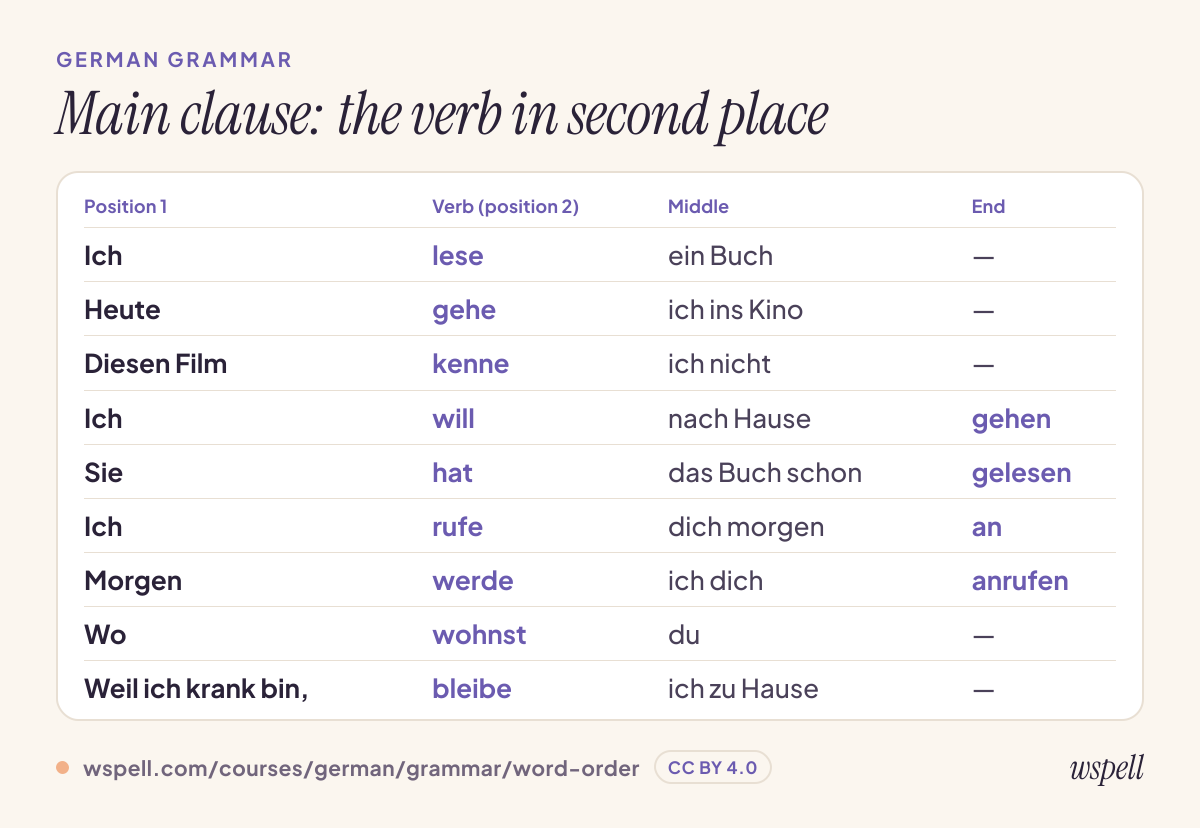
The verb comes second
In a German statement the finite (conjugated) verb is always the second element, no matter what fills the first; exactly one constituent may stand before it. A yes/no question and an imperative put the verb first.
- Ich trinke Kaffee. — I drink coffee.
- Meine Schwester wohnt in Berlin. — My sister lives in Berlin.
Heute gehe ich: the subject moves behind the verb
If a time phrase, an object or a place opens the sentence, the subject moves behind the finite verb — subject–verb inversion — because the verb must stay second; an unstressed pronoun may come before it (Morgen besucht uns meine Oma).
- Heute gehe ich ins Kino. — Today I'm going to the cinema.
- Morgen besucht uns meine Oma. — Tomorrow my grandma is visiting us.
- Diesen Film kenne ich nicht. — This film I don't know.
The verb bracket
The verb bracket: second place and the end
Many German sentences form a Satzklammer (verb bracket): the finite verb sits second and a second verb part — a participle, an infinitive or a separable prefix — closes the clause at the very end, framing the Mittelfeld between them.
- Ich habe gestern einen Kuchen gebacken. — I baked a cake yesterday.
- Wir müssen jetzt nach Hause gehen. — We have to go home now.
Ich rufe dich an: the prefix goes to the end
Separable-prefix verbs (anrufen, aufstehen, einkaufen, mitkommen) split in a main clause: the conjugated stem takes the verb's usual place (second in a statement, first in a command or a yes/no question) and the prefix jumps to the very end.
- Ich rufe dich morgen an. — I'll call you tomorrow.
- Der Zug fährt um acht ab. — The train departs at eight.
- Steh bitte auf! — Please stand up!
Questions
Kommst du mit? Yes/no questions start with the verb
A yes/no question is formed by putting the finite verb first, before the subject; no auxiliary 'do' is added as in English.
- Kommst du mit? — Are you coming along?
- Sprechen Sie Deutsch? — Do you speak German?
Wo wohnst du? The question word, then the verb
A W-question opens with the question word (wer, was, wann, wo, warum, wie…) and the finite verb comes right after it in second position, followed by the subject.
- Wo wohnst du? — Where do you live?
- Was machst du am Wochenende? — What are you doing at the weekend?
After weil, dass, ob: the verb at the end
| Main clause | Conjunction or question word | Subject | Middle | Verb at the end |
|---|---|---|---|---|
| Sie lernt Deutsch, | weil | sie | in Wien | arbeitet |
| Ich glaube, | dass | er | recht | hat |
| Ich weiß nicht, | ob | er | — | kommt |
| Sie fragt, | wann | der Zug | — | abfährt |
| Ich weiß, | dass | er | heute | ankommt |
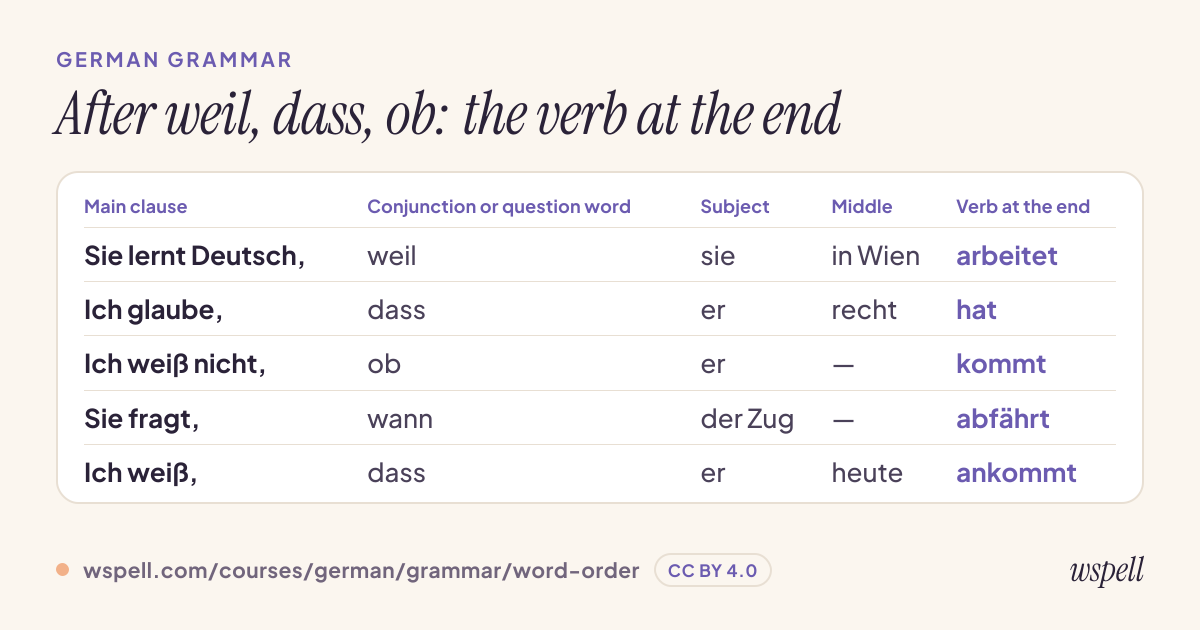
Weil, dass, ob: the verb goes to the end
A subordinating conjunction (weil, dass, wenn, als, ob, obwohl, damit, während, bevor, nachdem, seit, sodass) sends the finite verb to the very end of its clause, and a comma separates the two clauses.
- Ich bleibe zu Hause, weil ich krank bin. — I'm staying home because I'm ill.
- Er sagt, dass er später kommt. — He says that he'll come later.
Und, aber, oder, denn: no change in word order
The coordinating conjunctions und, aber, oder, denn and sondern join two main clauses WITHOUT changing word order — they sit in 'position zero', so the finite verb of the second clause stays second.
- Ich koche, und du deckst den Tisch. — I'll cook and you set the table.
- Er ist müde, aber er arbeitet weiter. — He's tired but he keeps working.
Denn or weil?
Both denn and weil mean 'because', but denn is a coordinating conjunction (main-clause order, verb second) while weil is subordinating (verb to the end). A weil-clause can come first (Weil ich krank bin, bleibe ich zu Hause); a denn-clause always follows what it explains.
- Ich bleibe zu Hause, denn ich bin krank. — I'm staying home, because I'm ill.
- Ich bleibe zu Hause, weil ich krank bin. — I'm staying home because I'm ill.
The middle of the sentence
Time before place
When a sentence has both a time and a place expression, time comes before place in German — the opposite of the usual English order.
- Wir fahren morgen nach Berlin. — We're driving to Berlin tomorrow.
- Ich war gestern im Kino. — I was at the cinema yesterday.
TeKaMoLo: when, why, how, where
As a rule of thumb the adverbials in the Mittelfeld follow the order TeKaMoLo: temporal (when), kausal (why), modal (how), lokal (where). You rarely have all four at once, but their relative order holds.
- Ich fahre morgen mit dem Auto zur Arbeit. — I'm driving to work by car tomorrow.
- Sie kam gestern wegen des Staus zu spät. — She arrived late yesterday because of the traffic jam.
Where nicht goes
For whole-sentence negation nicht comes late — after the objects and most adverbials but before the clause-final verb part (participle, infinitive, prefix). To negate just one element, nicht stands directly before it.
- Ich verstehe die Frage nicht. — I don't understand the question.
- Sie hat gestern nicht angerufen. — She didn't call yesterday.
- Wir wohnen nicht in München. — We don't live in Munich.
practise this chart
Drill these forms in real sentences — every answer checked.
practise now — free to try; some drills ask for a free account
save or print this chart
Under the main tables on this page sits a picture of each — keep one on your phone, share it or print it.
Free to share and adapt under CC BY 4.0 — credit wspell and link to this page. the licence
credit line to copy: German word order: where the verb goes — wspell, CC BY 4.0, https://wspell.com/courses/german/grammar/word-order
questions
Where does the verb go in a German sentence?
In a statement the conjugated verb is always in second place: Ich gehe heute ins Kino; Heute gehe ich ins Kino. A yes/no question puts it first (Kommst du mit?), and in a clause with weil, dass or ob it goes to the end: …, weil ich krank bin.
Why does the subject come after the verb?
When something other than the subject opens the sentence — heute, diesen Film — the verb must still be second, so the subject follows it: Heute gehe ich ins Kino.
What is TeKaMoLo?
A rule of thumb for the middle of the sentence: time, then cause, then manner, then place — Ich fahre morgen mit dem Auto zur Arbeit.