grammar chart · German
German prepositions and the cases they take
Every German preposition decides the case of its noun, which almost always follows it (a few may come after: dem Bahnhof gegenüber). Durch, für, gegen, ohne and um always take the accusative; aus, bei, mit, nach, seit, von and zu always take the dative. The nine two-way prepositions — an, auf, hinter, in, neben, über, unter, vor, zwischen — take the accusative for where to and the dative for where, and während, wegen and trotz take the genitive.
Always accusative: durch, für, gegen, ohne, um
| Preposition | Meaning | Example |
|---|---|---|
| durch | through; by means of / by | durch den Park |
| für | for (someone); for (a purpose) | für dich |
| gegen | against; around (a time) | gegen einen Baum |
| ohne | without | ohne Zucker |
| um | around; at (o'clock) | um den Tisch |
| bis | until; up to / as far as | bis nächsten Montag |
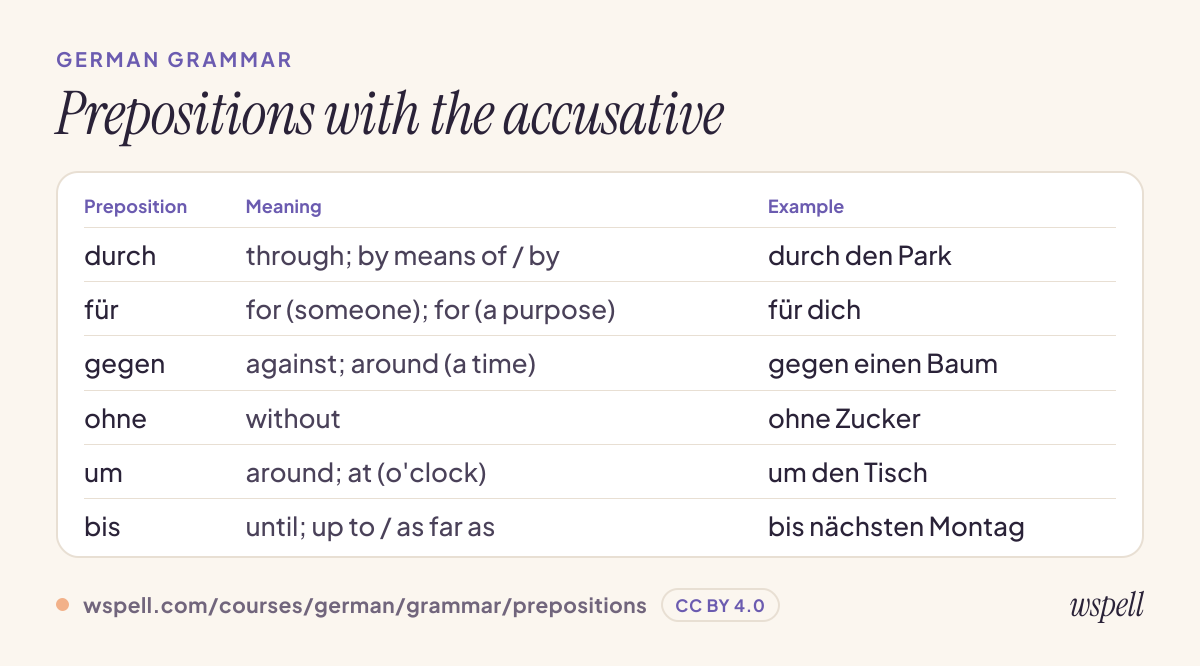
Durch, für, gegen, ohne, um
Memorise the always-accusative prepositions as a chant: durch, für, gegen, ohne, um (the classic 'durch-für-gegen-ohne-um'), plus bis and formal wider. Whatever noun follows them goes into the accusative. Entlang takes the accusative when it follows its noun (den Fluss entlang) and the genitive before it (entlang des Flusses).
- Durch den Wald, für die Kinder, ohne das Auto. — Through the forest, for the children, without the car.
Always dative: aus, bei, mit, nach, seit, von, zu
| Preposition | Meaning | Example |
|---|---|---|
| aus | out of; from; made of | aus dem Haus |
| außer | except / apart from | außer dem Chef |
| bei | at / near; at (someone's place); during / while | bei meinen Eltern |
| gegenüber | opposite / facing; towards (someone) | dem Bahnhof gegenüber |
| mit | with (together); with / using | mit meinem Freund |
| nach | to (place / direction) | nach Berlin |
| nach | after | nach dem Essen |
| seit | since; for (a period, still ongoing) | seit drei Jahren |
| von | from | von der Arbeit |
| zu | to (person / place); for / to | zum Arzt |
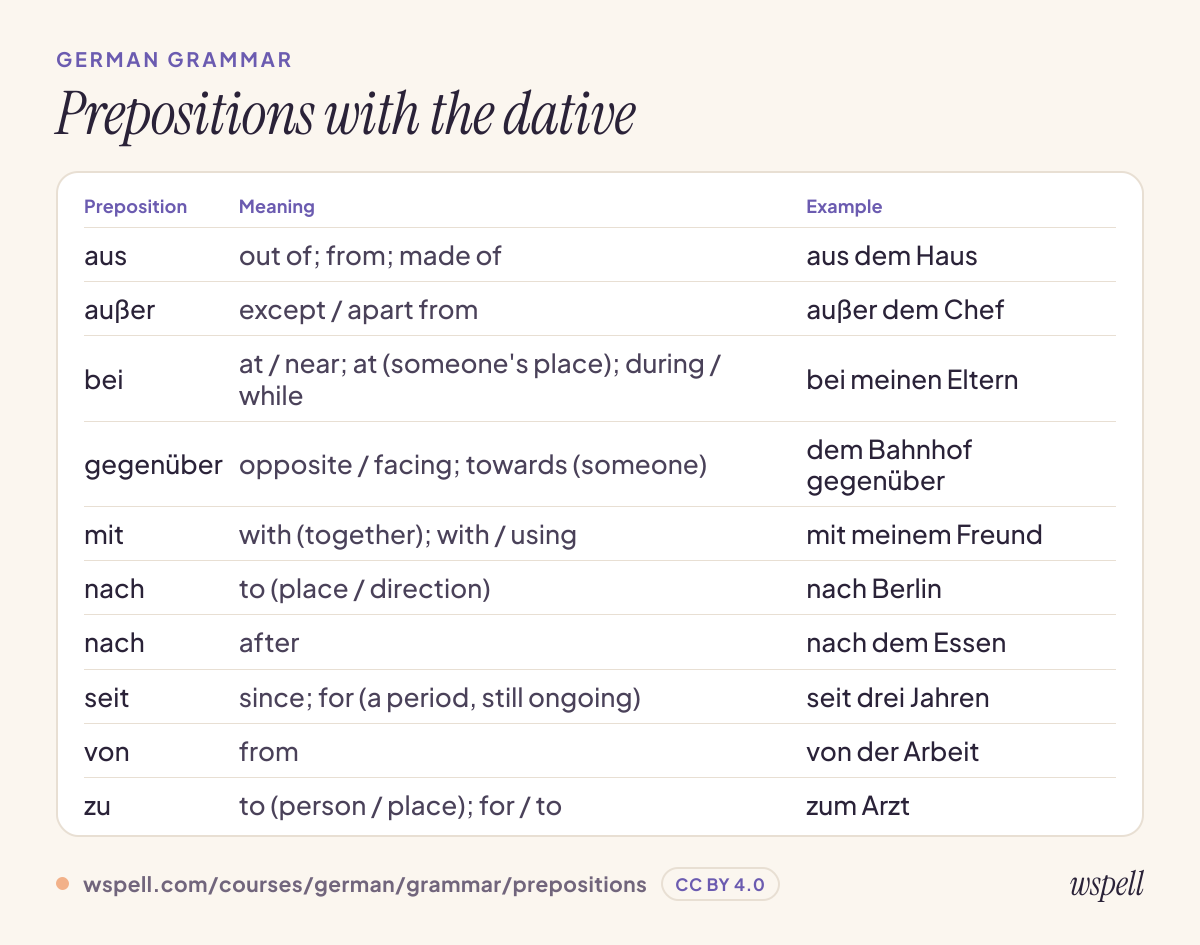
Aus, außer, bei, mit, nach, seit, von, zu
The everyday always-dative prepositions are learnt as a list: aus, außer, bei, mit, nach, seit, von, zu (add gegenüber). Whatever follows is dative, and several fuse with the article (zum, zur, vom, beim).
- Nach der Schule fahre ich mit dem Rad zu meiner Oma. — After school I ride my bike to my grandma's.
Two-way prepositions: wohin? or wo?
The accusative answers wohin? — where to; the dative answers wo? — where.
| Preposition | Meaning | Wohin? where to (accusative) | Wo? where (dative) |
|---|---|---|---|
| an | at, on (a wall, an edge) | an die Wand | an der Wand |
| auf | on (a surface) | auf den Tisch | auf dem Tisch |
| hinter | behind | hinter das Haus | hinter dem Haus |
| in | in, into | in die Stadt | in der Stadt |
| neben | next to | neben das Sofa | neben dem Sofa |
| über | over, above | über das Dach | über dem Dach |
| unter | under | unter das Bett | unter dem Bett |
| vor | in front of | vor das Haus | vor dem Haus |
| zwischen | between | zwischen die Fenster | zwischen den Fenstern |
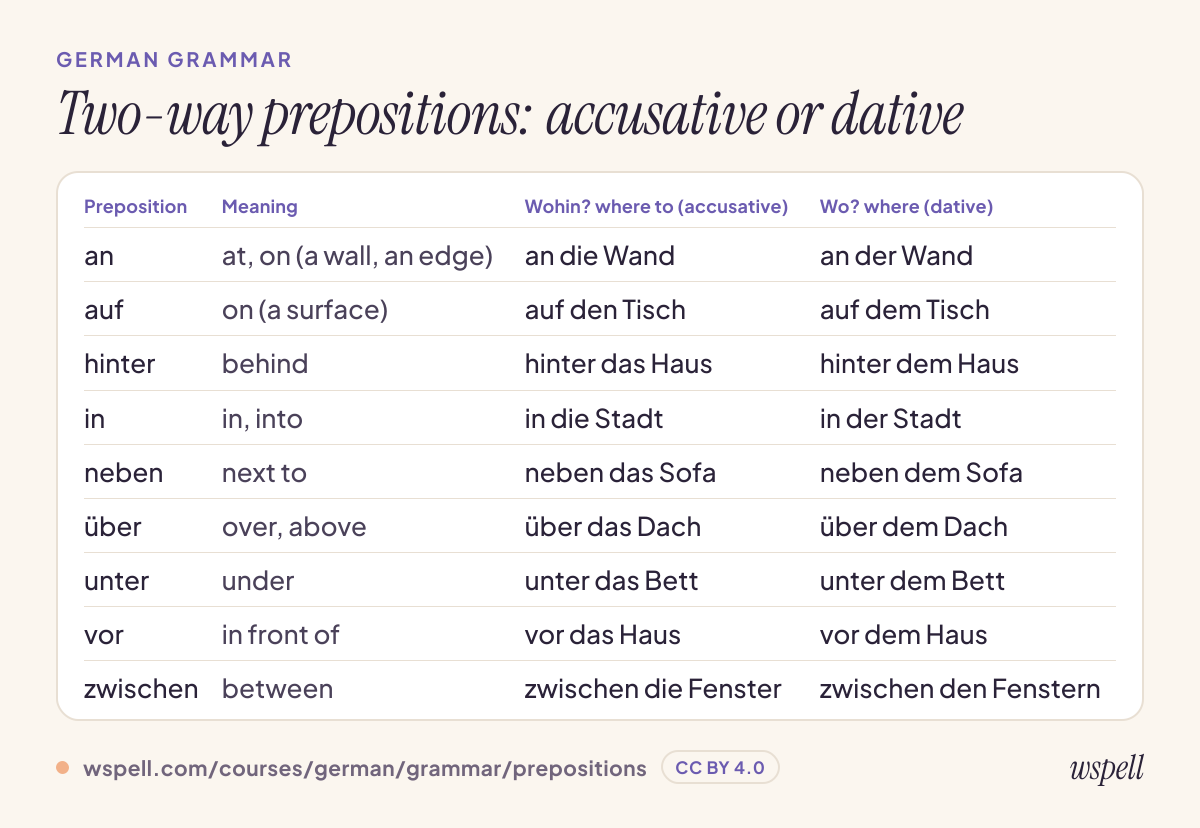
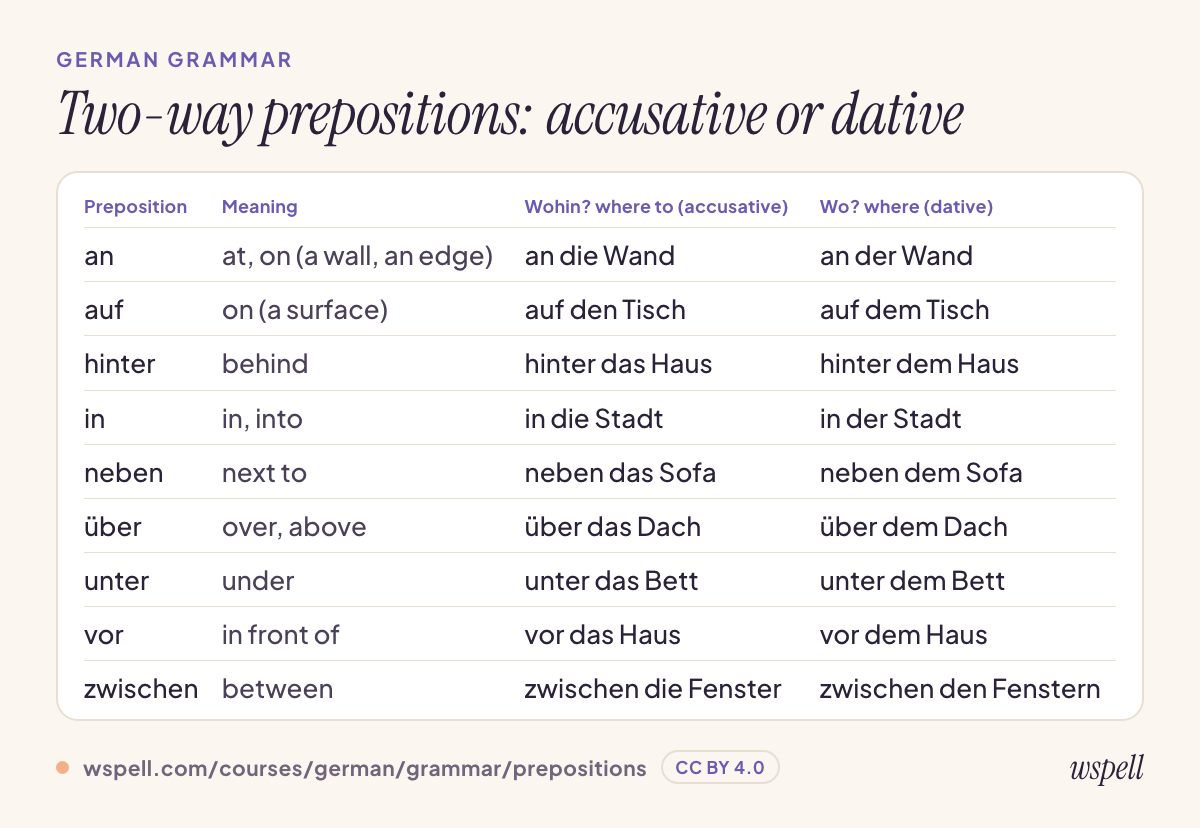
Wohin? accusative. Wo? dative.
Nine prepositions (an, auf, hinter, in, neben, über, unter, vor, zwischen) switch case by meaning: accusative for movement into a new position (wohin? — where to?), dative for a static location or movement within one (wo? — where?). The verb usually signals it: legen/stellen (acc) vs liegen/stehen (dat).
- Das Buch liegt auf dem Tisch. — The book is lying on the table.
- Ich lege das Buch auf den Tisch. — I put the book on the table.
Prepositions with the genitive
| Preposition | Meaning | Example |
|---|---|---|
| während | during | während des Urlaubs |
| wegen | because of | wegen des schlechten Wetters |
| trotz | despite | trotz des Regens |
| statt | instead of | statt des Autos |
| innerhalb | within (a period); inside | innerhalb einer Woche |
| außerhalb | outside / beyond | außerhalb der Stadt |
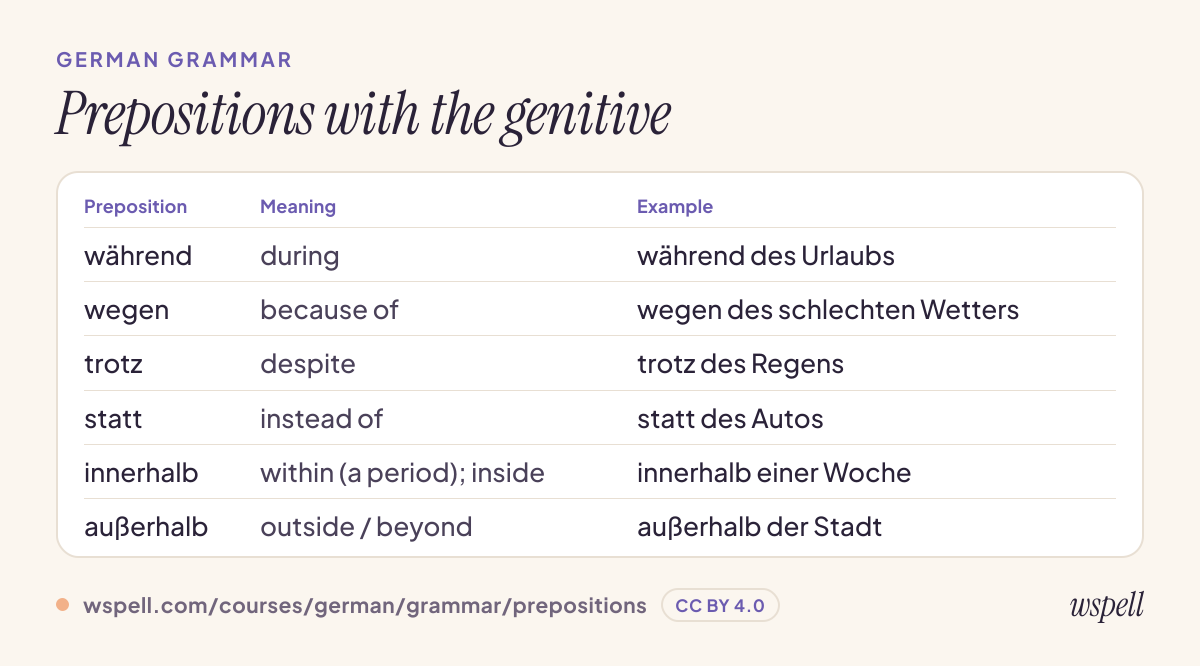
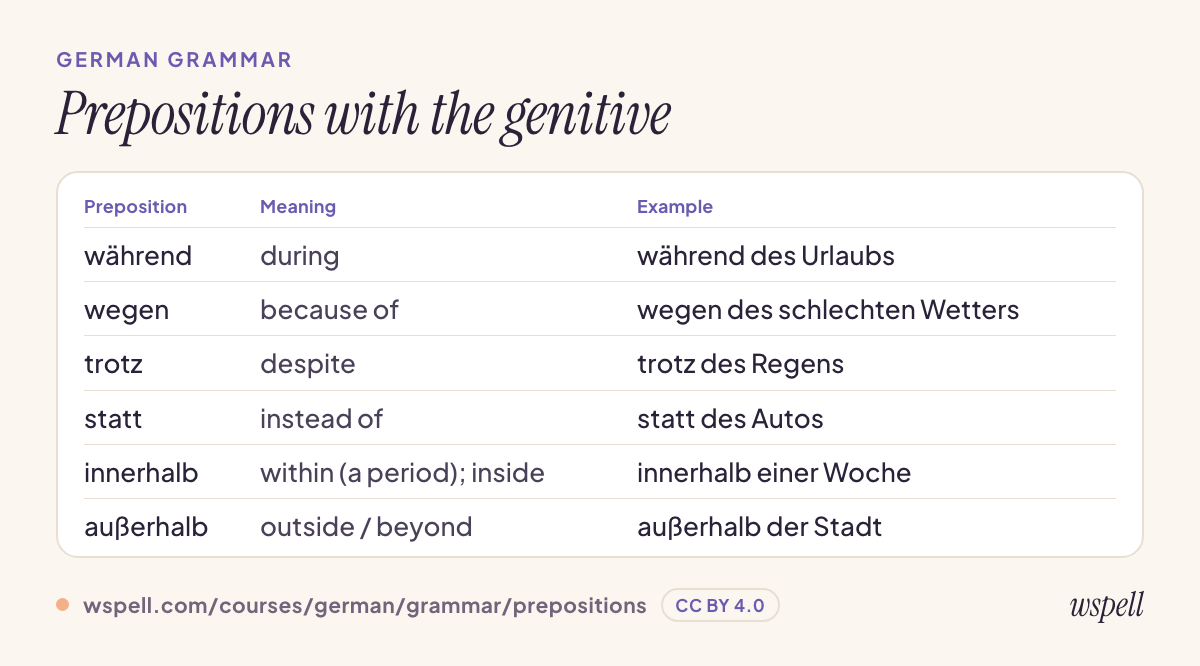
Während, wegen, trotz, statt
The everyday genitive prepositions are während, wegen, trotz and (an)statt; more formal ones include außerhalb, innerhalb, aufgrund and angesichts. Whatever follows them goes into the genitive in careful, standard German.
- Wegen des Staus kamen wir trotz der Eile zu spät. — Because of the traffic jam we arrived late despite the hurry.
practise this chart
Drill these forms in real sentences — every answer checked.
practise now — free to try; some drills ask for a free account
save or print this chart
Under the main tables on this page sits a picture of each — keep one on your phone, share it or print it.
Free to share and adapt under CC BY 4.0 — credit wspell and link to this page. the licence
credit line to copy: German prepositions and the cases they take — wspell, CC BY 4.0, https://wspell.com/courses/german/grammar/prepositions
questions
Which German prepositions take the accusative?
Durch, für, gegen, ohne and um always do, and so do bis and entlang when it follows its noun: für dich, ohne mich, durch den Park.
Which German prepositions take the dative?
Aus, außer, bei, mit, nach, seit, von, zu and gegenüber always do: mit dem Bus, nach der Arbeit, zum Arzt.
When does in take the accusative and when the dative?
In takes the accusative for movement into somewhere (wohin? — in die Stadt) and the dative for being there (wo? — in der Stadt). The same goes for the other eight two-way prepositions.