grammar chart · German
German adjective endings chart: weak, mixed and strong
A German adjective in front of a noun takes an ending, and which one depends on the word before it. After der, dieser or jeder the adjective is weak (-e or -en); after ein, kein or mein it is mixed; with no article it is strong and shows the case itself. Each table gives the ending for every case and gender, with the whole phrase under it.
Weak, mixed or strong? Look at the word before
Weak, mixed or strong: look at the word before
Which attributive ending an adjective takes depends on what comes before it: after a der-word the endings are 'weak', after an ein-word 'mixed', and with no determiner 'strong'. That is why the same adjective shifts — der gute Wein, ein guter Wein, guter Wein. The full tables live in the adjective-declension rules.
- Der gute Wein ist teuer. — The good wine is expensive.
- Guter Wein ist teuer. — Good wine is expensive.
Weak endings: after der, die, das
Only two endings: -e in the nominative singular and in the feminine and neuter accusative, -en everywhere else.
| Case | Masculine Mann | Feminine Frau | Neuter Kind | Plural Kinder |
|---|---|---|---|---|
| Nominative Nominativ | -e der gute Mann | -e die gute Frau | -e das gute Kind | -en die guten Kinder |
| Accusative Akkusativ | -en den guten Mann | -e die gute Frau | -e das gute Kind | -en die guten Kinder |
| Dative Dativ | -en dem guten Mann | -en der guten Frau | -en dem guten Kind | -en den guten Kindern |
| Genitive Genitiv | -en des guten Mannes | -en der guten Frau | -en des guten Kindes | -en der guten Kinder |
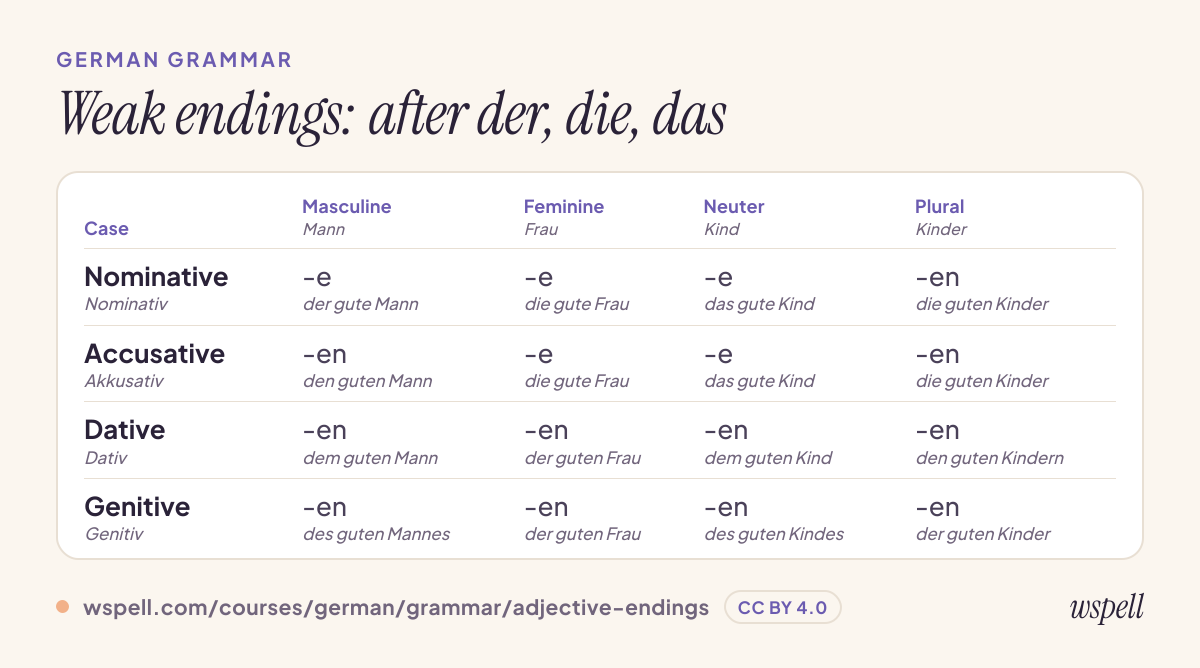
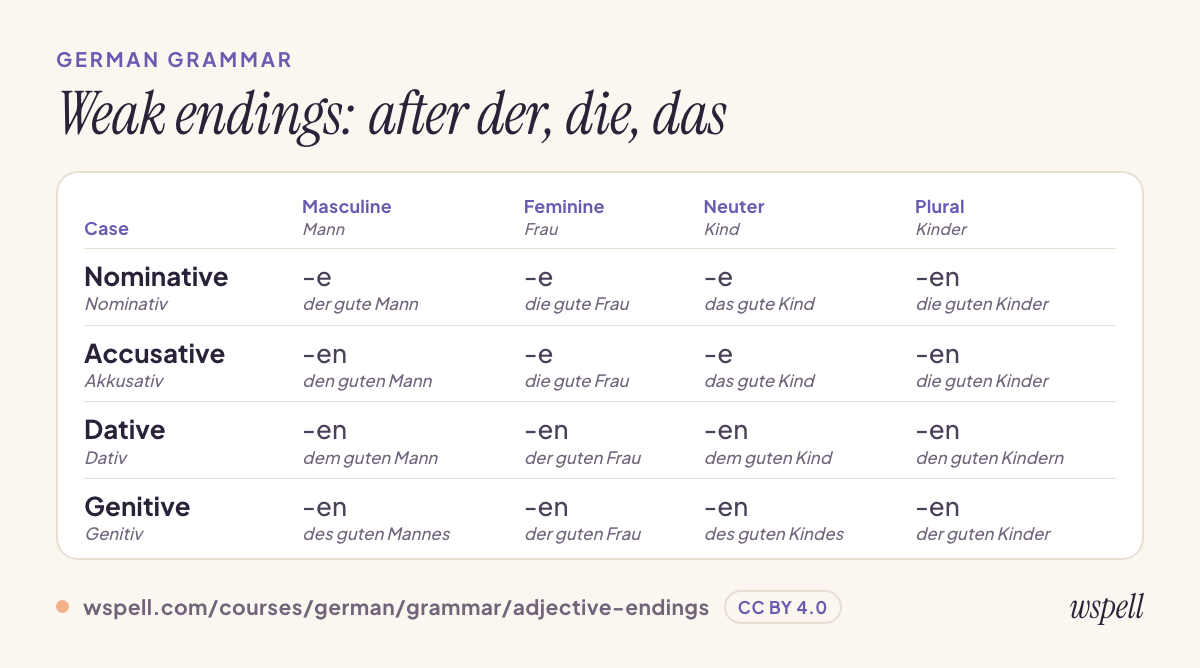
After der, dieser, jeder: only -e or -en
After a definite article or der-word (dieser, jeder, welcher) the adjective takes only two endings: -e in the nominative singular of every gender and in the feminine/neuter accusative, and -en everywhere else. The article already shows case, gender and number, so the adjective barely marks anything.
- Der alte Mann liest ein Buch. — The old man is reading a book.
- Ich sehe den alten Mann. — I see the old man.
Mixed endings: after ein, kein, mein
Where ein has no ending — the masculine nominative and the neuter nominative and accusative — the adjective shows the gender: ein guter Mann, ein gutes Kind. Ein has no plural, so the plural column uses keine.
| Case | Masculine Mann | Feminine Frau | Neuter Kind | Plural Kinder |
|---|---|---|---|---|
| Nominative Nominativ | -er ein guter Mann | -e eine gute Frau | -es ein gutes Kind | -en keine guten Kinder |
| Accusative Akkusativ | -en einen guten Mann | -e eine gute Frau | -es ein gutes Kind | -en keine guten Kinder |
| Dative Dativ | -en einem guten Mann | -en einer guten Frau | -en einem guten Kind | -en keinen guten Kindern |
| Genitive Genitiv | -en eines guten Mannes | -en einer guten Frau | -en eines guten Kindes | -en keiner guten Kinder |
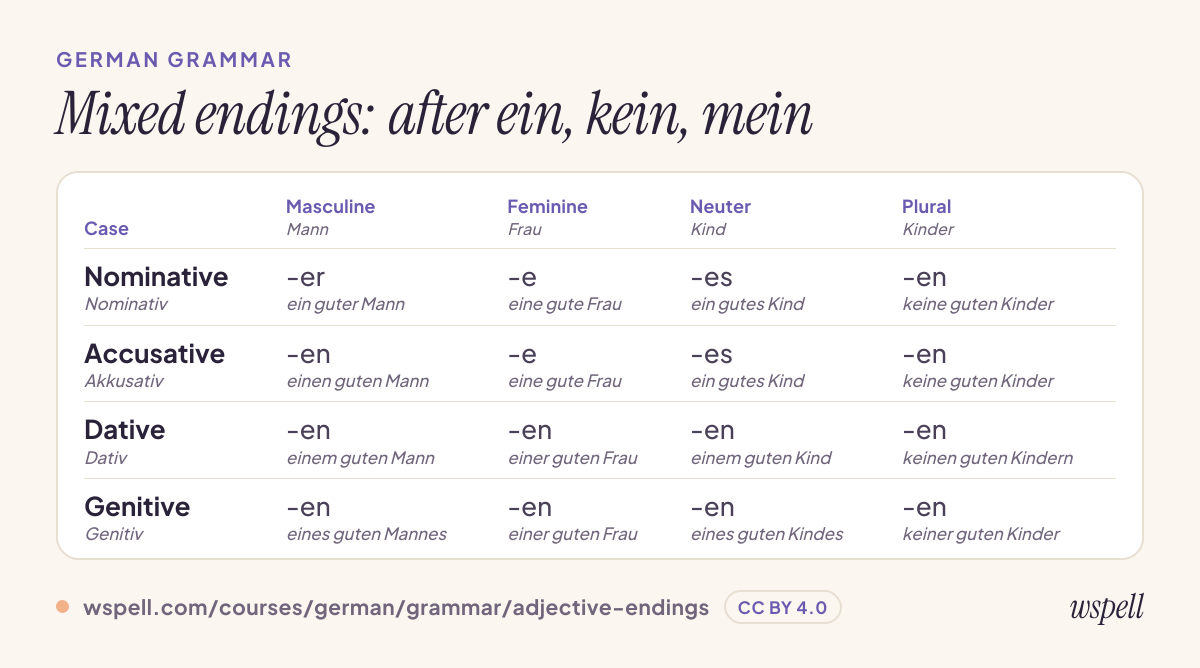
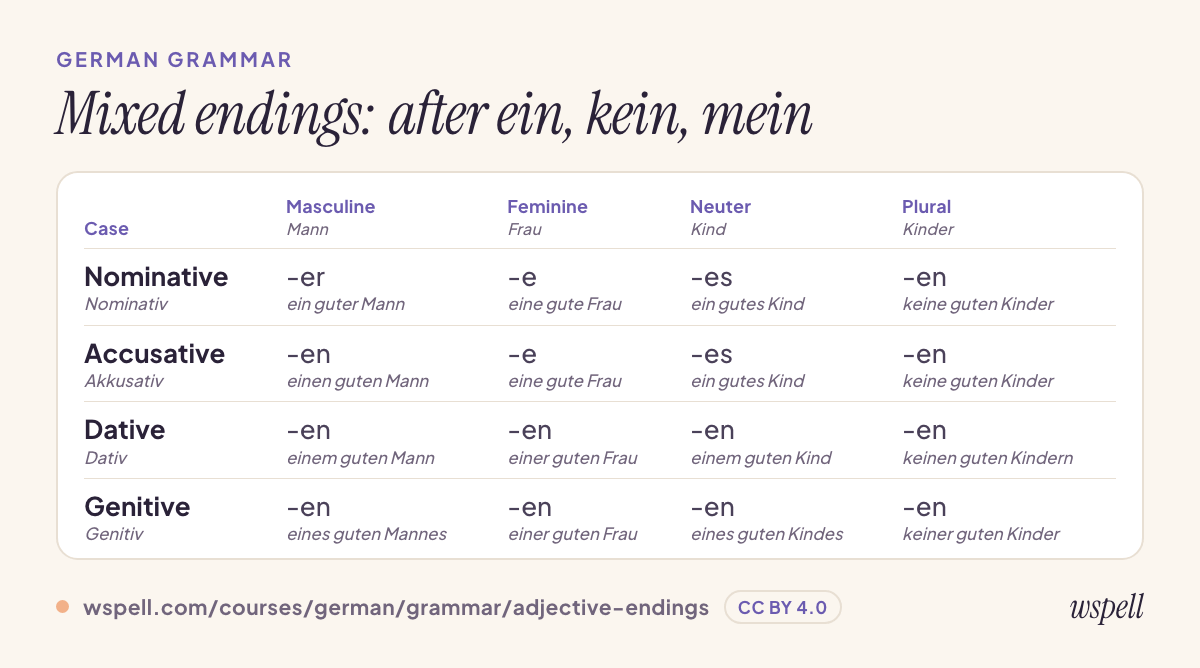
After ein, kein, mein: the adjective shows the gender
After ein-words (ein, kein, mein, dein, sein…) the adjective is mostly weak -en, except in the three cells where ein itself has no ending — masculine nominative and neuter nominative/accusative — where the adjective borrows the strong ending to show the gender.
- Das ist ein guter Freund. — That is a good friend.
- Ich habe einen guten Freund. — I have a good friend.
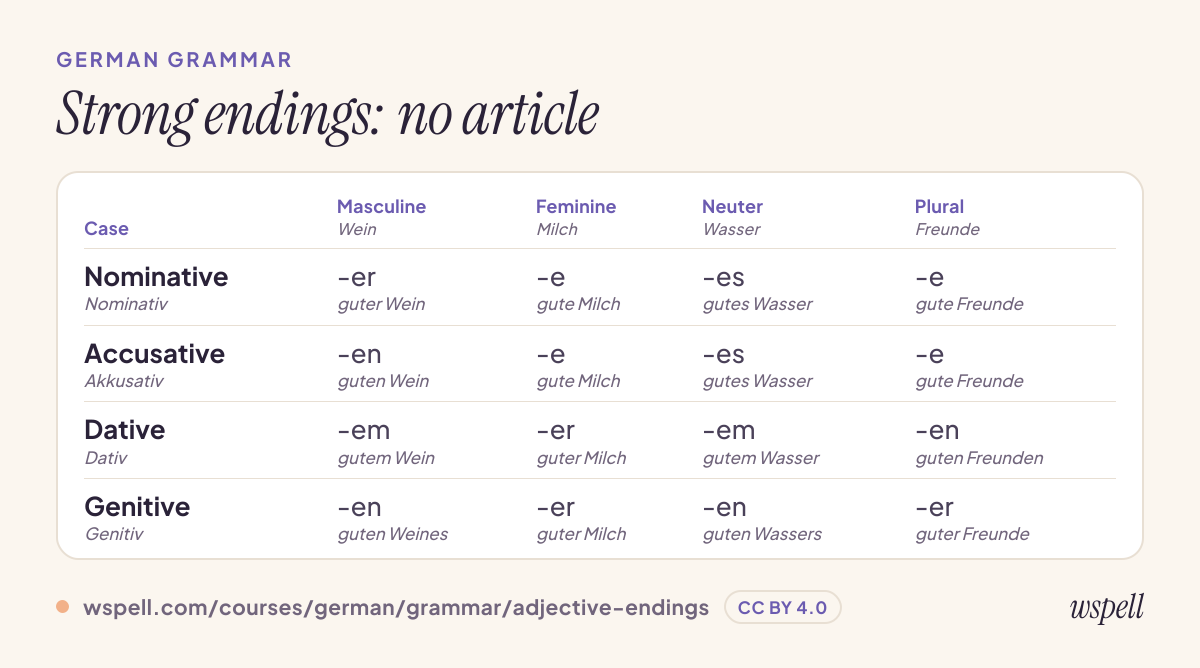
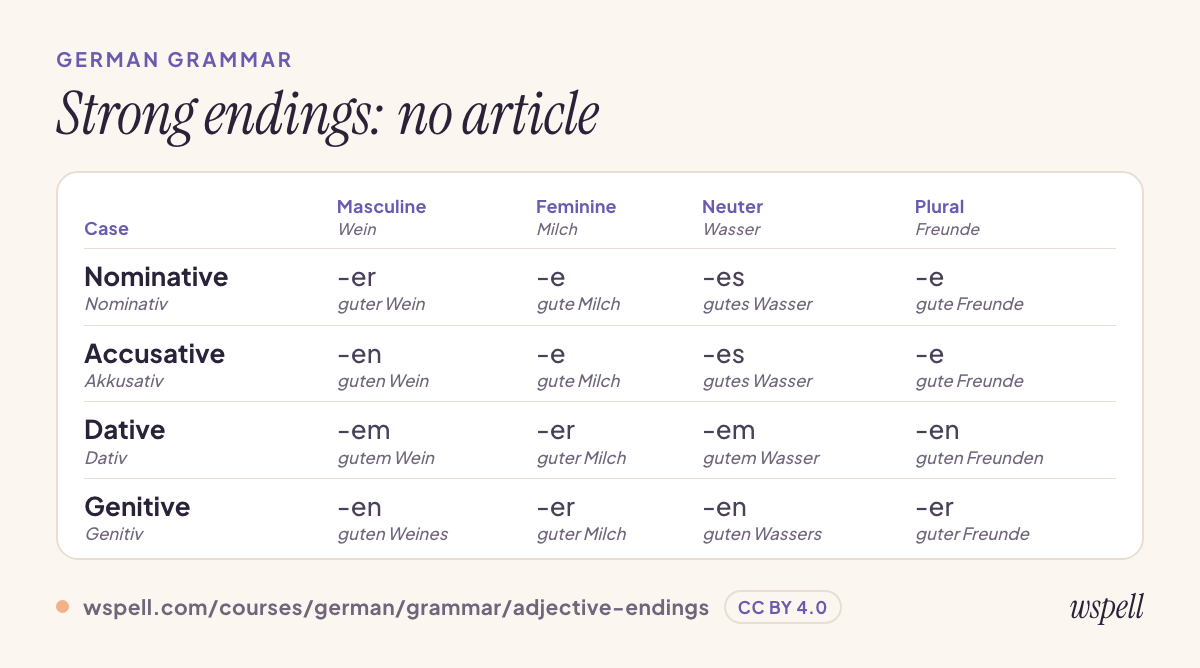
Strong endings: no article
With no article the adjective carries the signals of the article itself: guter like der, gutem like dem.
| Case | Masculine Wein | Feminine Milch | Neuter Wasser | Plural Freunde |
|---|---|---|---|---|
| Nominative Nominativ | -er guter Wein | -e gute Milch | -es gutes Wasser | -e gute Freunde |
| Accusative Akkusativ | -en guten Wein | -e gute Milch | -es gutes Wasser | -e gute Freunde |
| Dative Dativ | -em gutem Wein | -er guter Milch | -em gutem Wasser | -en guten Freunden |
| Genitive Genitiv | -en guten Weines | -er guter Milch | -en guten Wassers | -er guter Freunde |
No article: the adjective shows the case
With no article the adjective alone must show case, gender and number, so it takes the strong endings — the very signals a der-word normally carries (der→-er, das→-es, dem→-em…). This happens with mass and abstract nouns, bare plurals, and after words like viele.
- Guter Wein ist nicht billig. — Good wine is not cheap.
- Ich trinke gern kaltes Wasser. — I like drinking cold water.
Viele gute Freunde, but alle guten Freunde
Quantifiers that are not true determiners — viele, einige, wenige, mehrere, andere, and bare numbers — leave the adjective strong: viele gute Freunde, einige interessante Bücher, zwei kleine Kinder. But after alle and beide the adjective is weak: alle guten Freunde, beide kleinen Kinder.
- Ich habe viele gute Freunde. — I have many good friends.
- Sie hat einige interessante Bücher. — She has some interesting books.
Why the endings change
Why the endings change: the case is marked once
German never marks case and gender twice: when the determiner is missing or ending-less the adjective jumps to the strong ending to carry the signal, and when the determiner already shows it the adjective relaxes to -e or -en. That single principle generates all three patterns.
- Guter Wein schmeckt gut. — Good wine tastes good.
- Der gute Wein ist teuer. — The good wine is expensive.
Das Auto ist neu: no ending after sein
After sein, werden or bleiben the adjective is a predicate and stays in its bare dictionary form — no ending, ever: das Auto ist neu, die Blumen sind schön, wir sind müde. This is the easy case; endings appear only when the adjective sits in front of a noun.
- Das Auto ist neu. — The car is new.
- Die Blumen sind schön. — The flowers are beautiful.
Comparison: größer, am größten
Kleiner, älter, größer als: the comparative
The comparative adds -er to the adjective stem: schnell → schneller, klein → kleiner. Many short adjectives also umlaut the stem vowel: alt → älter, groß → größer, jung → jünger, lang → länger. The standard of comparison follows als ('than').
- Mein Bruder ist größer als ich. — My brother is taller than me.
- Der Zug ist schneller als das Auto. — The train is faster than the car.
Die schönste Stadt, am schönsten: the superlative
An attributive superlative uses the -st stem plus a declension ending, almost always after a der-word: die schönste Stadt, das größte Problem. Predicatively (after sein) use the uninflected am schönsten, am kältesten.
- Das ist die schönste Stadt Europas. — That is the most beautiful city in Europe.
- Im Winter ist es am kältesten. — In winter it is coldest.
Gut, besser, am besten
A few very common words compare irregularly and must be memorised: gut → besser → am besten, viel → mehr → am meisten, gern → lieber → am liebsten, hoch → höher → am höchsten, nah → näher → am nächsten. gut, viel and gern take another root, like English good/better/best; hoch and nah only change a sound: höher, am nächsten.
- Dieses Buch ist besser. — This book is better.
- Ich trinke lieber Tee. — I prefer to drink tea.
practise this chart
Drill these forms in real sentences — every answer checked.
practise now — free to try; some drills ask for a free account
save or print this chart
Under the main tables on this page sits a picture of each — keep one on your phone, share it or print it.
Free to share and adapt under CC BY 4.0 — credit wspell and link to this page. the licence
credit line to copy: German adjective endings chart: weak, mixed and strong — wspell, CC BY 4.0, https://wspell.com/courses/german/grammar/adjective-endings
questions
What are the German adjective endings after der?
-e in the nominative singular (der gute Mann, die gute Frau, das gute Kind) and in the feminine and neuter accusative, and -en everywhere else: den guten Mann, dem guten Kind, die guten Kinder.
Why is it ein guter Mann but der gute Mann?
Ein has no ending in the masculine nominative, so the adjective takes -er to show the gender. Der already shows it, so the adjective only needs -e.
Do adjectives after sein take an ending?
No. After sein, werden and bleiben the adjective stays in its dictionary form: Das Auto ist neu. Endings appear only in front of a noun: das neue Auto.