grammar chart · German
German possessive pronouns: mein, dein, sein, ihr and their endings
Each German pronoun has its possessive: ich – mein, du – dein, er – sein, sie – ihr. The stem tells you whose it is; the ending agrees with the thing owned and follows ein in every case: mein Vater, meine Mutter, meinem Vater, meiner Mutter.
One possessive for every person
| Nominative Nominativ | Possessive |
|---|---|
| ich I | mein |
| du you (informal) | dein |
| er he | sein |
| sie she | ihr |
| es it | sein |
| wir we | unser |
| ihr you all (informal) | euer |
| sie they | ihr |
| Sie you (formal) | Ihr |
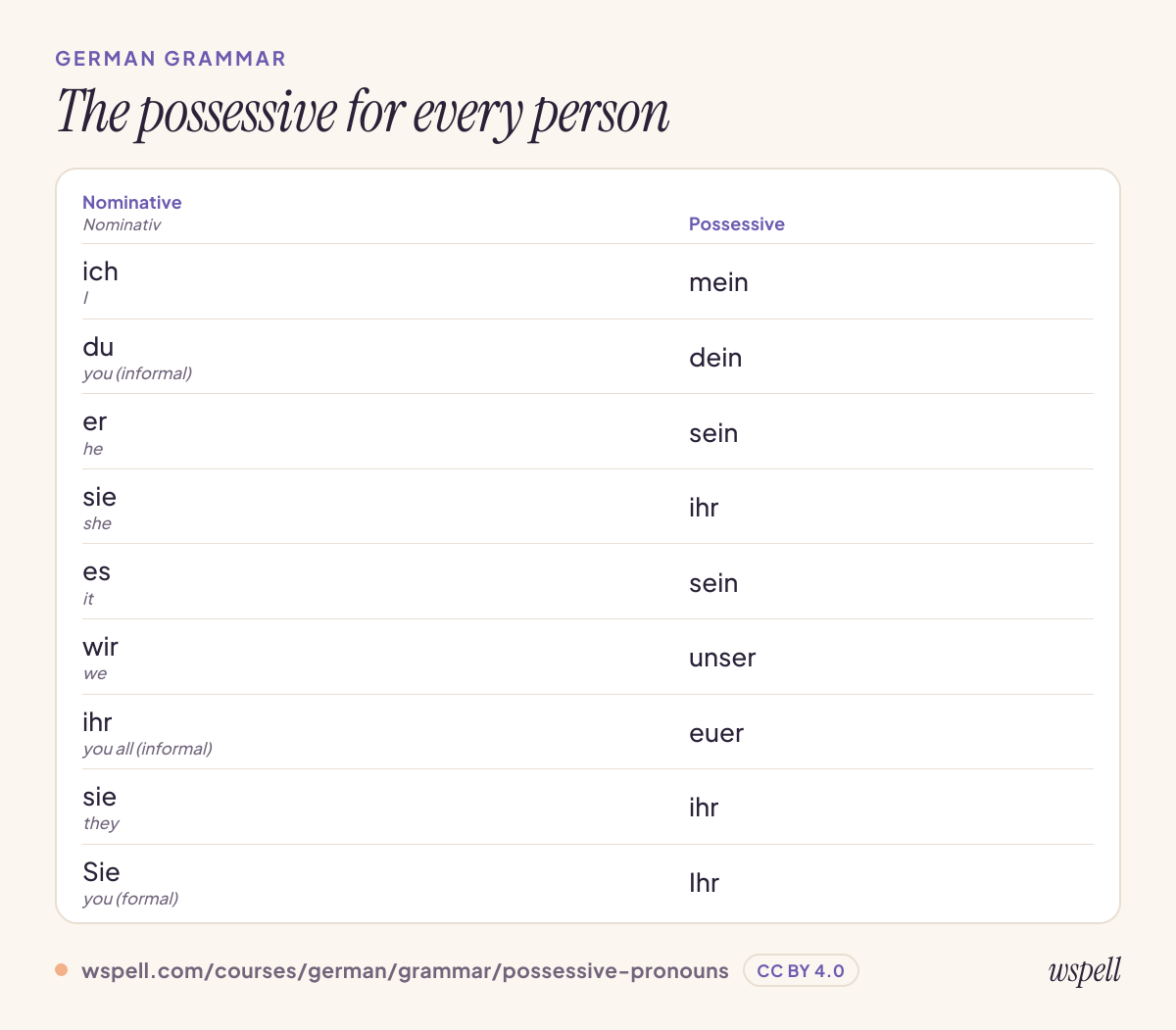
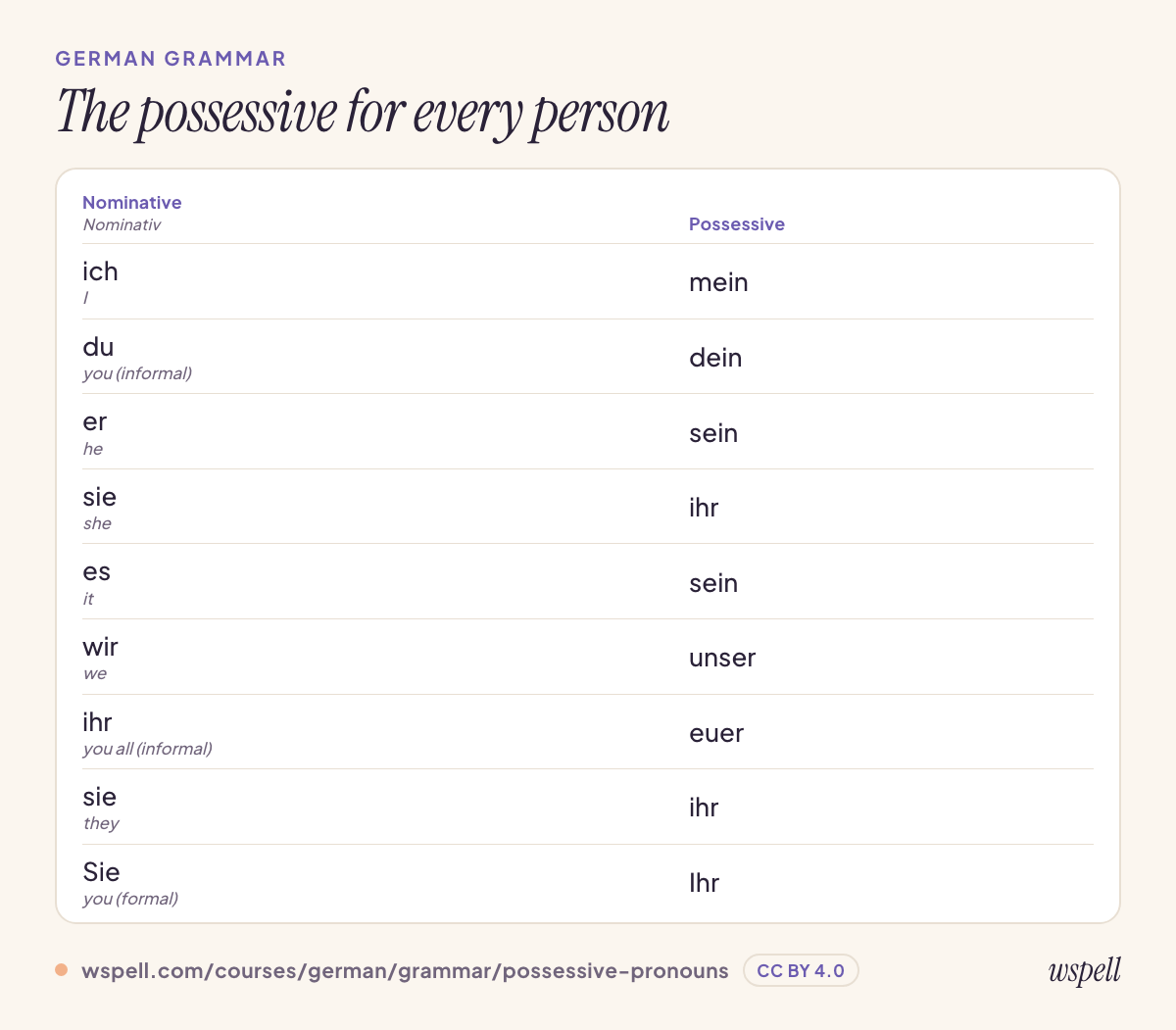
Mein, dein, sein, ihr: one possessive per person
Each person has a possessive stem: ich → mein, du → dein, er/es → sein, sie → ihr, wir → unser, ihr → euer, sie (pl) → ihr, Sie → Ihr. These are the bare forms before any case ending is added.
- Das ist mein Vater. — This is my father.
- Wo ist dein Auto? — Where is your car?
The endings: like ein
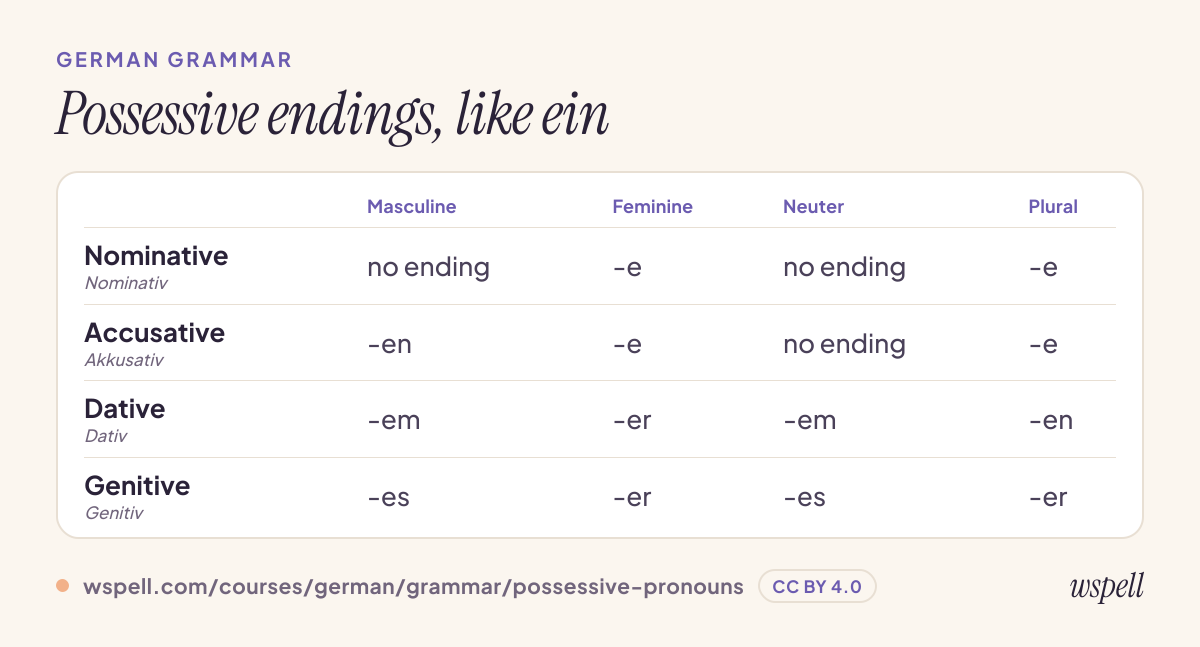
The ending comes from the noun that is owned, never from the owner.
| Case | Masculine Vater | Feminine Mutter | Neuter Kind | Plural Kinder |
|---|---|---|---|---|
| Nominative Nominativ | mein Vater | meine Mutter | mein Kind | meine Kinder |
| Accusative Akkusativ | meinen Vater | meine Mutter | mein Kind | meine Kinder |
| Dative Dativ | meinem Vater | meiner Mutter | meinem Kind | meinen Kindern |
| Genitive Genitiv | meines Vaters | meiner Mutter | meines Kindes | meiner Kinder |
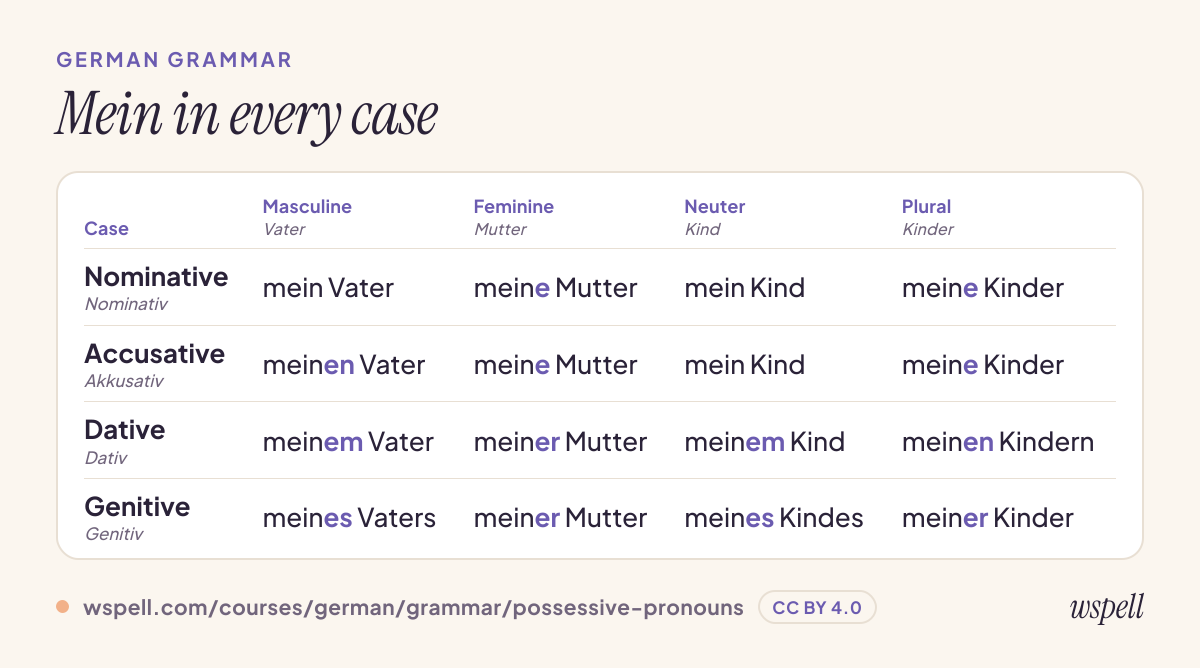
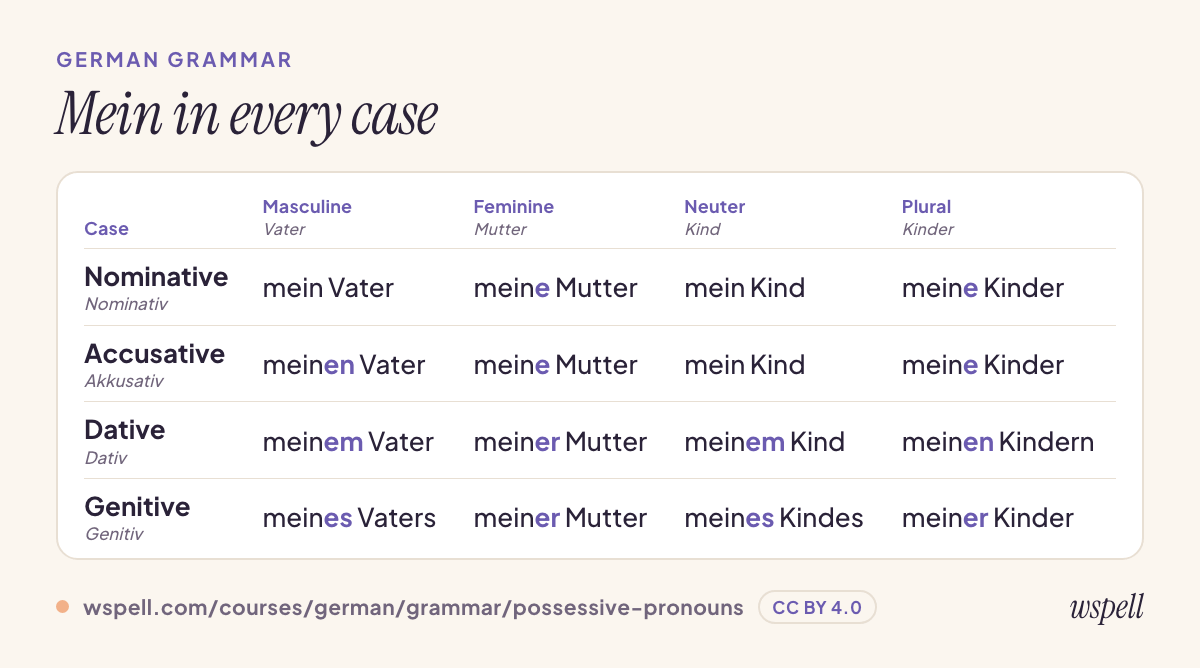
| Masculine | Feminine | Neuter | Plural | |
|---|---|---|---|---|
| Nominative Nominativ | no ending | -e | no ending | -e |
| Accusative Akkusativ | -en | -e | no ending | -e |
| Dative Dativ | -em | -er | -em | -en |
| Genitive Genitiv | -es | -er | -es | -er |
The ending follows the noun, not the owner
A possessive is a determiner that agrees in gender, number, and case with the thing possessed, using the same endings as ein/kein: mein Vater, meine Mutter, mein Kind, meine Eltern; accusative meinen Vater. The ending comes from the possessed noun, never the owner.
- Ich rufe meinen Bruder an. — I am calling my brother.
- Meine Mutter arbeitet hier. — My mother works here.
Sein or ihr: his or her
For third-person owners the stem is chosen by the owner, not by what is owned: a masculine or neuter owner takes sein, a feminine or plural owner takes ihr — by grammatical gender, not sex: Peter → seine Schwester, Anna → ihr Bruder, das Kind → sein Ball, die Firma → ihre Mitarbeiter.
- Peter und seine Schwester wohnen hier. — Peter and his sister live here.
- Anna liebt ihren Hund. — Anna loves her dog.
Euer and eure
Euer becomes eure
The stem euer keeps its full shape only when it stands with no ending (euer Haus). As soon as an ending attaches, the second e is dropped: eure Mutter, euren Vater, eurem Kind. Contrast unser, which keeps its e (unsere, unseren).
- Ist das euer Haus? — Is that your house?
- Wo sind eure Bücher? — Where are your books?
Mine, yours: meiner, meine, meins
Meiner, meine, meins: mine
When a possessive replaces a noun instead of accompanying it, it takes strong (der-word) endings: meiner (m), meine (f), meins (n), meine (pl). Used for 'mine, yours, hers': Dein Auto ist neu, meins ist alt.
- Dein Auto ist neu, meins ist alt. — Your car is new, mine is old.
- Das ist nicht mein Mantel, deiner hängt dort. — That's not my coat, yours is hanging there.
learn it step by step
save or print this chart
Under the main tables on this page sits a picture of each — keep one on your phone, share it or print it.
Free to share and adapt under CC BY 4.0 — credit wspell and link to this page. the licence
credit line to copy: German possessive pronouns: mein, dein, sein, ihr and their endings — wspell, CC BY 4.0, https://wspell.com/courses/german/grammar/possessive-pronouns
questions
How do you say his and her in German?
His is sein, her is ihr — chosen by the owner. The ending then agrees with the noun owned: sein Bruder, seine Schwester; ihr Bruder, ihre Schwester.
Do German possessive pronouns decline?
Yes, exactly like ein and kein: mein Vater, meinen Vater, meinem Vater, meines Vaters — and in the plural meine, meinen, meiner.
Why is it eure and not euer?
When euer takes an ending its second e usually drops: eure Mutter, euren Vater. Unser keeps its e: unsere, unseren.