grammar chart · German
German articles chart: der, die, das, ein and kein in every case
German has three genders and four cases, and the article changes with both: der becomes den, dem or des depending on its job in the sentence. The tables give the definite article, the indefinite article and kein in every case; below them come the contractions such as im and zum, and the endings that tell you a noun's gender.
The definite article: der, die, das
| Masculine | Feminine | Neuter | Plural | |
|---|---|---|---|---|
| Nominative Nominativ | der | die | das | die |
| Accusative Akkusativ | den | die | das | die |
| Dative Dativ | dem | der | dem | den |
| Genitive Genitiv | des | der | des | der |
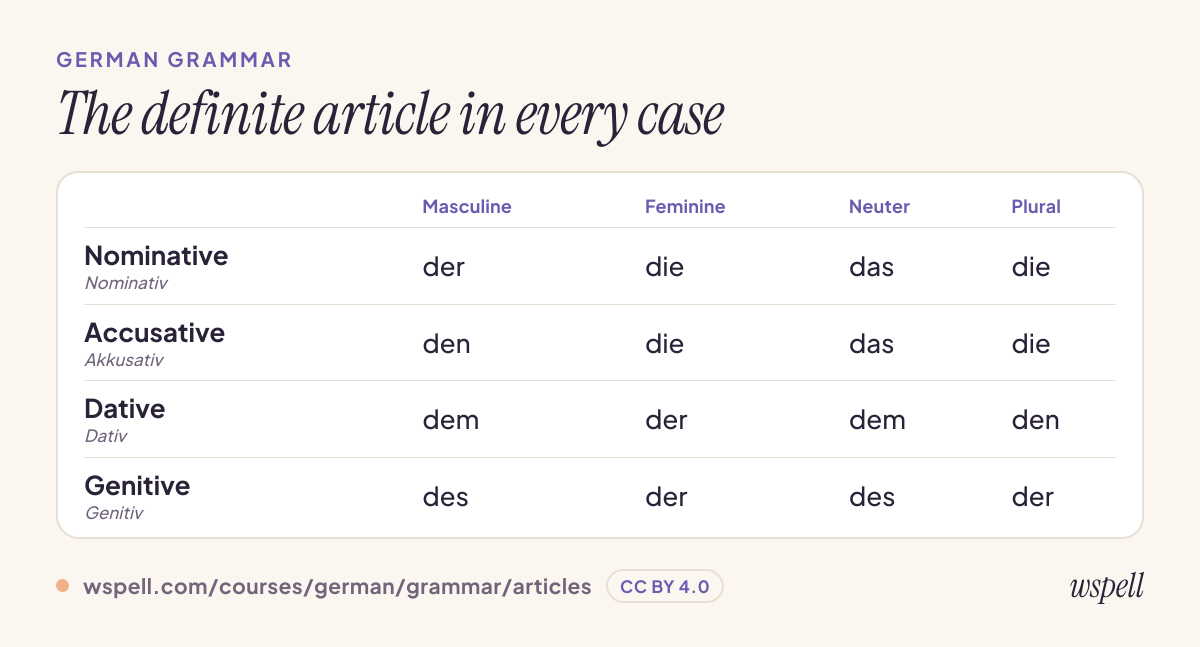
Der, die, das: gender, case and number in one word
German has three genders — masculine (der), feminine (die), neuter (das) — plus a shared plural (die). The article is not just 'the': it changes form across the four cases and carries the gender and number the noun itself often does not show. Learn to read case off the article.
- Der Mann liest die Zeitung. — The man is reading the newspaper.
- Das Kind spielt mit dem Ball. — The child is playing with the ball.
The indefinite article: ein, eine
| Masculine | Feminine | Neuter | Plural | |
|---|---|---|---|---|
| Nominative Nominativ | ein | eine | ein | — |
| Accusative Akkusativ | einen | eine | ein | — |
| Dative Dativ | einem | einer | einem | — |
| Genitive Genitiv | eines | einer | eines | — |
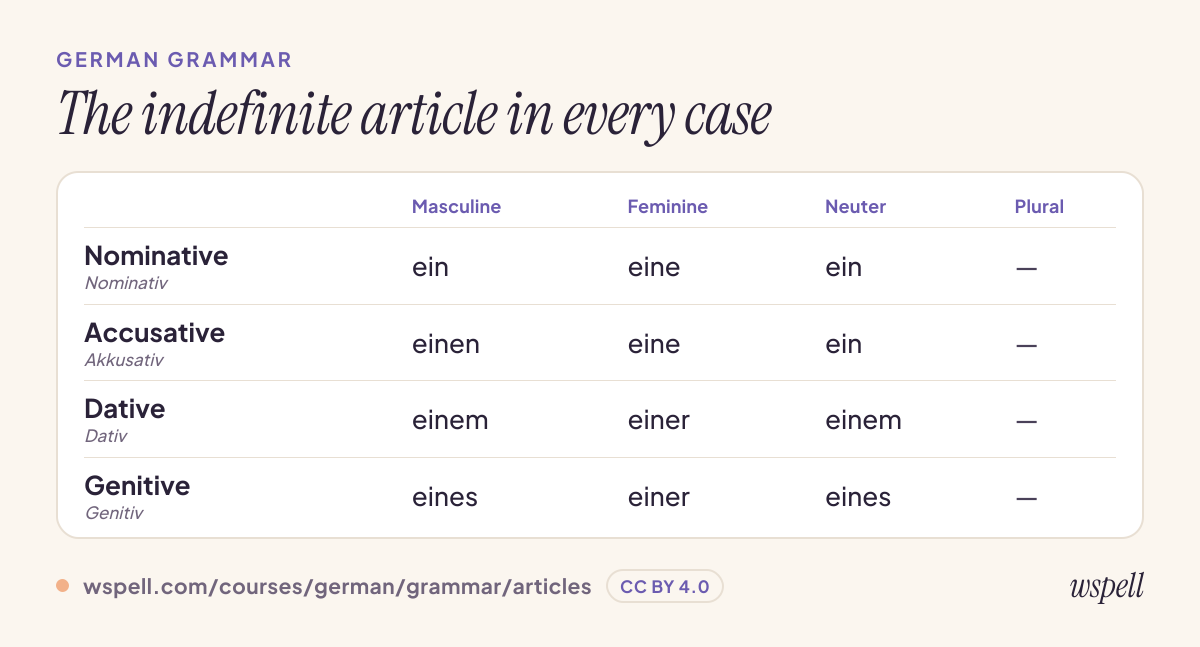
Ein, eine, ein — and no plural
The indefinite article is ein (m), eine (f) and ein (n) in the nominative — note that masculine and neuter are identical and ending-less. There is no plural indefinite article: 'houses' is simply Häuser, not any form of ein.
- Ein Mann steht an der Tür. — A man is standing at the door.
- Das ist eine gute Idee. — That is a good idea.
Kein: no, not a
| Case | Masculine Mann | Feminine Frau | Neuter Kind | Plural Kinder |
|---|---|---|---|---|
| Nominative Nominativ | kein Mann | keine Frau | kein Kind | keine Kinder |
| Accusative Akkusativ | keinen Mann | keine Frau | kein Kind | keine Kinder |
| Dative Dativ | keinem Mann | keiner Frau | keinem Kind | keinen Kindern |
| Genitive Genitiv | keines Mannes | keiner Frau | keines Kindes | keiner Kinder |
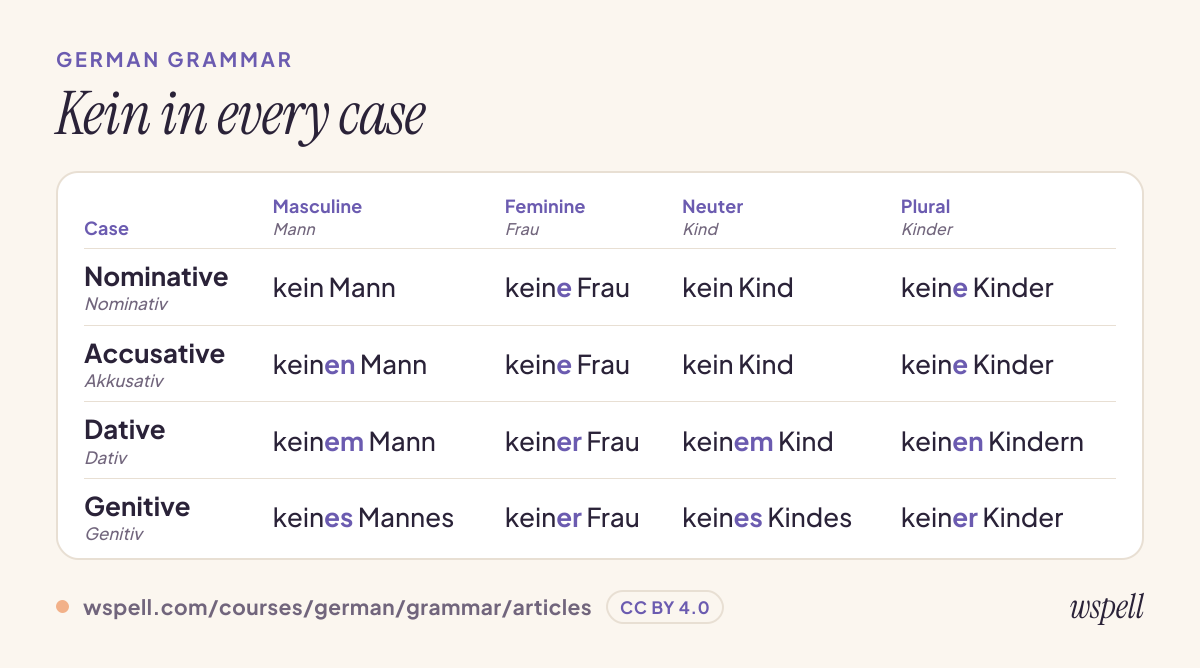
Kein: the negative article, with a plural
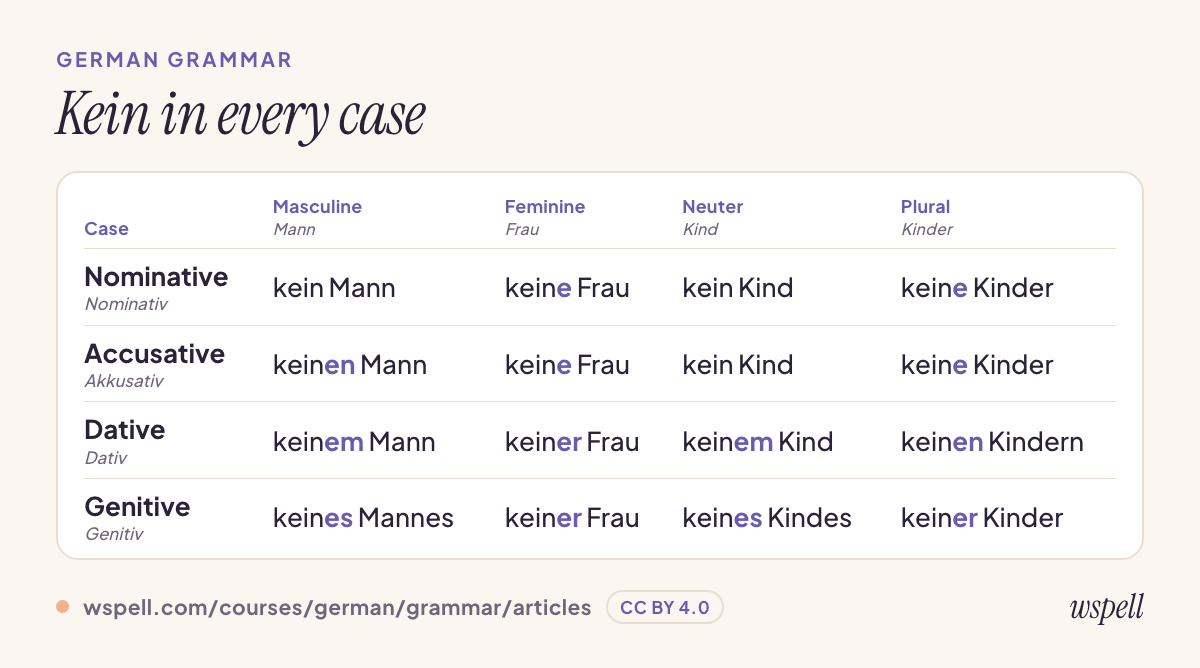
kein ('no / not a / not any') negates a noun and declines exactly like ein — kein/keine/kein, keinen…, keinem… — with one addition: unlike ein it has a plural, keine. Use it wherever English says 'no' or 'not any' before a noun.
- Ich habe kein Auto. — I have no car.
- Wir haben keine Kinder. — We have no children.
Kein or nicht?
Use kein to negate a noun that would otherwise take ein or no article (Ich habe kein Geld). Use nicht to negate a verb, an adjective, or a noun already fixed by der/a possessive (Das ist nicht mein Auto; Ich komme nicht). Choosing nicht where kein belongs is a classic error.
- Ich habe kein Geld. — I have no money.
- Das ist nicht mein Auto. — That is not my car.
Der, ein — or no article?
Der for the known, ein for the new
Use the indefinite ein to introduce something for the first time or as one of many, and the definite der/die/das once it is known, unique or already mentioned. A thing typically enters a text with ein and is picked up again with der.
- Dort steht ein Auto. Das Auto ist rot. — A car is standing over there. The car is red.
- Die Sonne scheint. — The sun is shining.
Er ist Lehrer: no article for jobs and nationalities
After sein or werden, a bare noun (no article) names a profession, nationality or religion: Er ist Lehrer, Sie wird Ärztin, Ich bin Deutscher. English keeps 'a' here, German drops it — adding ein is a typical English-speaker mistake unless the noun is modified (ein guter Lehrer).
- Sie ist Ärztin. — She is a doctor.
- Mein Bruder wird Lehrer. — My brother is becoming a teacher.
Im, am, zum, zur, ins: preposition and article in one word
| Dative Dativ | Accusative Akkusativ | |
|---|---|---|
| an dem | am | — |
| bei dem | beim | — |
| in dem | im | — |
| von dem | vom | — |
| zu dem | zum | — |
| zu der | zur | — |
| an das | — | ans |
| in das | — | ins |
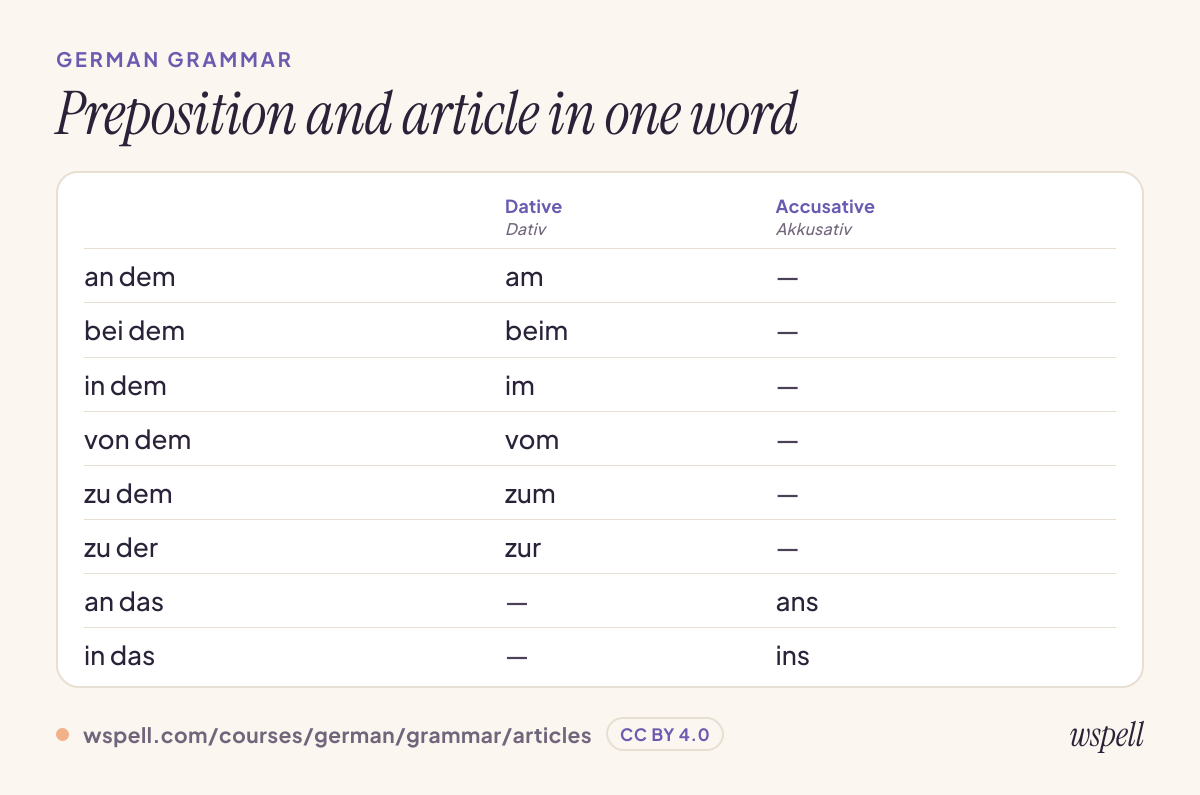
Im, am, zum, zur, ins: the everyday forms
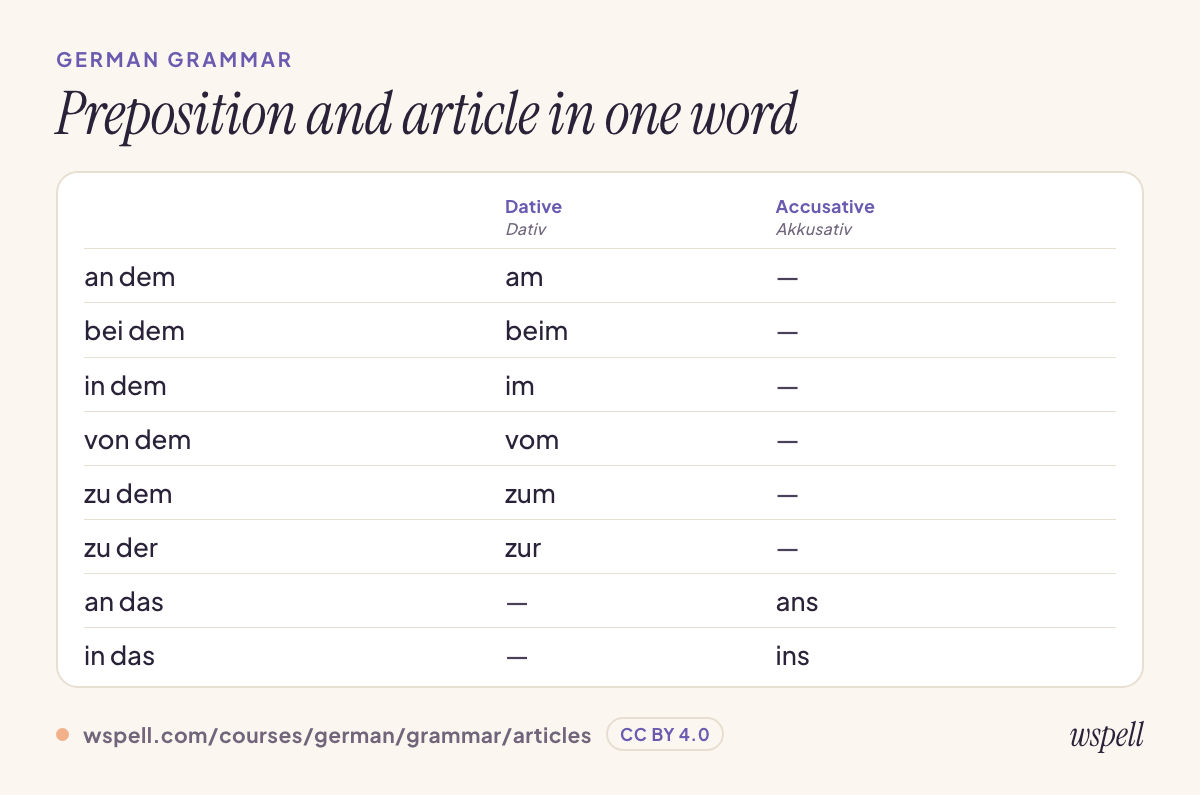
A preposition and a following dative/accusative article routinely fuse: in dem → im, an dem → am, bei dem → beim, von dem → vom, zu dem → zum, zu der → zur, in das → ins, an das → ans. These forms are the normal, everyday spoken and written choice.
- Wir gehen ins Kino. — We are going to the cinema.
- Am Montag gehe ich zum Arzt. — On Monday I go to the doctor.
Der, die or das? Clues from the ending
Learn every noun with der, die or das
German gender is a property of the word, not of meaning: das Mädchen ('girl') is neuter, die Person is always feminine, der Tisch masculine. Because it barely correlates with sense, the only safe habit is to memorise each noun together with der/die/das, never the noun alone.
- Das Mädchen ist noch jung. — The girl is still young.
- Der Tisch steht am Fenster. — The table stands by the window.
-ung, -heit, -keit, -schaft, -ion, -tät: die
A reliable set of derivational suffixes makes a noun feminine almost without exception: -ung, -heit, -keit, -schaft, -ion, -tät. Nouns in -ik and -ur are mostly feminine too (die Musik, die Kultur), though not all: das Abitur. If a noun ends in one of the first six, use die.
- Die Zeitung liegt auf dem Tisch. — The newspaper is lying on the table.
- Die Freiheit ist wichtig. — Freedom is important.
-er, -ling, -ismus, -or: mostly der
Agent nouns in -er (der Lehrer, der Fahrer), plus the suffixes -ling, -ismus and -or, are typically masculine. The -er clue is only a tendency — remember die Mutter, die Butter are feminine — but for people who do something it is dependable.
- Der Lehrer erklärt die Regel. — The teacher explains the rule.
- Der Motor ist kaputt. — The engine is broken.
-chen and -lein: always das
The diminutive suffixes -chen and -lein make any noun neuter, whatever the base word's gender, and usually umlaut the stem: die Frau → das Fräulein, der Hund → das Hündchen, das Brot → das Brötchen. This is why das Mädchen (from die Magd) is neuter.
- Das Brötchen schmeckt gut. — The bread roll tastes good.
- Wo ist das Kätzchen? — Where is the kitten?
Nouns in -e: mostly die
Most nouns ending in -e are feminine: die Lampe, die Blume, die Straße, die Katze. Watch the frequent exceptions: der Name, der Käse, der Junge are masculine, and das Auge, das Ende are neuter.
- Die Lampe ist neu. — The lamp is new.
- Der Name ist zu lang. — The name is too long.
practise this chart
Drill these forms in real sentences — every answer checked.
practise now — free to try; some drills ask for a free account
save or print this chart
Under the main tables on this page sits a picture of each — keep one on your phone, share it or print it.
Free to share and adapt under CC BY 4.0 — credit wspell and link to this page. the licence
credit line to copy: German articles chart: der, die, das, ein and kein in every case — wspell, CC BY 4.0, https://wspell.com/courses/german/grammar/articles
questions
What are the German articles in all four cases?
Definite: der, die, das, die (nominative); den, die, das, die (accusative); dem, der, dem, den (dative); des, der, des, der (genitive). Indefinite: ein, eine, ein; einen, eine, ein; einem, einer, einem; eines, einer, eines.
When does der become den?
In the masculine accusative: der Mann → Ich sehe den Mann. Feminine, neuter and plural articles are the same in the nominative and the accusative. Den is also the dative plural: mit den Kindern.
How do I know if a German noun is der, die or das?
Learn every noun with its article. Some endings help: -ung, -heit, -keit, -schaft, -ion and -tät are feminine, -chen and -lein neuter, and most nouns in -e are feminine, with exceptions such as der Name.