grammar chart · German
German personal pronouns chart: ich, mich, mir
German personal pronouns change with the case: ich is the subject, mich the direct object and mir the receiver. The table gives all nine — with sie (she), sie (they) and the formal Sie — in the nominative, accusative and dative; their genitive forms are rare today. Below it come the reflexive pronouns: mich, dich and sich.
Personal pronouns in three cases
| Nominative Nominativ | Accusative Akkusativ | Dative Dativ |
|---|---|---|
| ich I | mich | mir |
| du you (informal) | dich | dir |
| er he | ihn | ihm |
| sie she | sie | ihr |
| es it | es | ihm |
| wir we | uns | uns |
| ihr you all (informal) | euch | euch |
| sie they | sie | ihnen |
| Sie you (formal) | Sie | Ihnen |
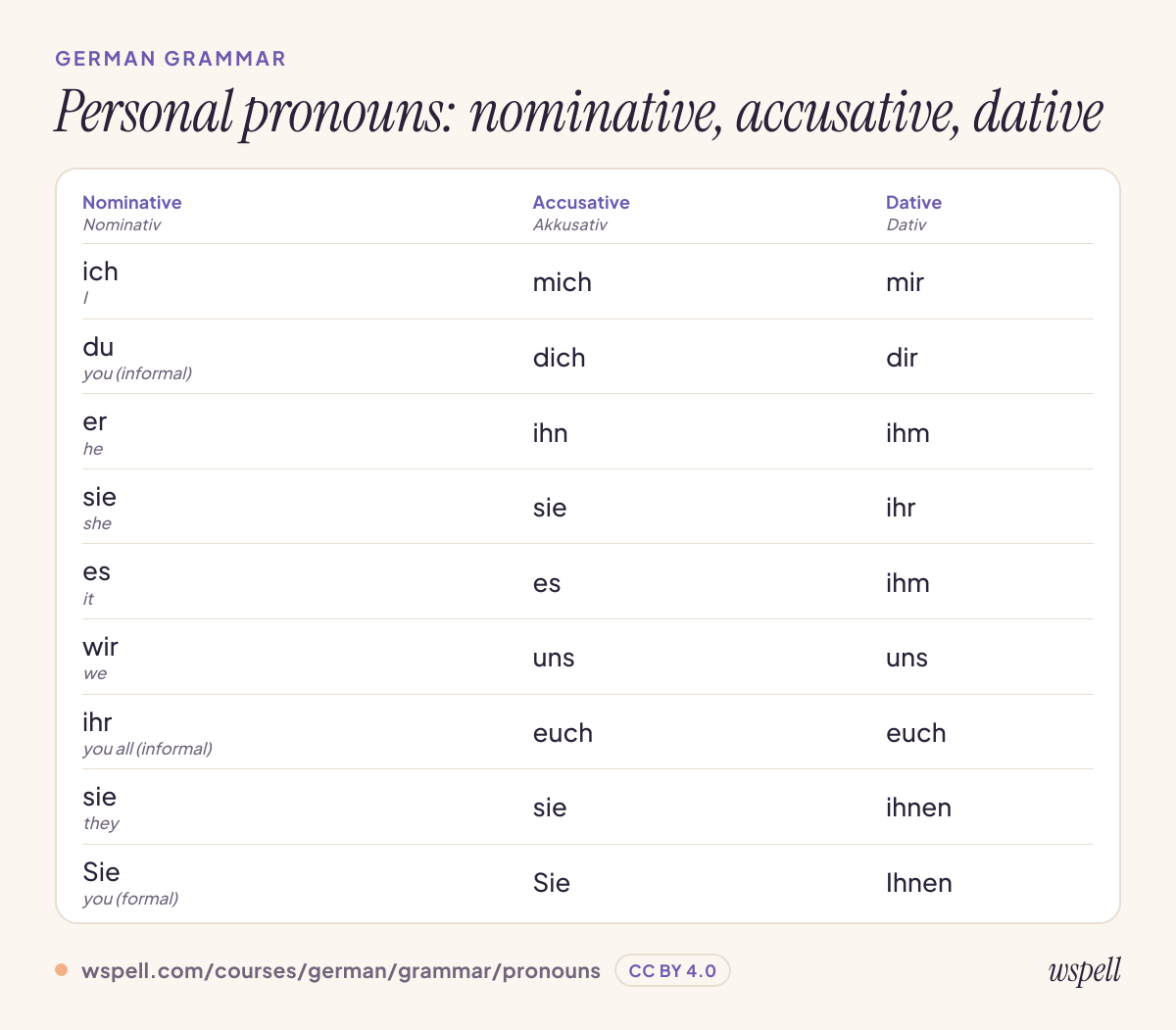
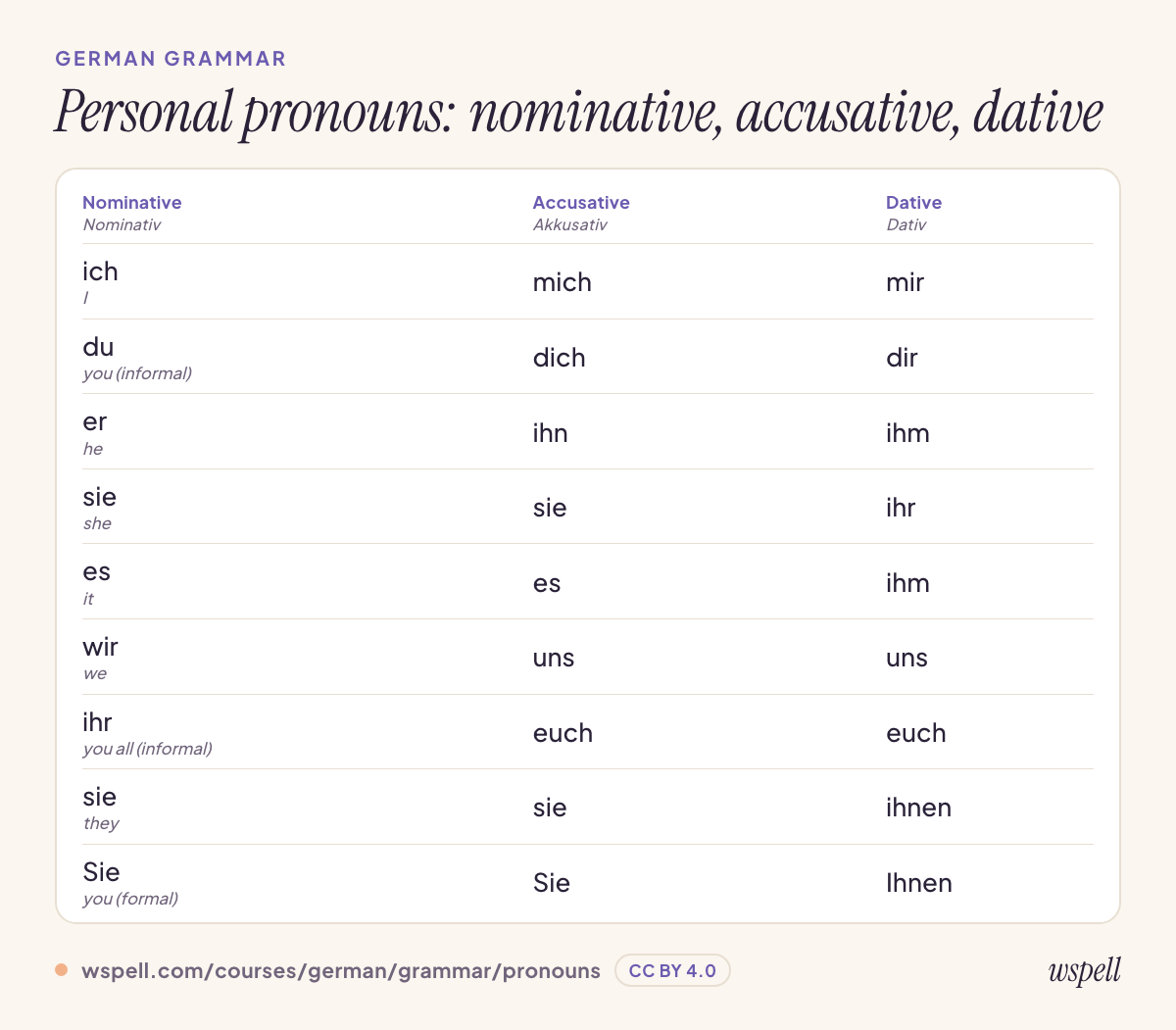
Ich, mich, mir: learn each pronoun in three cases
German personal pronouns inflect for three everyday cases (the genitive is rare and formal). Learn each person as a nom–akk–dat triple, e.g. ich–mich–mir, du–dich–dir, er–ihn–ihm, so the right form is automatic from the verb or preposition.
- Er kennt mich, ich kenne ihn, und sie vertraut mir. — He knows me, I know him, and she trusts me.
Er, ihn, ihm: one he, three forms
Where English uses him for both objects, German keeps three separate masculine forms: er (subject), ihn (accusative / direct object), ihm (dative / indirect object). Picking ihn vs ihm depends only on the case the verb or preposition needs.
- Ich sehe ihn. — I see him. (accusative)
- Ich gebe ihm das Buch. — I give him the book. (dative)
Der Tisch → er: pronouns follow the noun's gender
A third-person pronoun agrees with the grammatical gender of the noun it stands for, not with natural sex: der Tisch → er, die Lampe → sie, das Auto → es. So an inanimate der-noun is er, not es.
- Wo ist der Tisch? — Er steht dort. — Where is the table? — It is over there.
- Die Lampe ist neu; sie war teuer. — The lamp is new; it was expensive.
- Das Auto? Ich habe es verkauft. — The car? I sold it.
Du, ihr or Sie?
du is informal singular (family, friends, children); ihr is informal plural (addressing several such people); Sie is the polite form for one or many strangers, elders, and formal settings, and is always capitalised with a plural verb.
- Papa, kommst du mit? — Dad, are you coming? (informal singular)
- Kinder, seid ihr fertig? — Kids, are you ready? (informal plural)
- Herr Müller, was möchten Sie trinken? — Mr. Müller, what would you like to drink? (formal)
Sie, sie, Sie: she, they and formal you
One spoken form covers three meanings: sie = she (singular verb), sie = they (plural verb), and Sie = formal you (plural verb, always capitalised). Verb agreement and, in writing, the capital letter tell them apart.
- Sie ist Ärztin, aber sie sind Studenten. — She is a doctor, but they are students.
- Woher kommen Sie? — Where do you come from? (formal)
Reflexive pronouns: mich, dich, sich
| Nominative Nominativ | Reflexive |
|---|---|
| ich I | mich |
| du you (informal) | dich |
| er he | sich |
| sie she | sich |
| es it | sich |
| wir we | uns |
| ihr you all (informal) | euch |
| sie they | sich |
| Sie you (formal) | sich |
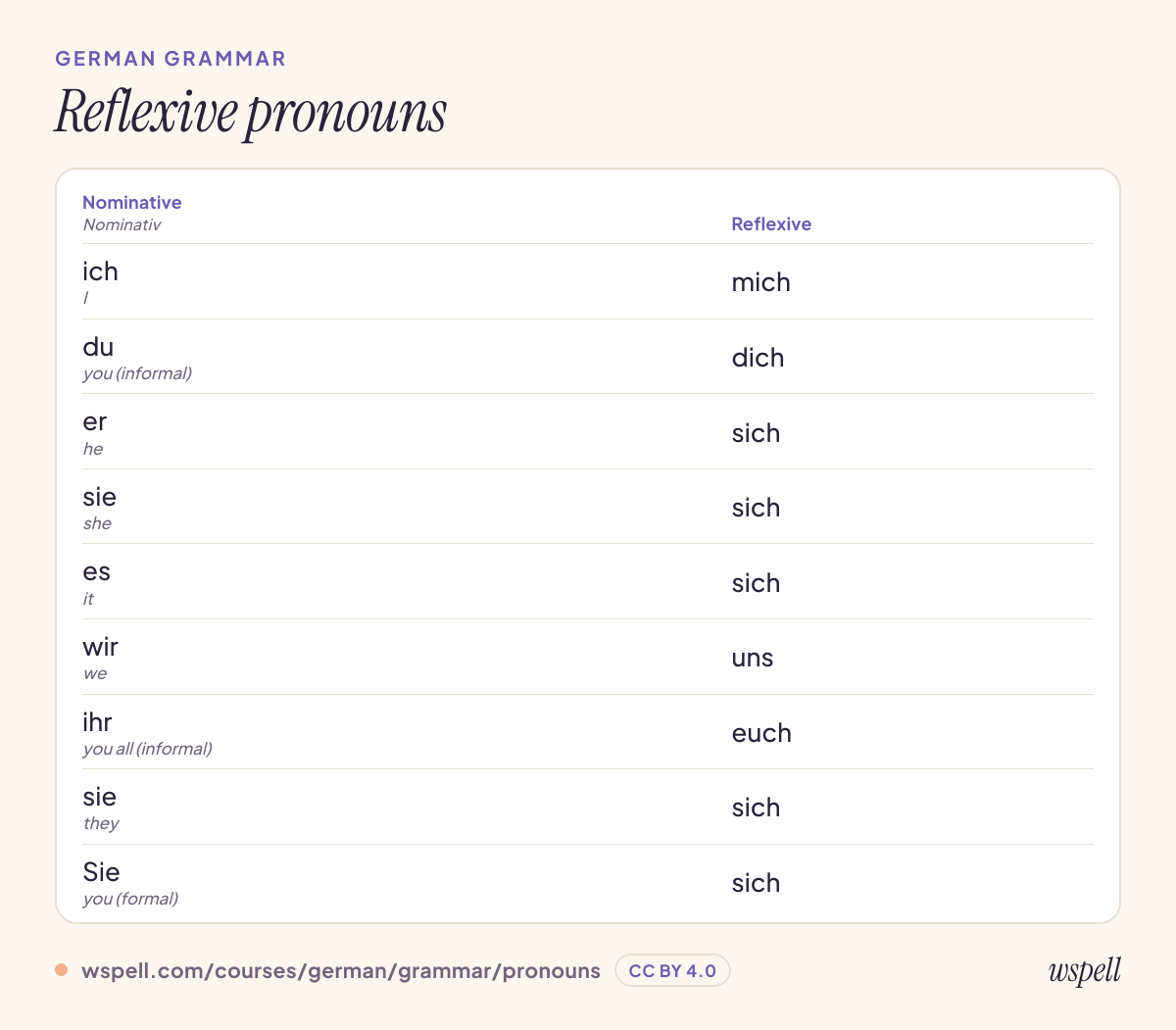
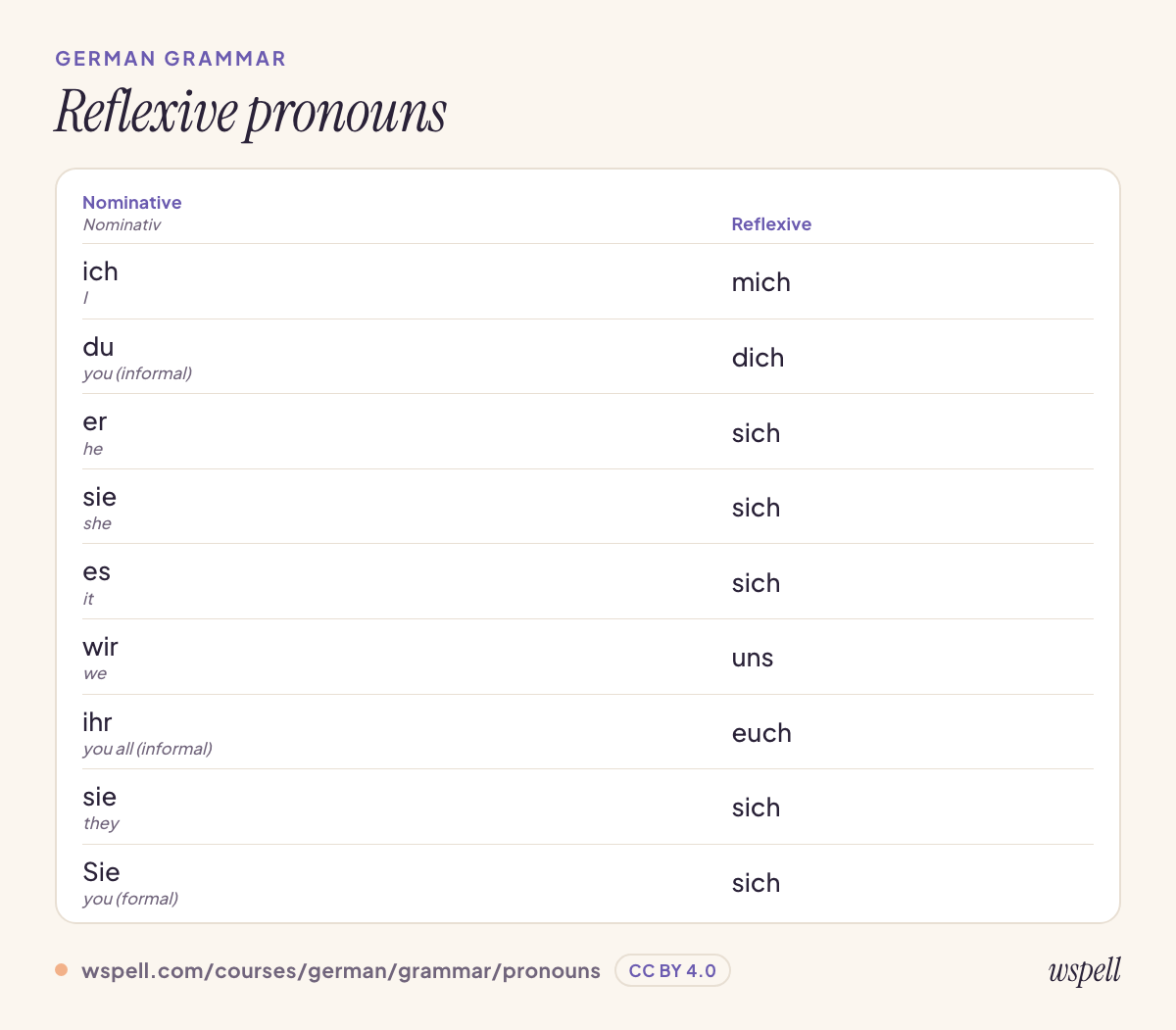
Mich, dich, sich
A reflexive pronoun points the action back at the subject. In the 1st/2nd person it equals the ordinary object pronoun (mich, dich, uns, euch); all third persons and formal Sie use the special word sich.
- Ich freue mich auf das Wochenende. — I am looking forward to the weekend.
- Setz dich bitte. — Please sit down.
Ich wasche mich, ich wasche mir die Hände
When the reflexive IS the direct object it is accusative (ich wasche mich). When there is already an accusative object, the reflexive becomes the dative beneficiary (ich wasche mir die Hände). Only the 1st/2nd singular show this contrast (mich/mir, dich/dir).
- Ich wasche mich. — I wash myself.
- Ich wasche mir die Hände. — I wash my hands.
practise this chart
Drill these forms in real sentences — every answer checked.
practise now — free to try; some drills ask for a free account
save or print this chart
Under the main tables on this page sits a picture of each — keep one on your phone, share it or print it.
Free to share and adapt under CC BY 4.0 — credit wspell and link to this page. the licence
credit line to copy: German personal pronouns chart: ich, mich, mir — wspell, CC BY 4.0, https://wspell.com/courses/german/grammar/pronouns
questions
What is the difference between ihn and ihm?
Ihn is accusative (the direct object: Ich sehe ihn), ihm is dative (the receiver: Ich gebe ihm das Buch). The verb or the preposition decides which one you need.
When do you use du, ihr and Sie?
Du for one person you know well, ihr for several of them, and Sie — always with a capital S and a plural verb — for one or more people you address formally.
Do German personal pronouns have a genitive?
They do (meiner, deiner, seiner), but it is rare and formal today. Possession is said with mein, dein and sein, and after wegen or statt everyday speech takes the dative instead (wegen mir).