grammar chart · German
German modal verbs chart: können, müssen, dürfen, wollen, sollen, mögen
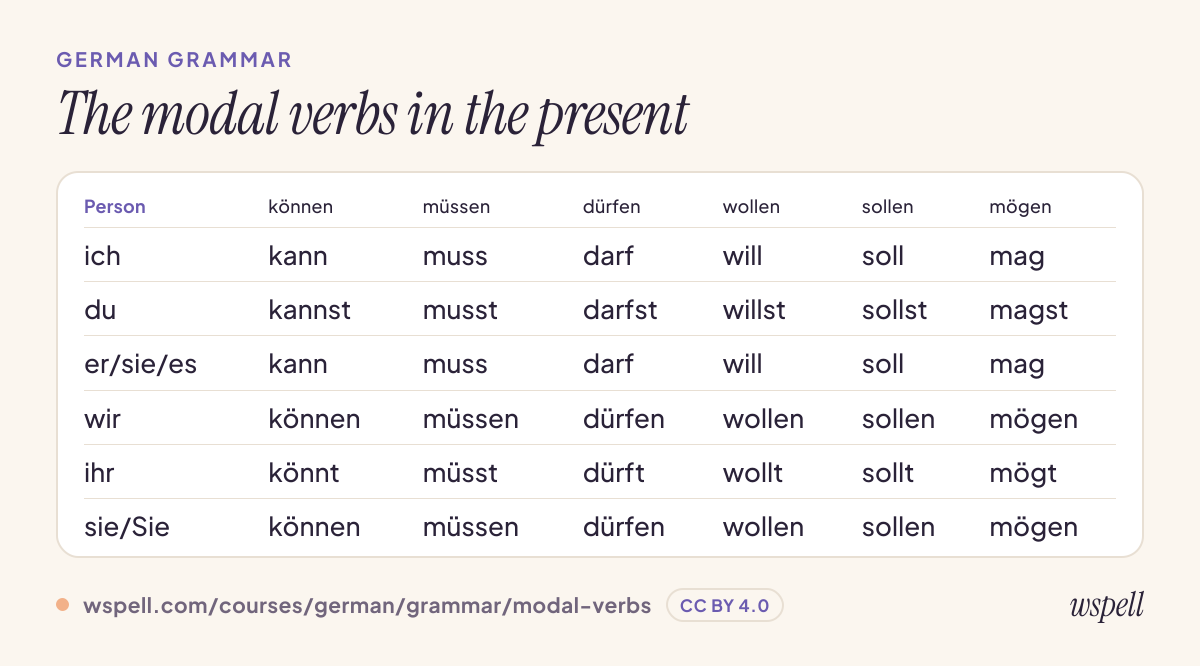
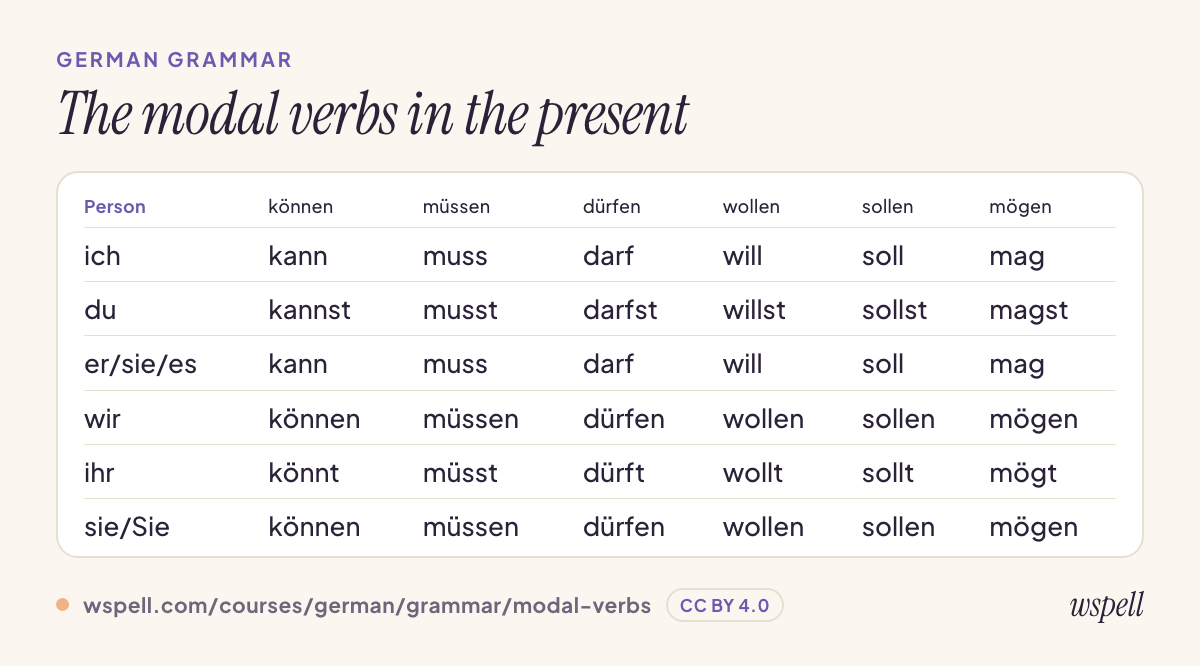
German has six modal verbs: können (can), müssen (must), dürfen (may), wollen (want), sollen (should) and mögen (like). In the present their ich- and er-forms are the same and have no ending, and all but sollen change their vowel in the singular. The verb that follows stays in the infinitive, at the end of the clause; after weil or dass the modal itself comes last (…, weil ich arbeiten muss).
The six modal verbs in the present
| Person | können | müssen | dürfen | wollen | sollen | mögen |
|---|---|---|---|---|---|---|
| ich | kann | muss | darf | will | soll | mag |
| du | kannst | musst | darfst | willst | sollst | magst |
| er/sie/es | kann | muss | darf | will | soll | mag |
| wir | können | müssen | dürfen | wollen | sollen | mögen |
| ihr | könnt | müsst | dürft | wollt | sollt | mögt |
| sie/Sie | können | müssen | dürfen | wollen | sollen | mögen |
How the modal verbs conjugate
All modals share one pattern: the ich- and er/sie/es-forms are identical and take NO ending, and five of the six change their stem vowel in the singular (kann/muss/darf/will/mag; only sollen keeps -o-). The plural forms are regular.
- Er kann heute nicht kommen. — He can't come today.
- Ich muss und du musst auch. — I have to and you have to as well.
What each modal verb means
Können: can, be able to
können means 'can/be able to' (learned ability, or possibility in a situation): ich kann, du kannst, er kann, wir können, ihr könnt, sie können. Like every modal, its ich- and er-forms are identical and take no ending; like most of them, it changes its vowel in the singular.
- Ich kann gut schwimmen. — I can swim well.
- Kannst du mir helfen? — Can you help me?
Müssen: must, have to
müssen means 'must/have to' (necessity): ich muss, du musst, er muss, wir müssen, ihr müsst, sie müssen. Note the singular has -u- and the plural -ü-.
- Ich muss jetzt gehen. — I have to go now.
- Wir müssen noch einkaufen. — We still have to go shopping.
Dürfen: may, be allowed to
dürfen means 'may/be allowed to' (permission): ich darf, du darfst, er darf, wir dürfen, ihr dürft, sie dürfen. The singular has -a-, the plural -ü-.
- Darf ich hier sitzen? — May I sit here?
- Kinder dürfen hier spielen. — Children are allowed to play here.
Wollen: want to
wollen means 'want to / intend to' (a firm wish): ich will, du willst, er will, wir wollen, ihr wollt, sie wollen. Beware the false friend: ich will means 'I want', not 'I will'.
- Ich will Deutsch lernen. — I want to learn German.
- Sie wollen ein Haus kaufen. — They want to buy a house.
Sollen: should, be supposed to
sollen means 'should / be supposed to' (an obligation or expectation coming from someone else): ich soll, du sollst, er soll, wir sollen, ihr sollt, sie sollen. It is the only modal with no vowel change in the singular.
- Du sollst mehr schlafen. — You should sleep more.
- Ich soll den Arzt anrufen. — I'm supposed to call the doctor.
Mögen and möchte: like, would like
mögen means 'to like' (mag, magst, mag, mögen, mögt, mögen) and is often used without an infinitive: Ich mag Kaffee. Its Konjunktiv II möchte means 'would like' and is the polite way to order or request: ich möchte, du möchtest, er möchte, wir möchten, ihr möchtet, sie möchten.
- Ich mag keinen Fisch. — I don't like fish.
- Ich möchte einen Kaffee, bitte. — I would like a coffee, please.
The second verb goes to the end
A modal verb takes a second verb in the infinitive, which moves to the very end of the clause, forming a verb bracket: Ich muss heute lange arbeiten. The modal is conjugated in position 2; the plain infinitive closes the clause.
- Ich kann heute Abend nicht kommen. — I can't come this evening.
- Wir wollen im Sommer nach Italien fahren. — We want to go to Italy in summer.
Nicht müssen or nicht dürfen?
These two negations are opposites in meaning. nicht dürfen = 'must not / not allowed to' (a prohibition): Du darfst nicht rauchen. nicht müssen (or kein … müssen) = 'not have to / need not' (absence of necessity): Du musst nicht kommen.
- Du darfst nicht rauchen. — You must not smoke.
- Du musst nicht warten, geh ruhig. — You don't have to wait, go ahead.
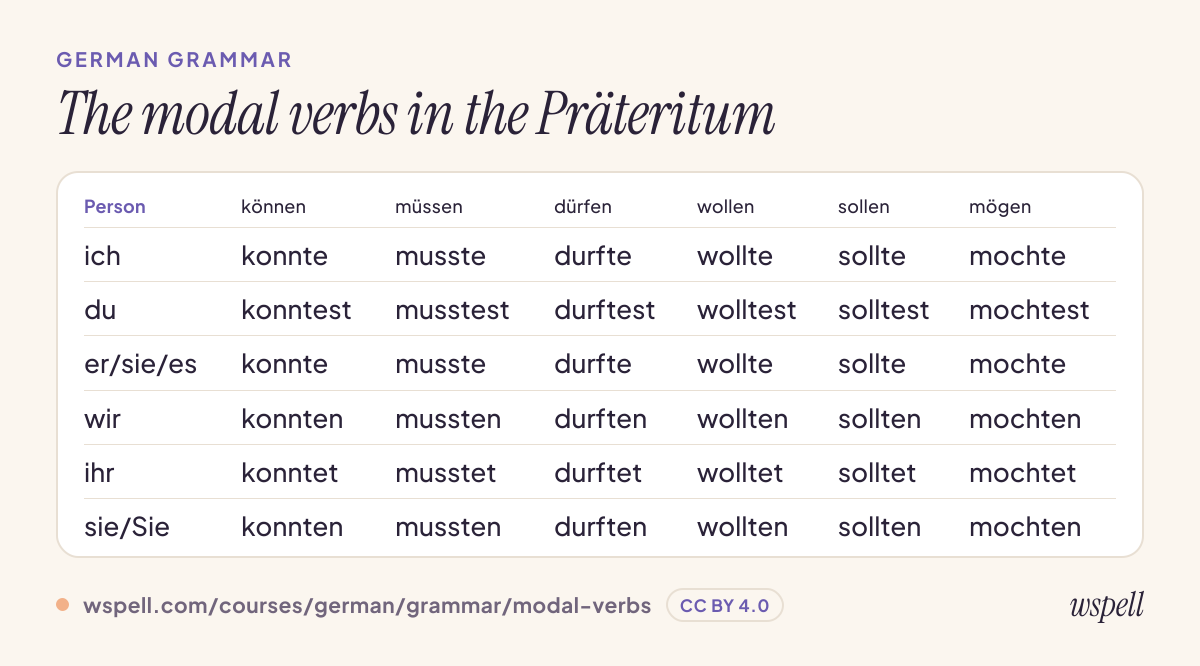
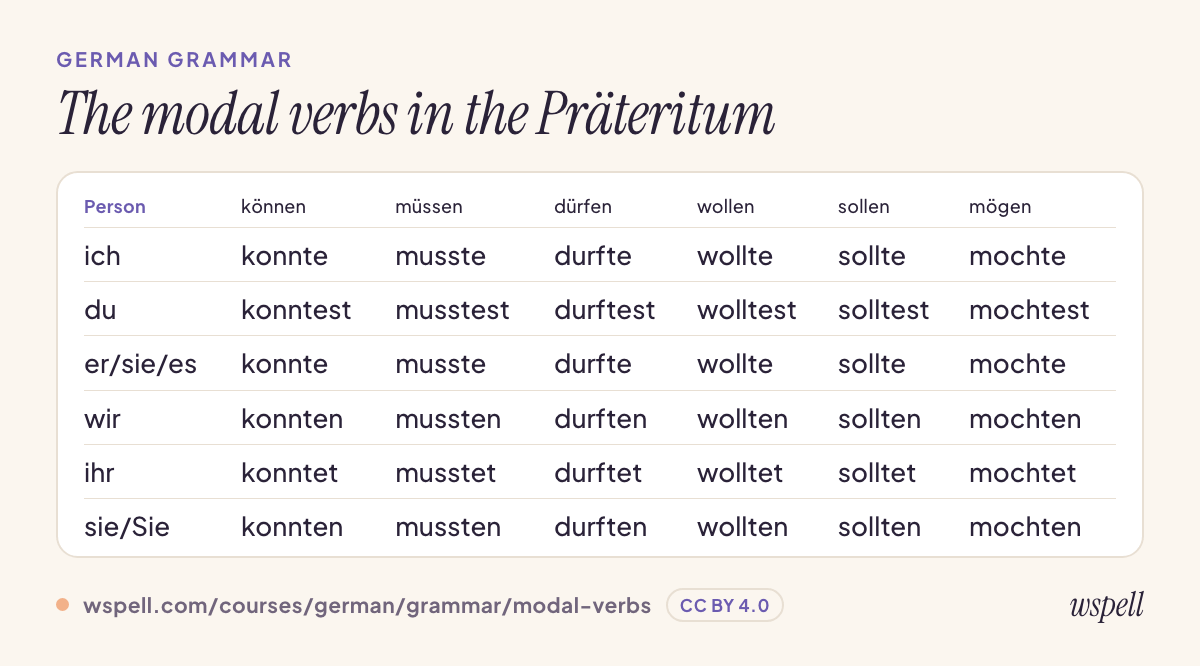
The modal verbs in the past: konnte, musste
| Person | können | müssen | dürfen | wollen | sollen | mögen |
|---|---|---|---|---|---|---|
| ich | konnte | musste | durfte | wollte | sollte | mochte |
| du | konntest | musstest | durftest | wolltest | solltest | mochtest |
| er/sie/es | konnte | musste | durfte | wollte | sollte | mochte |
| wir | konnten | mussten | durften | wollten | sollten | mochten |
| ihr | konntet | musstet | durftet | wolltet | solltet | mochtet |
| sie/Sie | konnten | mussten | durften | wollten | sollten | mochten |
War, hatte, konnte: the Präteritum in speech
Even in speech, sein, haben, werden and the modal verbs normally use the Präteritum rather than the Perfekt: sein → war, haben → hatte, werden → wurde, können → konnte, müssen → musste, wollen → wollte. Learn war/hatte early.
- Gestern war ich krank. — Yesterday I was ill.
- Wir hatten keine Zeit. — We had no time.
learn it step by step
save or print this chart
Under the main tables on this page sits a picture of each — keep one on your phone, share it or print it.
Free to share and adapt under CC BY 4.0 — credit wspell and link to this page. the licence
credit line to copy: German modal verbs chart: können, müssen, dürfen, wollen, sollen, mögen — wspell, CC BY 4.0, https://wspell.com/courses/german/grammar/modal-verbs
questions
What are the six German modal verbs?
Können (can), müssen (must, have to), dürfen (may, be allowed to), wollen (want to), sollen (should, be supposed to) and mögen (like). Möchte, 'would like', is a form of mögen.
What is the difference between nicht müssen and nicht dürfen?
Du musst nicht kommen means you don't have to come; du darfst nicht kommen means you are not allowed to come.
Where does the second verb go after a modal verb?
To the end of the clause, as an infinitive without zu: Ich kann heute nicht kommen. Wir wollen im Sommer nach Italien fahren.