grammar chart · German
German plural nouns: the five plural endings
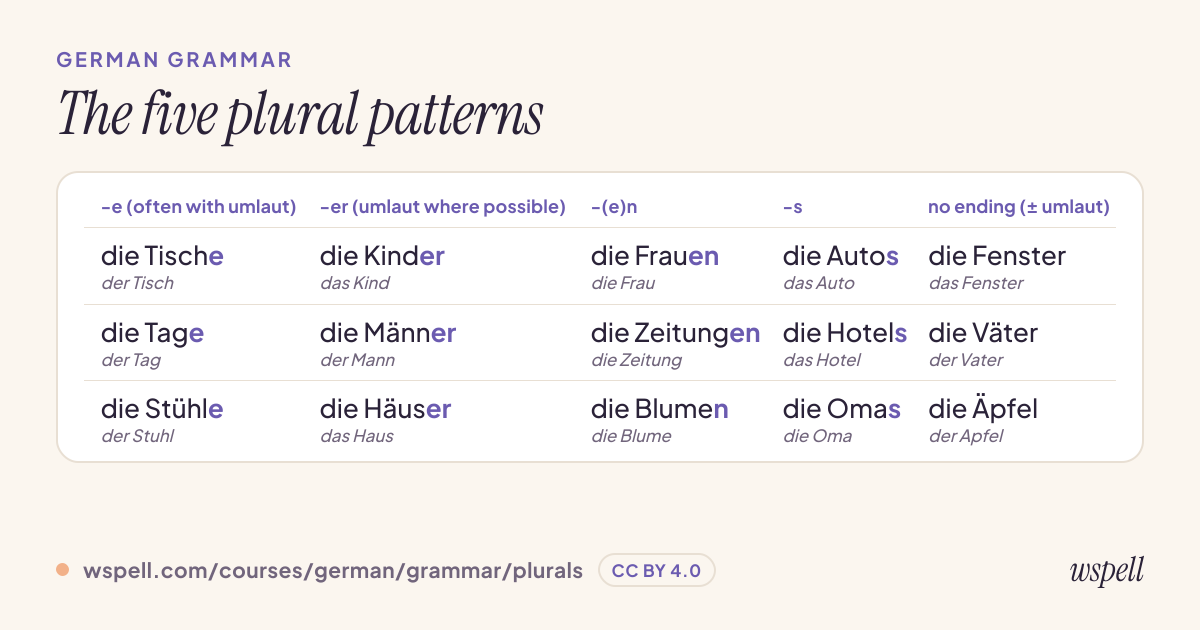
German plurals come in five patterns: -e, -er, -(e)n, -s or no ending at all, and the -e, -er and no-ending groups often add an umlaut (Stühle, Männer, Väter). In the nominative and accusative plural the article is die for every gender (den in the dative, der in the genitive). Which pattern a noun takes is only partly predictable, so learn every noun with its article and its plural.
The five plural patterns
| -e (often with umlaut) | -er (umlaut where possible) | -(e)n | -s | no ending (± umlaut) | |
|---|---|---|---|---|---|
| die Tische der Tisch | die Kinder das Kind | die Frauen die Frau | die Autos das Auto | die Fenster das Fenster | |
| die Tage der Tag | die Männer der Mann | die Zeitungen die Zeitung | die Hotels das Hotel | die Väter der Vater | |
| die Stühle der Stuhl | die Häuser das Haus | die Blumen die Blume | die Omas die Oma | die Äpfel der Apfel |
Five ways to form the plural
German builds the plural in five broad ways — add -e, add -er, add -(e)n, add -s, or add nothing — often with an umlaut on top. Which one a noun uses is only partly predictable, so learn each noun's plural together with its article, exactly as you learn its gender.
- Ein Buch, zwei Bücher. — One book, two books.
- Hier stehen viele Tische. — There are many tables here.
Each pattern in detail
-e, often with an umlaut: Tische, Stühle
A large group, mostly masculine, forms the plural in -e, and where the stem vowel can umlaut it usually does: der Tisch → die Tische, der Stuhl → die Stühle, die Hand → die Hände, der Tag → die Tage. Whether the umlaut appears has to be learned per noun.
- Die Stühle stehen im Garten. — The chairs are in the garden.
- Ich habe zwei Hände. — I have two hands.
-er, with an umlaut where possible: Kinder, Häuser
Many neuter and some masculine nouns take -er, and they umlaut a, o, u whenever the vowel allows: das Kind → die Kinder, das Buch → die Bücher, das Haus → die Häuser, der Mann → die Männer. If the noun is neuter and short, -er is a good guess.
- Die Kinder spielen im Park. — The children are playing in the park.
- Ich lese zwei Bücher. — I am reading two books.
-(e)n, the plural of most feminine nouns: Frauen
The -(e)n plural is the reliable one: it never takes an umlaut, and most feminine nouns use it — die Frau → die Frauen, die Blume → die Blumen, die Zeitung → die Zeitungen. Nouns in -e, and feminine nouns in -el and -er, add just -n (Blumen, Regeln, Schwestern); others add -en, and -in becomes -innen (Lehrerinnen). A few common feminine nouns take -e or no ending with an umlaut instead: die Hand → die Hände, die Mutter → die Mütter.
- Die Frauen arbeiten hier. — The women work here.
- Ich kaufe drei Zeitungen. — I am buying three newspapers.
-s for loanwords: Autos, Hotels
The -s plural, borrowed from English and French, attaches to many loanwords, abbreviations and nouns ending in a full vowel: das Auto → die Autos, das Hotel → die Hotels, die Oma → die Omas, die CD → die CDs. It never umlauts.
- Die Autos stehen auf der Straße. — The cars are parked on the street.
- Wir übernachten in zwei Hotels. — We are staying in two hotels.
No ending: Fenster, Väter
Most masculine and neuter nouns ending in -er, -el or -en add no plural ending at all; the singular and plural look alike except for a possible umlaut and the article: der Lehrer → die Lehrer, das Fenster → die Fenster, der Apfel → die Äpfel, der Vater → die Väter. The article die is then your only plural signal.
- Die Lehrer sind heute nicht da. — The teachers are not here today.
- Wir kaufen frische Äpfel. — We are buying fresh apples.
The umlaut that marks the plural
Across the -e, -er and zero classes, a stem a, o, u or au very often shifts to ä, ö, ü or äu in the plural: die Mutter → die Mütter, der Vater → die Väter, die Nacht → die Nächte, der Baum → die Bäume. The umlaut alone can be what distinguishes plural from singular.
- Die Mütter warten vor der Schule. — The mothers are waiting outside the school.
- Die Nächte werden kälter. — The nights are getting colder.
The plural in the dative: -n
Die for every gender, -n in the dative
In the plural gender disappears: the article is die for what were masculine, feminine and neuter nouns alike. One case still marks the noun itself — the dative plural adds -n to the plural form (die Kinder → mit den Kindern), unless it already ends in -n or -s (Autos, Frauen).
- Ich spiele mit den Kindern. — I am playing with the children.
- Die Männer und die Frauen warten. — The men and the women are waiting.
Nouns with only a plural, or only a singular
Die Eltern, die Leute: only a plural
Some nouns exist only in the plural: die Leute, die Eltern, die Ferien, die Kosten — they take plural agreement and have no singular. Others are used only in the singular: das Obst, die Milch, das Gemüse are treated as uncountable and have no everyday plural.
- Die Leute warten draußen. — The people are waiting outside.
- Meine Eltern wohnen in Köln. — My parents live in Cologne.
practise this chart
Drill these forms in real sentences — every answer checked.
practise now — free to try; some drills ask for a free account
save or print this chart
Under the main tables on this page sits a picture of each — keep one on your phone, share it or print it.
Free to share and adapt under CC BY 4.0 — credit wspell and link to this page. the licence
credit line to copy: German plural nouns: the five plural endings — wspell, CC BY 4.0, https://wspell.com/courses/german/grammar/plurals
questions
How do you form the plural in German?
With one of five endings: -e (der Tisch → die Tische), -er (das Kind → die Kinder), -(e)n (die Frau → die Frauen), -s (das Auto → die Autos) or none (das Fenster → die Fenster), often with an umlaut.
What is the plural article in German?
Die, for every gender: der Mann → die Männer, die Frau → die Frauen, das Kind → die Kinder. In the dative it is den, and the noun adds -n: mit den Kindern.
Are German plurals predictable?
Partly. Most feminine nouns take -(e)n, many loanwords take -s, and most masculine and neuter nouns in -er, -el or -en take no ending. Learn the rest with the noun.