grammar chart · German
German verb conjugation: the present tense
In the present tense a German verb drops -en and adds an ending for each person: ich spiele, du spielst, er spielt, wir spielen, ihr spielt, sie spielen. Some strong verbs change their vowel in the du- and er-forms (du fährst, er spricht), and sein, haben and werden are irregular. One present tense covers both 'I play' and 'I am playing'.
Regular endings: spielen, arbeiten, heißen
| Person | Ending | spielen | arbeiten | heißen |
|---|---|---|---|---|
| ich | -e | spiele | arbeite | heiße |
| du | -st | spielst | arbeitest | heißt |
| er/sie/es | -t | spielt | arbeitet | heißt |
| wir | -en | spielen | arbeiten | heißen |
| ihr | -t | spielt | arbeitet | heißt |
| sie/Sie | -en | spielen | arbeiten | heißen |
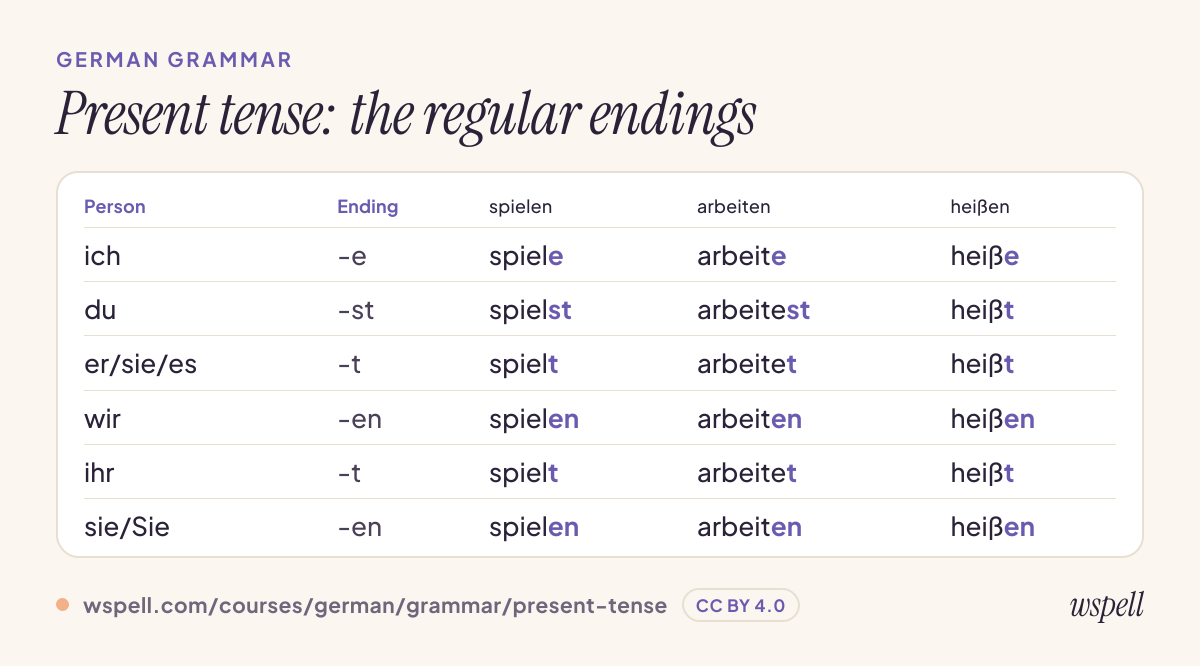
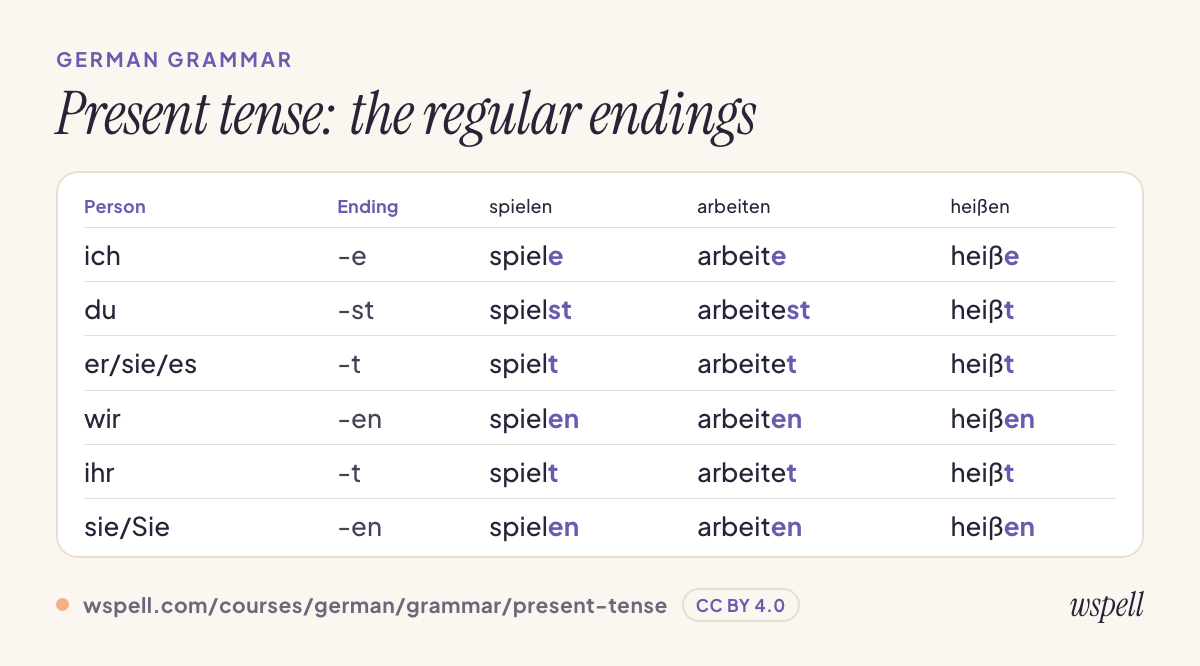
The endings -e, -st, -t, -en, -t, -en
Regular (weak) verbs drop the -en of the infinitive and add -e, -st, -t, -en, -t, -en to the stem. So spielen → ich spiele, du spielst, er/sie/es spielt, wir spielen, ihr spielt, sie/Sie spielen.
- Ich spiele gern Fußball. — I like to play football.
- Wir wohnen in Berlin. — We live in Berlin.
Du arbeitest: an extra -e- after -t and -d
When the stem ends in -t or -d, or in -m or -n after another consonant (atmen, öffnen, rechnen), an -e- is inserted before -st and -t so the ending can be pronounced: arbeiten → du arbeitest, er arbeitet, ihr arbeitet; finden → du findest, er findet; öffnen → du öffnest. After l, r or a silent h there is no -e-: lernen → du lernst, wohnen → du wohnst.
- Du arbeitest zu viel. — You work too much.
- Er findet den Schlüssel nicht. — He can't find the key.
Du heißt: -t instead of -st after s, ß, z
When the stem already ends in a sibilant (-s, -ß, -z, -x), the du-form ending loses its -s and is just -t, so it looks like the er-form: heißen → du heißt, tanzen → du tanzt, reisen → du reist.
- Wie heißt du? — What's your name?
- Du tanzt sehr gut. — You dance very well.
Verbs that change their vowel: fahren, sprechen, lesen
Only the du- and er/sie/es-forms change their vowel; the endings stay regular, except that after an s the du-form adds only -t (du liest).
| Person | Ending | fahren | sprechen | lesen |
|---|---|---|---|---|
| ich | -e | fahre | spreche | lese |
| du | -st | fährst | sprichst | liest |
| er/sie/es | -t | fährt | spricht | liest |
| wir | -en | fahren | sprechen | lesen |
| ihr | -t | fahrt | sprecht | lest |
| sie/Sie | -en | fahren | sprechen | lesen |
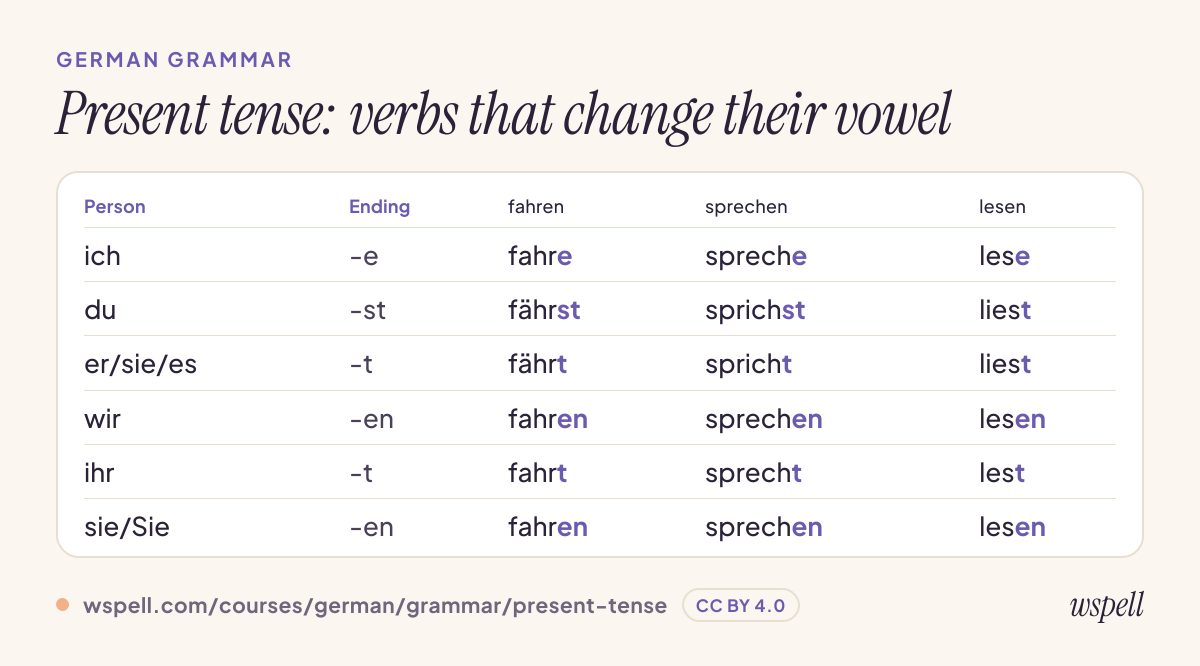
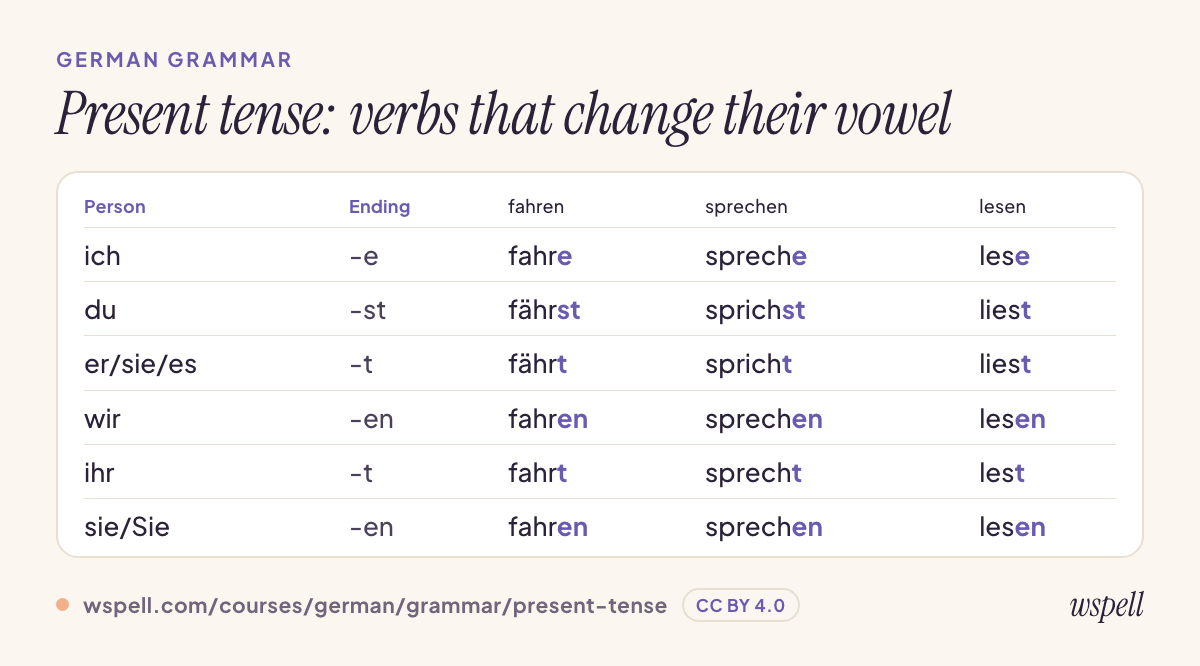
A becomes ä: du fährst, er fährt
Strong verbs with stem -a- take an umlaut -ä- in the du- and er/sie/es-forms: fahren → du fährst, er fährt; schlafen → du schläfst, er schläft; tragen → du trägst, er trägt; fallen → du fällst, er fällt. Other persons stay -a-.
- Er fährt nach Hamburg. — He is driving to Hamburg.
- Das Kind schläft schon. — The child is already asleep.
E becomes i: du sprichst, er spricht
Many strong verbs change stem -e- to -i- in the du- and er/sie/es-forms only; the other persons keep -e-. So geben → du gibst, er gibt; essen → du isst, er isst; sprechen → du sprichst, er spricht; nehmen → du nimmst, er nimmt.
- Er gibt mir das Buch. — He gives me the book.
- Du sprichst sehr schnell. — You speak very fast.
E becomes ie: du liest, er liest
A second group of strong verbs lengthens stem -e- to -ie- in the du- and er/sie/es-forms: lesen → du liest, er liest; sehen → du siehst, er sieht; empfehlen → du empfiehlst, er empfiehlt. The wir/ihr/sie forms keep -e-.
- Sie liest jeden Abend. — She reads every evening.
- Siehst du das Haus dort? — Do you see the house over there?
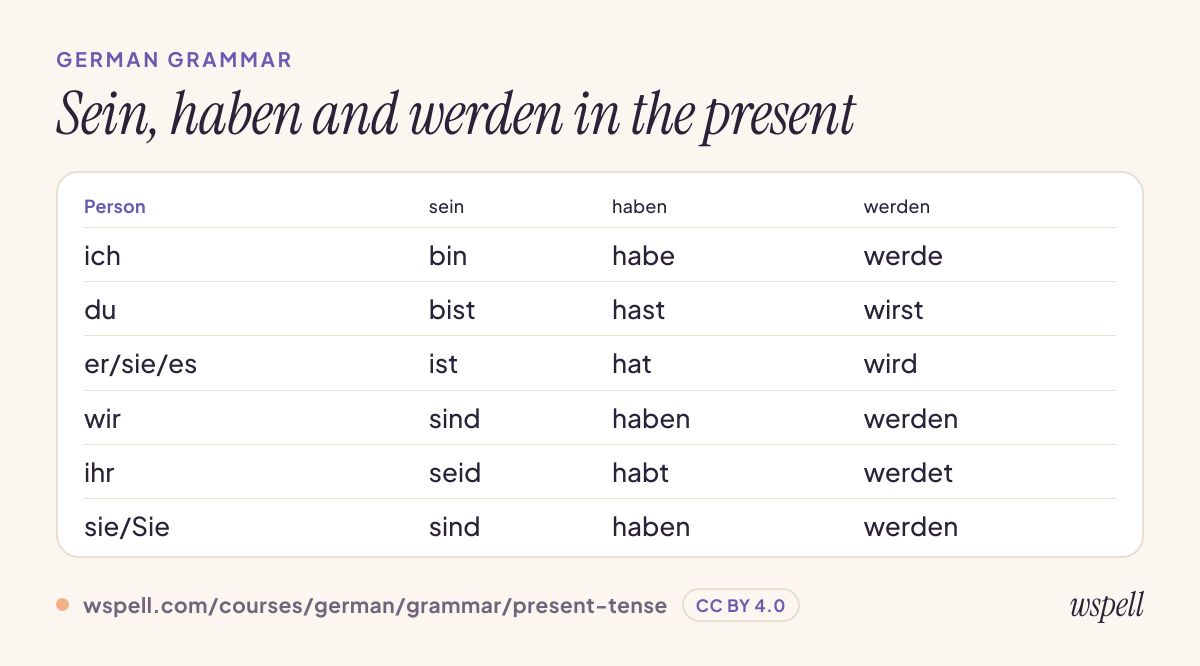
Sein, haben, werden
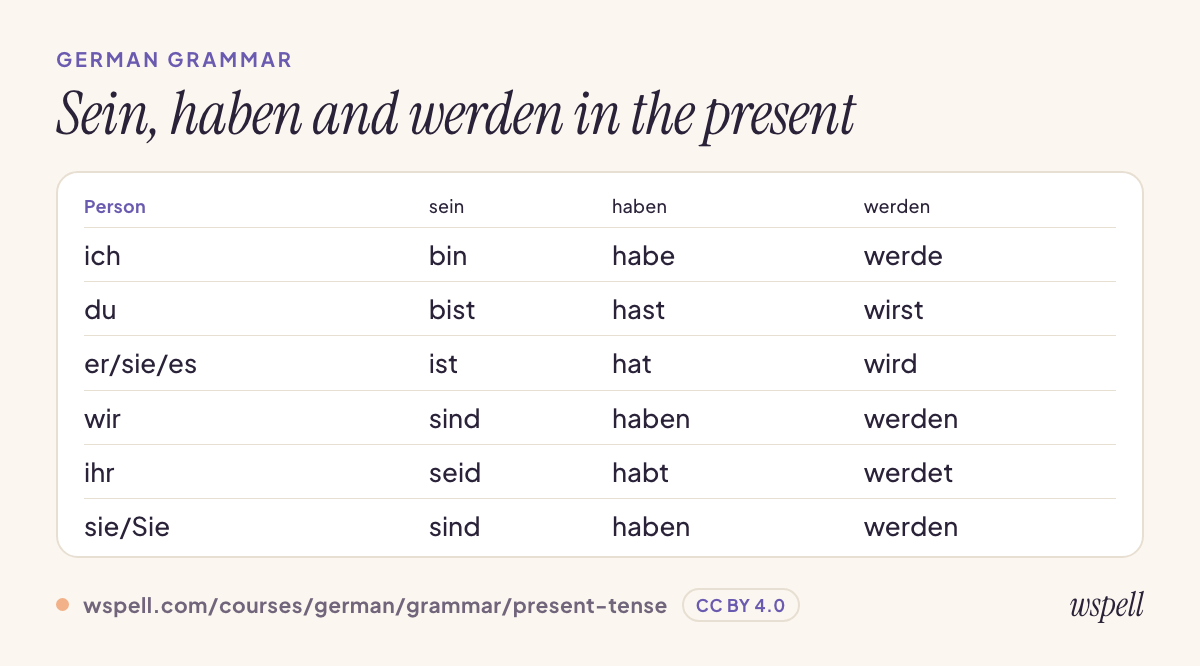
| Person | sein | haben | werden |
|---|---|---|---|
| ich | bin | habe | werde |
| du | bist | hast | wirst |
| er/sie/es | ist | hat | wird |
| wir | sind | haben | werden |
| ihr | seid | habt | werdet |
| sie/Sie | sind | haben | werden |
Sein: ich bin, du bist, er ist
sein (to be) is the most irregular verb and must be memorised: ich bin, du bist, er/sie/es ist, wir sind, ihr seid, sie/Sie sind. It is also the perfect-tense auxiliary for many verbs of motion and change of state.
- Ich bin müde. — I am tired.
- Wir sind Studenten. — We are students.
Haben: ich habe, du hast, er hat
haben (to have) is irregular in the du- and er-forms, which drop the -b-: ich habe, du hast, er/sie/es hat, wir haben, ihr habt, sie/Sie haben. It is the main perfect-tense auxiliary.
- Ich habe zwei Brüder. — I have two brothers.
- Hast du Zeit? — Do you have time?
Werden: ich werde, du wirst, er wird
werden (to become) is irregular: ich werde, du wirst, er/sie/es wird, wir werden, ihr werdet, sie/Sie werden. It also builds the future tense (werden + infinitive) and the passive voice (werden + past participle).
- Es wird kalt. — It is getting cold.
- Sie wird Ärztin. — She is becoming a doctor.
When to use the present tense
One present tense for 'I play' and 'I am playing'
German has one present tense where English has two (I play / I am playing) — both are ich spiele. With a time word the present also expresses the future: Morgen fahre ich nach Köln (Tomorrow I'll drive to Cologne).
- Ich lese gerade ein Buch. — I am reading a book right now.
- Nächste Woche beginnt der Kurs. — The course begins next week.
Morgen fahre ich: the present for the future
In everyday German the future is most often expressed with the present tense plus a time word, rather than with werden: Morgen fliege ich nach Rom (Tomorrow I'm flying to Rome). The werden-future is reserved for emphasis, promises and predictions.
- Nächstes Jahr ziehen wir um. — Next year we're moving house.
- Heute Abend koche ich. — This evening I'll cook.
practise this chart
Drill these forms in real sentences — every answer checked.
practise now — free to try; some drills ask for a free account
save or print this chart
Under the main tables on this page sits a picture of each — keep one on your phone, share it or print it.
Free to share and adapt under CC BY 4.0 — credit wspell and link to this page. the licence
credit line to copy: German verb conjugation: the present tense — wspell, CC BY 4.0, https://wspell.com/courses/german/grammar/present-tense
questions
What are the German present tense endings?
-e, -st, -t, -en, -t, -en: ich spiele, du spielst, er spielt, wir spielen, ihr spielt, sie/Sie spielen.
Why is it du fährst but ich fahre?
Many strong verbs change their stem vowel in the du- and er/sie/es-forms only: fahren → du fährst, er fährt; sprechen → du sprichst; lesen → du liest. The other persons keep the vowel of the infinitive.
How do you conjugate sein in German?
Ich bin, du bist, er/sie/es ist, wir sind, ihr seid, sie/Sie sind. Sein is completely irregular and worth learning first.