grammar chart · German
German cases chart: the four cases with der and ein
German has four cases, and the article is what shows them: der Mann is the subject, den Mann the direct object, dem Mann the receiver and des Mannes the owner. The first table gives each case its question and its job; the next two decline Mann, Frau, Kind and Kinder with der, then with ein, which has no plural.
What each case does
| Case | Question | What it does |
|---|---|---|
| Nominative Nominativ | wer? was? | the subject; the dictionary form |
| Accusative Akkusativ | wen? was? | the direct object; after für, ohne, durch, um |
| Dative Dativ | wem? | the receiver; after mit, bei, von, zu, aus |
| Genitive Genitiv | wessen? | the owner (whose?); after wegen, während, trotz |
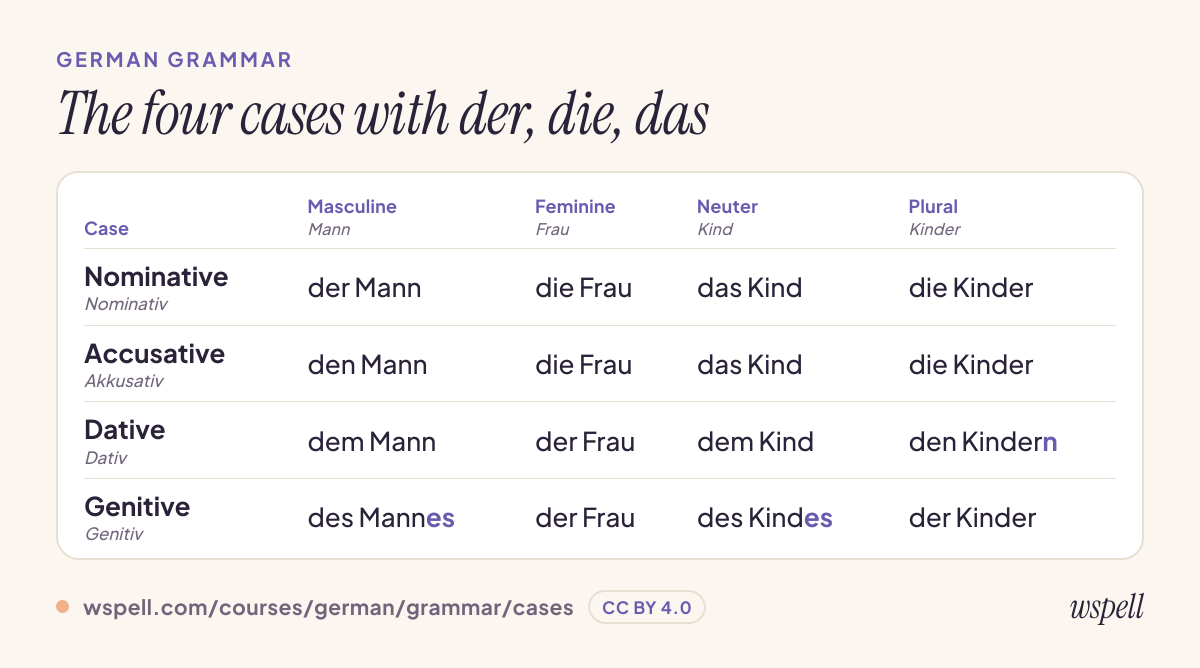
The four cases with der, die, das
Only the masculine changes in the accusative (den Mann). In the dative the plural noun adds -n (den Kindern), and in the genitive most masculine and neuter nouns add -(e)s (des Mannes) — the nouns that add -n take -(e)n instead (des Jungen).
| Case | Masculine Mann | Feminine Frau | Neuter Kind | Plural Kinder |
|---|---|---|---|---|
| Nominative Nominativ | der Mann | die Frau | das Kind | die Kinder |
| Accusative Akkusativ | den Mann | die Frau | das Kind | die Kinder |
| Dative Dativ | dem Mann | der Frau | dem Kind | den Kindern |
| Genitive Genitiv | des Mannes | der Frau | des Kindes | der Kinder |
The four cases with ein, eine
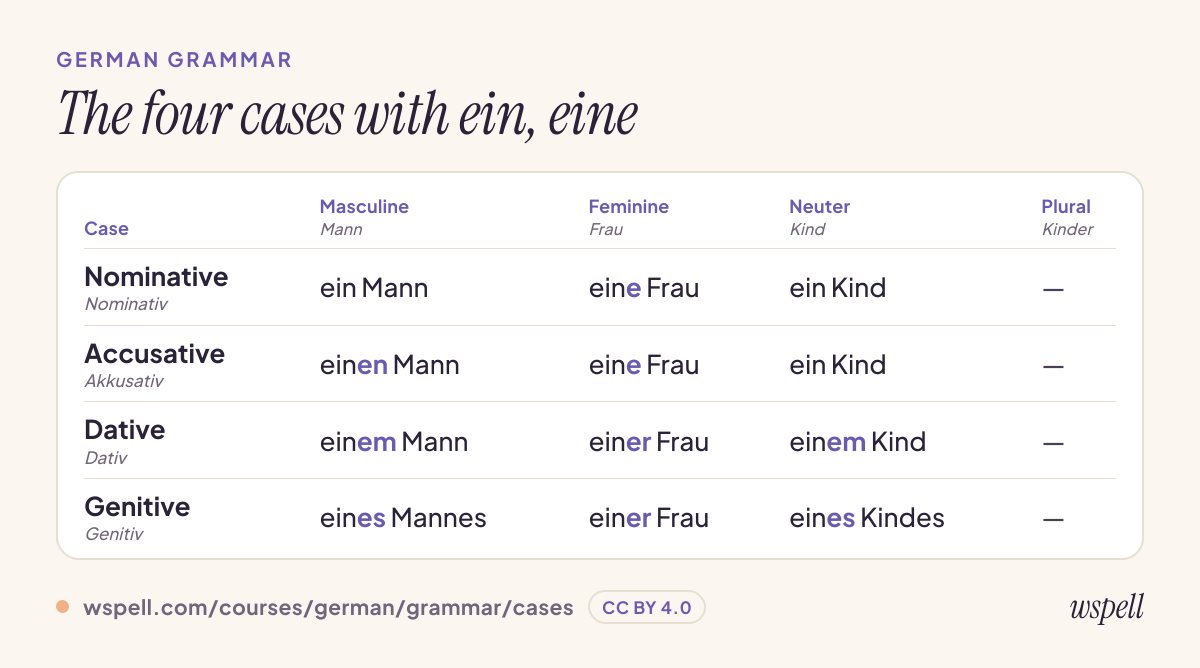
Ein takes the endings of der — einen, einem, eines — except where it has none: ein Mann in the masculine nominative, ein Kind in the neuter nominative and accusative. It has no plural.
| Case | Masculine Mann | Feminine Frau | Neuter Kind | Plural Kinder |
|---|---|---|---|---|
| Nominative Nominativ | ein Mann | eine Frau | ein Kind | — |
| Accusative Akkusativ | einen Mann | eine Frau | ein Kind | — |
| Dative Dativ | einem Mann | einer Frau | einem Kind | — |
| Genitive Genitiv | eines Mannes | einer Frau | eines Kindes | — |
Nominative: the subject
Nominative: the subject and the dictionary form
The nominative (Nominativ) names the subject that performs the action and is the dictionary/citation form. Answers wer? / was? (who/what?).
- Der Mann liest ein Buch. — The man is reading a book.
Er ist ein guter Lehrer: the nominative after sein
After the copula sein the predicate noun stays in the NOMINATIVE, not the accusative, because it renames the subject rather than being acted on: Er ist ein guter Lehrer.
- Er ist ein guter Lehrer. — He is a good teacher.
- Das ist mein Bruder. — That is my brother.
Accusative: the direct object
The accusative (Akkusativ) marks the direct object of a transitive verb — the thing directly acted on. Answers wen? / was? (whom/what?).
- Ich lese einen Roman. — I am reading a novel.
Der becomes den: only the masculine changes
The classic beginner trap: in the accusative ONLY the masculine changes ending — der→den, ein→einen, mein→meinen, kein→keinen. Feminine (die/eine), neuter (das/ein) and plural (die) look exactly like the nominative.
- Ich habe einen Bruder und eine Schwester. — I have a brother and a sister.
- Ich sehe den Mann, die Frau und das Kind. — I see the man, the woman and the child.
Es gibt + accusative: there is, there are
The existential es gibt (there is / there are) is ALWAYS followed by the accusative, in both singular and plural: es gibt einen Fehler, es gibt keine Milch.
- Es gibt einen Supermarkt in der Nähe. — There is a supermarket nearby.
- Es gibt keinen Zucker mehr. — There is no more sugar.
Dative: the receiver
The dative (Dativ) marks the indirect object — the recipient or beneficiary. Answers wem? (to whom?). With two noun objects the dative person comes before the accusative thing: Ich gebe dem Kind das Buch; an accusative pronoun comes first: Ich gebe es dem Kind.
- Ich gebe dem Kind einen Apfel. — I give the child an apple.
Helfen, danken, gefallen: verbs with a dative object
A set of verbs takes a DATIVE object where English would expect a direct object. Core list: helfen, danken, gefallen, gehören, passen, antworten, folgen, glauben (also gratulieren, begegnen, schmecken). Learn each verb together with its dative.
- Kannst du mir helfen? — Can you help me?
- Ich glaube dir nicht. — I don't believe you.
Den Kindern: the dative plural adds -n
Every noun adds -n to its plural in the dative — den Kindern, den Männern, den Freunden — unless the plural already ends in -n or -s (die Autos → den Autos, die Frauen → den Frauen). It is an easy ending to drop.
- Ich helfe den Kindern. — I help the children.
- Sie spricht mit den Männern. — She talks to the men.
Genitive: whose?
The genitive (Genitiv) marks possession and the English 'of' relation, standing AFTER the thing possessed: das Auto meines Vaters, die Fenster des Hauses. With names the -s genitive normally comes first: Peters Auto, Annas Bruder. Answers wessen? (whose?).
- Das ist das Auto meines Vaters. — That is my father's car.
- Die Fenster des Hauses sind alt. — The windows of the house are old.
Des Mannes, des Autos: the genitive -(e)s
Regular masculine and neuter nouns add -s or -es in the genitive singular: des Autos, des Lehrers, but des Mannes, des Kindes, des Hauses. One-syllable nouns and those ending in -s / -ß / -z / -x usually take the fuller -es. Feminine nouns never change.
- das Dach des Hauses — the roof of the house
- der Motor des Autos — the car's engine
Von + dative instead of the genitive in speech
In spoken and casual German the possessive genitive is routinely replaced by von + dative: das Auto von meinem Vater instead of das Auto meines Vaters. The genitive prepositions drift the same way (wegen dem Regen). Both replacements are colloquial; the genitive stays the written standard.
- Das ist das Auto von meinem Vater. — That's my father's car.
- Wegen dem Regen bleiben wir zu Hause. — Because of the rain we stay home.
Wer, wen, wem, wessen
| Case | Who |
|---|---|
| Nominative Nominativ | wer |
| Accusative Akkusativ | wen |
| Dative Dativ | wem |
| Genitive Genitiv | wessen |
Wer, wen, wem: who in every case
The interrogative for people declines: wer (nominative/subject), wen (accusative/direct object), wem (dative/after dative prepositions). There is no gender or plural — one form per case.
- Wer ist das? — Who is that?
- Wen hast du eingeladen? — Whom did you invite?
- Mit wem sprichst du? — Whom are you talking to?
Nouns that add -n: der Junge, den Jungen
Der Junge, den Jungen: nouns that add -n
A group of (mostly animate) masculine nouns — der Junge, der Student, der Kollege — add -(e)n in the accusative, dative and genitive singular and throughout the plural, everywhere except the nominative singular. This is the n-declension (schwache Nomen).
- Ich sehe den Jungen. — I see the boy.
- Das Buch gehört dem Studenten. — The book belongs to the student.
| Case | Singular Junge | Plural Jungen | Singular Student | Plural Studenten |
|---|---|---|---|---|
| Nominative Nominativ | der Junge | die Jungen | der Student | die Studenten |
| Accusative Akkusativ | den Jungen | die Jungen | den Studenten | die Studenten |
| Dative Dativ | dem Jungen | den Jungen | dem Studenten | den Studenten |
| Genitive Genitiv | des Jungen | der Jungen | des Studenten | der Studenten |
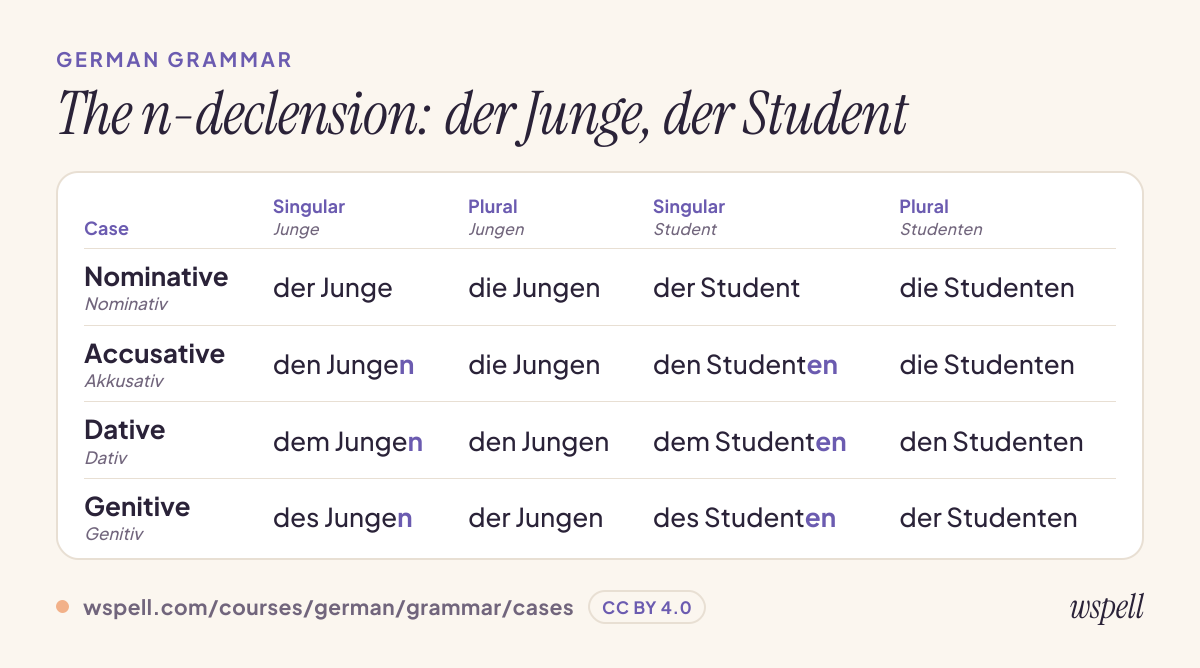
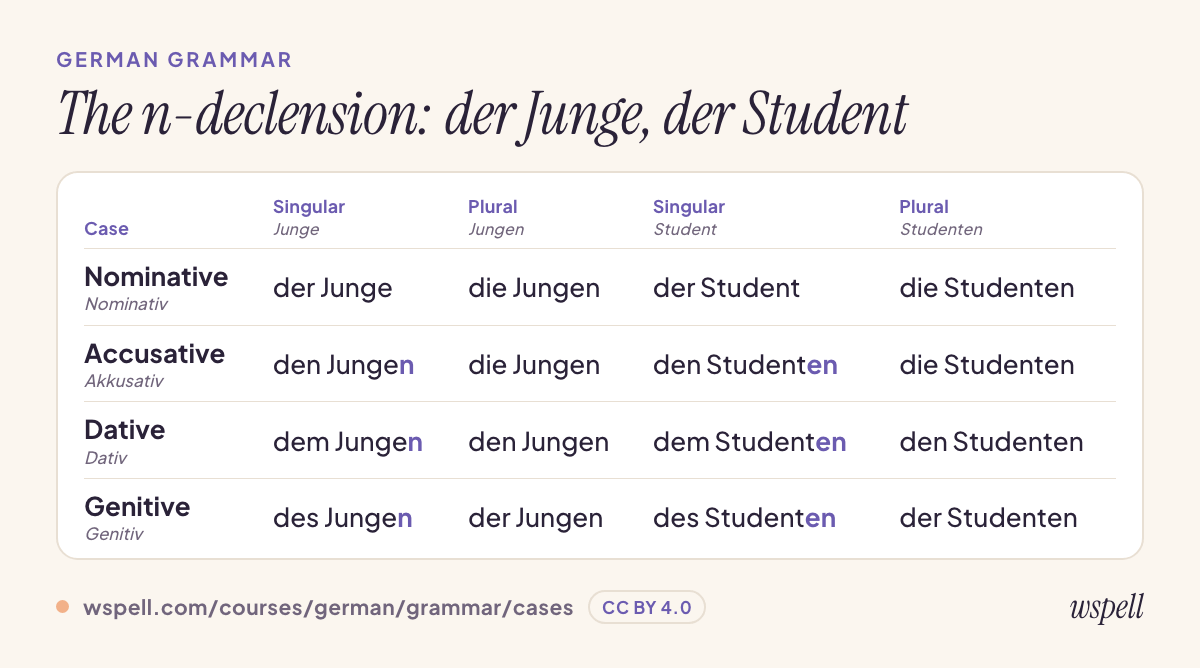
practise this chart
Drill these forms in real sentences — every answer checked.
practise now — free to try; some drills ask for a free account
save or print this chart
Under the main tables on this page sits a picture of each — keep one on your phone, share it or print it.
Free to share and adapt under CC BY 4.0 — credit wspell and link to this page. the licence
credit line to copy: German cases chart: the four cases with der and ein — wspell, CC BY 4.0, https://wspell.com/courses/german/grammar/cases
questions
How many cases are there in German?
Four: the nominative (the subject), the accusative (the direct object), the dative (the receiver) and the genitive (the owner). Prepositions and some verbs decide the case too.
How do I know which German case to use?
Ask what the noun does: the subject is nominative (wer? was?), the direct object accusative (wen? was?), the receiver dative (wem?), the owner genitive (wessen?). After a preposition its own case applies: mit dem Bus, für den Bus.
Does the noun itself change in the German cases?
Mostly the article changes. The noun adds -(e)s in the masculine and neuter genitive (des Mannes) and -n in the dative plural (den Kindern), and a group of masculine nouns adds -(e)n in every form but the nominative singular (den Jungen, die Jungen).